
Trump accuses Canada of seeking US state 'benefits' as talks fail
 5 Min Read
Canada's Mark Carney vows dollar-for-dollar retaliation from Sept. 8 as Washington imposes new 50% tariffs on a range of Canadian goods.
-
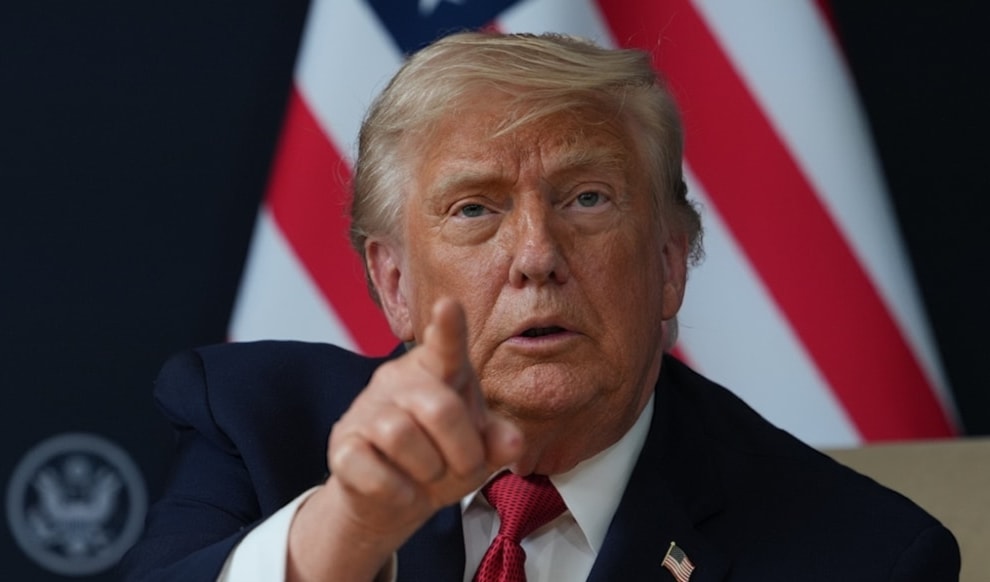
US President Donald Trump gestures as he meets with India's Prime Minister Narendra Modi on the sidelines of the G7 summit, June 17, 2026, France (AP)
Trump accused Canada of seeking “the benefits of being a State, without being one” after trade negotiations between Washington and Ottawa broke down late Friday, BBC reported.
In his first remarks since the talks collapsed, prompting new 50% US tariffs on a range of Canadian products, Trump also accused American farmers of having paid “massive amounts of Tariffs” for years.
The comments came after Canadian Prime Minister Mark Carney described the latest US tariffs as a “miscalculation” intended to “hurt and divide us.”
Carney said Canada would respond to Trump's tariffs “dollar-for-dollar” beginning Sept. 8, including counter-levies on steel, dairy products, appliances, and electronics. He said the two countries were now in a "trade war".
“They asked too much and they offered too little,” Carney said Saturday. “You're at war when you get attacked. We got attacked,” he added.
No obvious route toward a settlement
Trump's latest remarks mirror his repeated calls for Canada to become America's “51st state” since he returned to office, comments that have angered Canadian political leaders and residents.
The breakdown in negotiations has disrupted a highly integrated trading relationship between the two countries, with no obvious route toward a settlement.
“We cannot accept what they've offered, and we will not give what they've asked,” Carney said.
New tariffs affect a limited share of Canadian imports
Both governments had expressed optimism earlier in the week that an agreement could be reached. But the negotiations unraveled after each side accused the other of introducing changes at the last minute.
The new 50% US tariffs will cover a range of Canadian products, adding to existing American duties on Canadian steel, aluminum, automobiles and lumber.
The latest measures are relatively narrow, applying to about $20 billion (£15 billion; C$28 billion) worth of Canadian imports, or roughly 5% of the total. Affected products include wine, dairy, cement, clothing, and hockey equipment.
Carney said Canada was responding “reluctantly” with retaliatory measures to defend its interests. He said details of those measures would be announced in the coming days.
Canadian leaders rally behind Carney
Leaders from other federal parties, including Canada's Conservative opposition, expressed support for Carney, as did several provincial leaders.
Tariffs, which are taxes imposed on goods imported from other countries, have been central to Trump's trade agenda. The US president has argued that they will encourage manufacturing in the United States and create domestic jobs.
Opponents of the policy say the duties have increased costs for American consumers while disrupting and harming the global economy.
Carney's Saturday address was his first to Canadians since he announced late Friday that the two sides would not reach an agreement. He accused US negotiators of making “last-minute changes” that he described as “unfair” and “uneconomic".
US negotiators, in turn, accused Canada of introducing “new demands and walk backs” on provisions that had already been agreed upon.
'Unacceptable' terms
On Saturday, US Trade Representative Jamieson Greer told Fox News that there were no plans to restart negotiations.
Greer also said the United States had been willing to reduce some tariffs on Canadian goods under the proposed agreement.
Carney disputed that account, saying Washington had put forward “unacceptable” terms that were overly restrictive, including limits on Canada's ability to negotiate new trade agreements with other countries.
He also rejected the claim that Canada had introduced demands at the last minute, saying: “We clarified what was on offer and were continually disappointed by the answers.”
'It was never acceptable to Canadians'
Doug Ford, premier of Canada's most populous province, Ontario, backed Carney and said Trump “can't be trusted.”
British Columbia Premier David Eby said the US demand for limits on Canada's ability to negotiate other trade agreements “would reduce us to the economic equivalent of the 51st state."
“It was never acceptable to Canadians,” Eby said.
Conservative opposition leader Pierre Poilievre also appeared to back Carney, describing the new US tariffs as “unjustified".
Quebec Premier Christine Fréchette warned that the tariffs were likely to result in job losses.
“Behind these numbers are real people,” she said, promising measures to assist sectors affected by the tariffs.
Alberta Premier Danielle Smith, whose oil-producing province has sought closer ties with the Trump administration, called on both countries to return to negotiations.
Dispute threatens wider North American trade framework
The breakdown follows more than a year of intermittent trade negotiations, which accelerated in recent weeks after Washington set a deadline for reaching an agreement or facing additional tariffs.
The US and Canada were also participating in a required review of the existing North American free trade agreement, known as USMCA, alongside Mexico.
Trump signed the agreement during his first term, replacing the 1994 North American Free Trade Agreement. The pact supports $1.6 trillion (£1.2 trillion) in annual trade among Canada, the United States, and Mexico.
Earlier this summer, Canada and Mexico formally asked for USMCA to be extended for another 16 years. The United States declined to renew the agreement in its existing form.
Asked what Friday's collapse in trade negotiations would mean for the North American trade agreement, Carney said it was “certainly not good news”.


