
How, and why, US data centers in the Gulf became targets of war
 5 Min Read
Drone strikes on Amazon data centres in the UAE and Bahrain have exposed the vulnerability of US tech infrastructure in the Gulf, and threatened the region's AI ambitions.
-
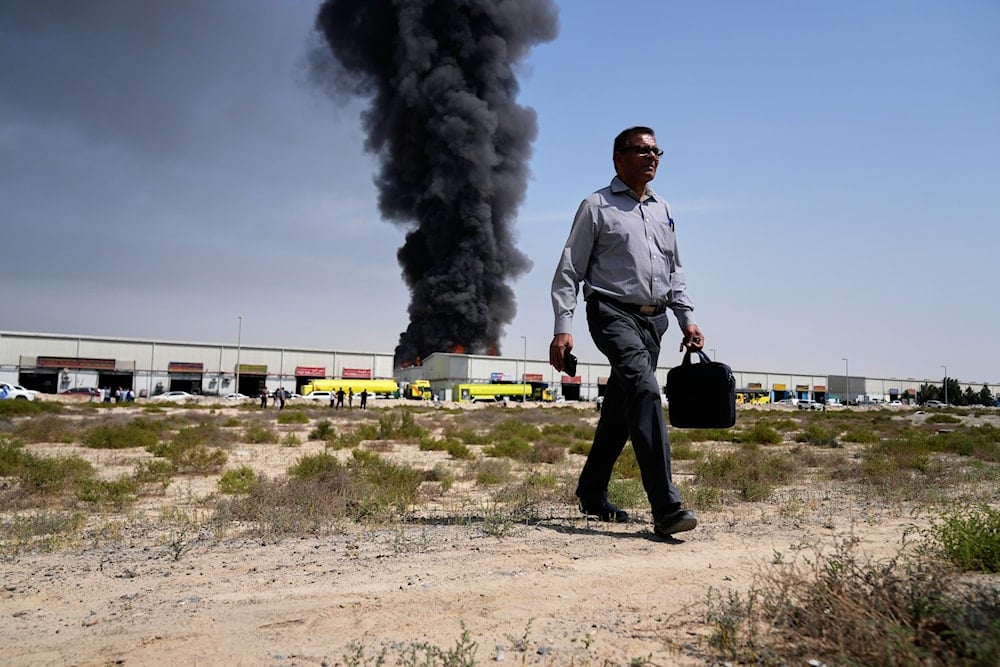
A man walks away after watching a black plume of smoke rising from a warehouse in the industrial area of Sharjah City, United Arab Emirates, Sunday, March 1, 2026, following reports of Iranian strikes in Dubai (AP Photo/Altaf Qadri)
The drone strikes that knocked Amazon Web Services facilities offline in the United Arab Emirates and Bahrain this week were not random acts of escalation. They were, according to analysts and industry insiders, a calculated strike on infrastructure that the United States has quietly woven into its military architecture across West Asia.
Amazon and Google hold a $1.2 billion contract with the Israeli government to provide cloud computing and artificial intelligence services to entities, including the Israeli occupation forces.
That contract, largely absent from Western coverage of the strikes, may explain why AWS facilities, and not the dozens of data centers operated by local Gulf companies on behalf of US tech giants, were the ones that were hit.
"It would be easier to target AWS," Ed Galvin, founder of data center research firm DC Byte, told Bloomberg, noting that other US tech services are typically housed within locally operated facilities, making them harder to identify and strike.
Of approximately 230 data centers built or under development across Gulf Arab states, only a handful are wholly owned and operated by a US company, according to DC Byte. All three struck this week belong to Amazon.
What was hit
The strikes took down two of AWS's three availability zones in the UAE, one site located near Al Maktoum International Airport in Dubai, according to DC Byte, and damaged a facility in Bahrain situated close to a local military base and the King Fahd Causeway connecting the island to Saudi Arabia.
Consumer services, including online banking, were disrupted across the region. In a statement to clients, AWS said it was working to restore services while urging customers to migrate workloads to data centers outside West Asia, acknowledging that "the broader operating environment in the Middle East remains unpredictable."
What Western media outlets fail to mention is that the exchange has not been one-sided. "Israel" and the United States have struck at least two data centers in Tehran, according to Holistic Resilience, a nonprofit organisation that maps airstrike activity.
A new front in an old logic
Data centers have entered the battlefield as legitimate targets because they power surveillance systems, drone navigation, real-time analysis of satellite footage, and the digital backbone of modern military operations.
Attacking such facilities can "paralyze banks, paralyze government offices," Daniel Efrati, chief executive of NED Data Centers, told Bloomberg. "If you have one minute of downtime, it can cost any organization millions."
Soft targets with hard consequences
The physical vulnerability of these facilities has been laid bare by this week's strikes. Data centers are sprawling, visible, and dependent on exposed infrastructure, e.g., cooling units, diesel generators, gas turbines, that can be disabled without a direct hit on the building itself.
"If you knock out some of the chillers you can take them fully offline," Sam Winter-Levy, a fellow at the Carnegie Endowment for International Peace, told the Financial Times. Conventional data center security is designed to repel cyberattacks and physical intruders; it was not designed for drones.
Gulf AI ambitions under fire
The strikes land at a particularly fraught moment for Gulf states whose economic diversification strategies rest heavily on positioning themselves as global AI hubs. Saudi Arabia's Humain and the UAE's G42, both state-backed, have committed to vast data center clusters and signed major deals with Nvidia, Amazon, and Microsoft.
The UAE is constructing one of OpenAI's "Stargate" facilities in Abu Dhabi. Microsoft announced last month it would open a new Azure facility in Saudi Arabia before the end of the year. Those ambitions now carry a new risk premium.
"The Gulf sold itself as a safe alternative to other markets," Jessica Brandt, a senior fellow at the Council on Foreign Relations, told the Financial Times. "That argument just got harder to make."
The new table stakes
Harder, but not necessarily fatal. Several analysts caution that the political and economic momentum behind Gulf AI investment is unlikely to be reversed by the strikes alone.
What has changed is the calculus around protection. "You can't hide data centers," Noah Sylvia, an analyst at the Royal United Services Institute, told Bloomberg. "But you can put air defence systems on them."
One industry veteran based in the Gulf compared the situation to Intel's chip manufacturing plants in "Israel," ringed by military air defences, telling the Financial Times that for a project of Stargate's scale, that kind of protection is now "table stakes."
A global precedent
The broader implication reaches beyond the Gulf. "This is a harbinger of what's to come," Winter-Levy told the Financial Times, "and these types of attacks are not going to be limited to the Middle East."
For the first time in history, the data centers that underpin the global digital economy have become a theater of war. The infrastructure the US built to project technological power across a volatile region has become a target precisely because of what it enables.


