
UK Foreign Office, council staff logins hacked, offered on dark web
 4 Min Read
UK government-linked logins and critical infrastructure credentials were exposed in an alleged Russia-linked Fortinet cyber breach, raising fears of wider infiltration and potential ransomware attacks.
-
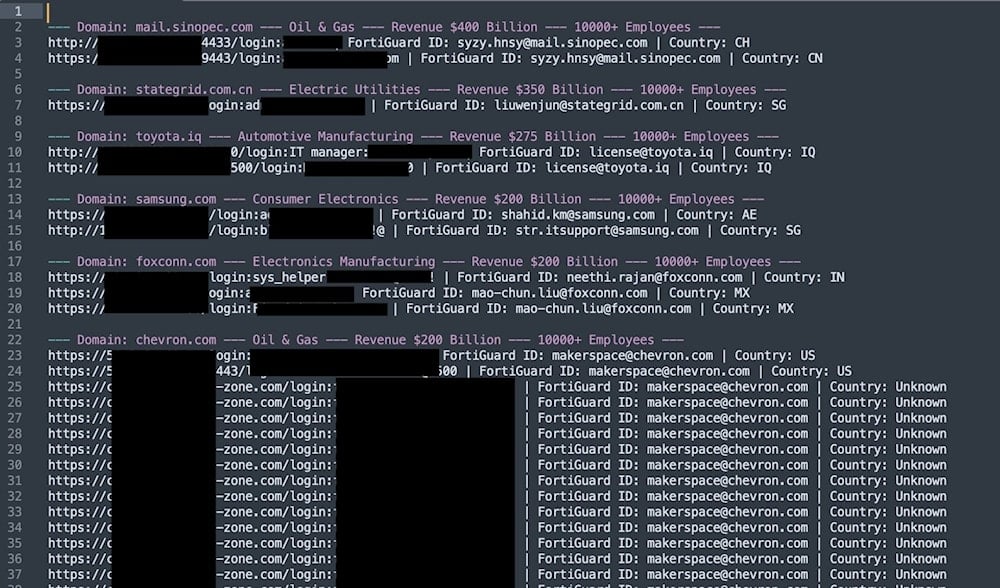
A redacted screenshot allegedly showing Fortinet-related login credentials and corporate domains exposed in the FortiBleed cyber breach (X, @IntCyberDigest)
Login details linked to UK government officials, overseas Foreign Office staff, local authorities, and critical infrastructure providers have been exposed in a major cyber breach involving Fortinet security systems, raising concerns over possible infiltration across sensitive networks, The Telegraph reported.
The attack, referred to by researchers as FortiBleed, has been linked to suspected Russian-speaking hackers, though there is currently no evidence proving state involvement.
More than 80,000 Fortinet firewalls were reportedly compromised worldwide. Attackers allegedly obtained email addresses and passwords, giving them the potential ability to access protected systems or sell the credentials to other malicious actors.
According to The Telegraph, a list of exposed accounts includes overseas Foreign Office personnel, IT staff at British embassies in Thailand and Mauritius, and local government officials in Derbyshire and Waltham Forest in east London.
Some of the stolen credentials are reportedly being sold on dark web forums for up to $60,000, around £44,000.
Critical infrastructure concerns
The breach has raised particular concern because some of the exposed credentials are linked to organizations involved in healthcare, energy, medicine supply, and other essential services.
Cybersecurity experts warned that access to suppliers and connected systems could provide attackers with a pathway into wider networks, including those used by the NHS.
Dr. Saif Abed, a former NHS doctor and cybersecurity expert, warned that the incident could have serious consequences for patient safety.
“NHS organisations, pharmacies, labs, and their suppliers are highly dependent on products like those compromised by FortiBleed,” he said. “This is exactly the type of hack that’s the first step for launching catastrophic ransomware attacks that can threaten patient safety across the country.”
The warning follows a June 2024 cyberattack on Synnovis, a pathology services provider, which disrupted NHS operations and led to the cancellation of more than 1,000 operations and 2,000 appointments.
Campaign remains active
The FortiBleed campaign was first identified by cybersecurity researcher Volodymyr Diachenko. Attackers are reportedly using valid login details from earlier leaks to compromise Fortinet devices and turn them into collection points for further data harvesting.
Diachenko said the breach could provide access to “core networks” inside the Foreign Office and warned that other government departments may also be at risk.
The Telegraph reported that the code used in the operation was written in Russian. An online operator using the name “SantaAd” is reportedly offering access to stolen credentials on dark web forums.
The UK’s National Cyber Security Centre has issued an urgent alert confirming a “brute force” campaign targeting Fortinet systems. Organizations have been urged to audit their networks, change reused or default passwords, and isolate compromised devices.
No confirmed state involvement
Although the campaign has been associated with Russian-speaking actors, direct involvement by the Russian state has not been established.
British intelligence officials have previously warned that Moscow has increasingly relied on or encouraged proxy hacker groups, allowing them to operate while maintaining plausible deniability.
In May 2024, GCHQ director Anne Keast-Butler warned that Russia’s relationship with non-state cyber actors was growing more concerning.
She said, “Before, Russia simply created the right environments for these groups to operate, but now they’re nurturing and inspiring these non-state cyber actors.”
Security officials have long warned that hackers operating from Russia can benefit from a form of sanctuary, provided that their activity does not cross Moscow’s red lines or trigger major diplomatic fallout.
An NCSC spokesman said, “We have provided support to organisations in the UK affected by malicious targeting of Fortinet edge devices globally."
“Organisations using Fortinet VPN and firewalls should change all default or reused passwords as set out by the advice available on the NCSC website."
“To stay alert to malicious activity on your networks, the NCSC recommends signing up for its Early Warning service to gain potentially invaluable time to help detect and stop attacks.”
Read more: France suffers massive medical data breach affecting 15 mln people


