
Colonization in print: How Western Liberal journalists distort Lebanon and Palestine
-
 Matt Wolfson
- 5 May 2026 13:48
- 8 Shares
 25 Min Read
Matt Wolfson argues that Western liberal journalism often disguises colonial assumptions as “objectivity,” reducing Lebanese and Palestinians to victims, extremists, or background figures. He traces this distortion through elite media networks, Zionist influence, and decades of reporting that obscures cause, context, and resistance.
-
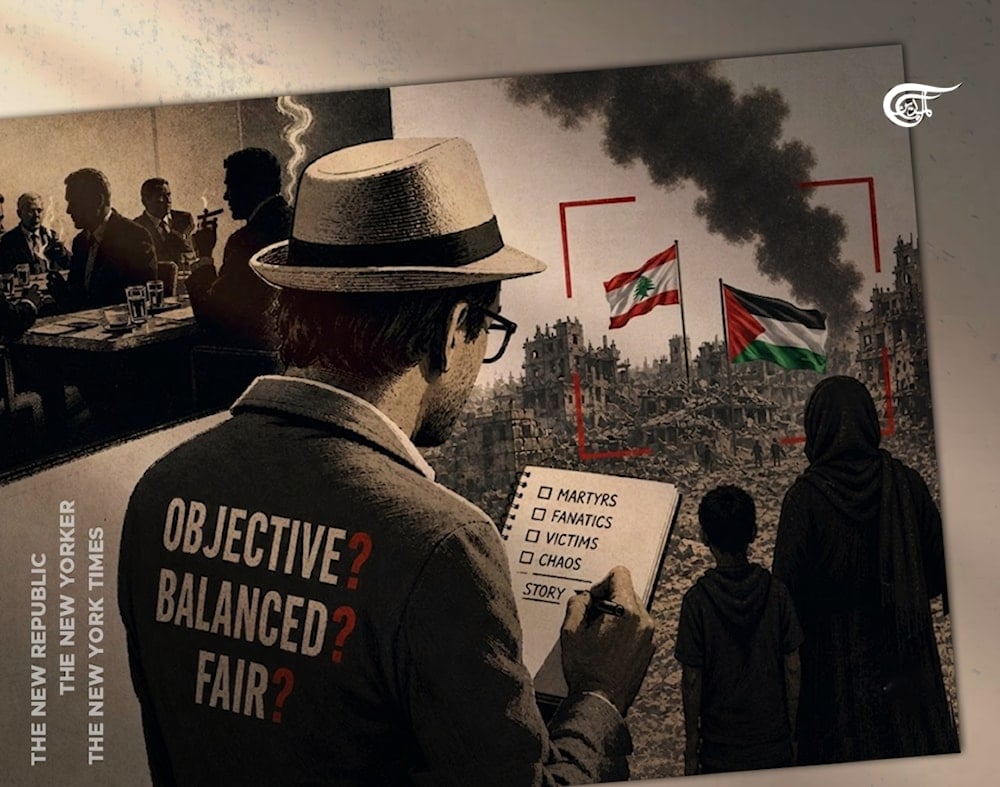
Our government levies a toll on Beirut measured in martyrs: people who the Western liberal information system works to flatten into villains or victims and ultimately to disclaim. (Al Mayadeen English; AI-Generated/ Edited by Batoul Chamas)
On Wednesday, April 15, as the Israeli incursion in Lebanon that started in March and killed over 2,000 people and displaced over 1 million began to “wind down,” Charles Glass, a well-regarded British-American war correspondent who teaches at the American University of Beirut and has reported on the city off-and-on for 50 years, appeared online with a 3,500 word piece titled “Beirut, Now and Then” for The London Review of Books (LRB).
The LRB is the most Left-wing of Britain’s mainstream journalistic intellectual publications, with an audience of 74,000 paid print subscribers. It is arguably the most successful intellectual magazine in Europe and for some readers, including myself, it is the West’s most consistently reliable mainstream print magazine. Yet the defining feature of Glass’s summation for the LRB of reporting in one of the world’s most important cities was its complete and seemingly almost self-parodic lack of anthropology. Judging by Glass’s account, the protagonists of Beirut are not the Lebanese. They do not rate names. Glass’s protagonists, all named, are the barman of the Hotel Saint Georges who made “martinis and other concoctions”; the Swiss agent of the Red Cross who “negotiated…for the lives of…Palestinian[s] along with some poor Lebanese and Syrians”; and veteran or rising correspondents from The New York Times, The Washington Post, The Sunday Times, The Daily Telegraph, The Financial Times, The Economist, The Guardian, The Associated Press, The BBC, and Reuters.
These Westerners, particularly the older ones, are “courtly” and “gracious.” They “supply one another with copious quantities of alcohol…in preparation for [reporting on] the [next] morning’s savagery.” They exemplify “the era of the journalistic raconteur, satirized by Evelyn Waugh…whose favored [pastimes] involved the finagling of expenses.” They believe that “the only qualities essential for real success in journalism are rat-like cunning, a plausible manner and a little literary ability.” They are bonded by “curiosity, competition and a lust to tell stories, but…also companionship.” By contrast, in Glass’s account, the Lebanese are “aspiring martyrs” or “Christian fanatics” who are “often drugged” and “shooting and shelling one another.”. Addicted to “gutting, looting and burning” they “besieged and massacred one another’s populations”, creating “a maelstrom that lacked sense as much as purpose”. Or else, in Glass’s equally broad-brush humanitarian inversion, they are not villains but victims “dying of thirst, hunger and lack of medicines”. Though Glass may have learned in Beirut “how to cultivate sources among the fighting factions” and “get to hospitals to interview survivors,” not one of these peoples’ testimonies appear in his article.
Of course, the absences in Glass’s account may seem not to matter, since he is, by his own acknowledgment, summing up his reportorial career rather than actually “covering” the current war. And yet Glass’s “off-duty” perspective is precisely what makes the piece so instructive. When Glass lets down his hair and speaks freely, the perspective he lets his readers into resembles, in more forthright terms, the quieter approach of many of the Western journalists actually covering this war. Namely: an approach which either fails to grapple with certain perspectives (most notably those of the “martyrs” and “fanatics”); or which reduces those perspectives to a factual and ethical muddle in which an overall story of cause and effect, and of the moral onuses at play, remains impossible to fathom.
The absences and unfathomability of this journalistic approach are often justified on the part of its practitioners by rejecting what in Western media is pejoratively called “positionality” in favor of “objectivity”: a “just the facts” approach that doesn’t “take sides.” But the flaws of this kind of “objective” approach have been recognized by creative nonfiction writers, practitioners of what is known as “New Journalism,” for many years: namely, that a writer can think himself “objective,” in an unexamined way, while being quietly affected by an ideology. And in fact, there is an underlying ideology many “objective” journalists are to greater or lesser degrees affiliated with that shapes their reportage, one that comes through persistently in Glass’s unfiltered summation of his years in Beirut. This ideology is the ideology of colonialism, sustained by a dominant liberal media culture connected to intelligence and financial networks: a culture which enjoys many of these networks’ privileges and which adopts these networks’ priorities as its own. These priorities are very clear-cut and almost always unacknowledged. “Order” is upheld in the name of “balance” and “fair-mindedness” against “chaos” and “extremism”: the “maelstrom” and “fanaticism” from which Glass sought refuge with his “courtly” and “gracious” band of reporters.
These priorities can also make for extremely limited copy, since reporters who take them seriously fail to fully question labels like “order,” “balance” and who really represents them. Indeed, Western reporters’ focus on what they see as order and balance and their aversion to what they see as disorder and extremism has led them, in the last half-century, to fail to fully examine an extremist fanaticist project which creates disorder, Zionism, to the detriment of logical contextual reporting on causes and effects. In my last report for Al Mayadeen English, I reported on the Zionist technologist billionaire Larry Ellison and his efforts to direct American media in a pro-Zionist direction. But Ellison is a late player in a wider—and a longer—game. Looking at the recent history of Western liberal reportage, the editors and owners who shape it, and the way Zionism has profited from it, helps elucidate how the insidious process of distortion works, and how it de facto disowns people outside of the West, particularly in Palestine and in Lebanon.
The roots of this point of view reach back to the end of the Second World War and the rise of the “second” Anglo-American Empire, as America succeeded Britain in setting the terms for much of the world. Journalism, though it was not acknowledged this way, was a de facto extension of that endeavor. Indeed, Glass may have learned his craft in Beirut in the 1970s from “legendary correspondents” of newspapers like The Sunday Times, but these correspondents learned from other people in Britain’s and America’s imperial cores with agendas of their own.
One of these teachers was Evelyn Waugh’s friend Ian Fleming: famously the hard-drinking author of the James Bond novels and less famously an ex-intelligence officer and the foreign editor of The Sunday Times who seems to have recruited his reporters largely from British intelligence. Fleming, significantly, was politically connected as well. In 1956, Fleming hosted Prime Minister Anthony Eden for two weeks in Jamaica when Eden had a nervous breakdown after the failed Suez Canal “capture” with France and "Israel". In 1960, Fleming spent an evening at a house in Georgetown advising presidential contender (and Bond aficionado) John F. Kennedy how to “take out” Fidel Castro in Cuba; and Kennedy’s CIA later developed anti-Castro plans suspiciously similar to Fleming’s.
This mixing of journalism with intelligence and imperial politics was typical, and so were the opinions that flowed from it: ones supporting empire in the name of balance and “civilization” and order. Fleming’s co-attendee at the 1960 dinner, Joseph Alsop, a prominent Washington Post columnist, was a regular attendee of gatherings in McLean, Virginia, with CIA chief Allen Dulles, whose biographer credited Fleming with introducing Dulles to espionage two decades earlier, and his deputies James Jesus Angleton and Desmond FitzGerald. These were hard-drinking WASPs who engineered America’s entanglements in Vietnam; the latter of whom died a few years before his daughter, Frances, won a Pulitzer Prize for Vietnam reportage. The New York Times’s executive editor omitted key details from stories, for example, reports on the upcoming invasion of Cuba, which became the Bay of Pigs, out of deference to Allen Dulles. Kennedy’s confidante, Clare Boothe Luce’s husband, Henry Luce, actively supported the Dulles Brothers’ endeavors via his ownership of Time Magazine. Time’s ethos, infused with “prodigious quantities” of wine, “French and domestic,” was described by ex-Time journalist John Gregory Dunne as “pervaded by…Protestant entitlement and arrogance…often spectacularly unearned…or earned largely in the city rooms of the Harvard Crimson or the Yale Daily News or the Daily Princetonian” and run through Luce’s Presbyterian belief that Anglo-American Empire and civilization were one and the same.
Fleming’s character Bond aggressively models this worldview: an upper-caste consumer of the finer things (martinis “shaken not stirred”) who doubles as maintainer of civilization against the “primevally” egoistic machinations of the “underworld.” Fleming’s and Waugh’s friend the journalist Graham Greene handled this view more subtly but equally definitively in his novella and movie The Third Man: a send-up of American “swagger” in which a popular writer of Westerns arrives in postwar Berlin to be “educated” in the “complexity” of the ravaged city, in Greene’s telling a “maelstrom” of savage avarice held together by British civil servants who are the true heroes of the piece. A family friend of Fleming’s, Isaiah Berlin, the Jewish Zionist Oxford intellectual and an ex-spy who became a mentor to the editors of America’s main intellectual-journalist magazines after 1980, expressed this view philosophically when he portrayed Anglo-American Empire’s “liberal” guarantee of “negative liberty” as the only safeguard against totalitarian fanaticisms. Even Frances FitzGerald, who critiqued the War in Vietnam as an essentially colonial endeavor, fell into what one perceptive reviewer described as a liberal trap:
a problem facing all writers with radical views [like FitzGerald] who want to convey the situation in Vietnam to liberal readers. Anyone brought up in the liberal tradition absorbs a profound sense of symmetry which includes the belief that “there are two sides to every question”…In order to be plausible to liberals [FitzGerald] appears to feel obliged to put any moral scraps she can on the American side of the scales…[and] has accepted the official American view too uncritically.
In the extended aftermath of Vietnam, these liberal imperial straitjackets on reporting did not loosen in the face of hard reality. They tightened instead. Some of this tightening had to do with changes in the way politicians and military-intelligence operators treated the press. After Vietnam, military restrictions on the press increased, transforming independent journalists commiserating with each other at night into a herd operating together by day. By January of 1990, The Los Angeles Times was reporting regarding the coverage of the War in Panama that “nearly a hundred and twenty-five journalists, after spending less than twelve hours in Panama without leaving Howard Air Base, where they were informed that there was shooting in the streets of Panama City…accepted the Southern Command’s offer of a charter flight back to Miami.” In 1991, during the First Gulf War, the American Press corps accepted an agreement with the military that “only a pool of journalists would be permitted to cover the war directly...That pool went wherever the American military press officer chose to take it….When other reporters, [tried] to get independent information…members of the pool actually berated them.”
But the other reason for the tightening was that, as the Cold War neared its end and American attention turned to the Middle East’s newly-available natural resources, American media networks were sold by WASPs to adherents of a religious supremacist ideology, Zionism, which depends on America’s support of "Israel". In the 1970s, The New Republic was bought by the Jewish Zionist Martin Peretz, who converted it into a mouthpiece for Zionist liberalism, influenced, via its powerful literary editor Leon Wieseltier, who was mentored at Oxford by Isaiah Berlin.
In the 1980s, Vanity Fair was relaunched by, and The New Yorker came under the control of the Jewish Zionist Newhouse Family of Conde Nast Publications, which hired as its “star” editors the British journalist Tina Brown and the British commonwealthman and Time alumnus Graydon Carter. The Atlantic was bought by Peretz’s ally Mort Zuckerman, CBS News was bought by Peretz’s Zionist ally Laurence Tisch, and The New York Times appointed A.M. Rosenthal, an ardent Zionist, as executive editor. In the 1990s, the Redstone Family, Jewish Zionists, bought CBS; and David Remnick, a Jewish Zionist, was appointed editor-in-chief of The New Yorker. In the 2010s, the Jewish Zionist Ezra Klein launched Vox News, then decamped to The New York Times, where he became its single most influential columnist; and Jeffrey Goldberg, a former IOF soldier during the Second Intifada, became the editor of The Atlantic.
These are the publications that have served as incubators for the “modern” Democratic Party since Bill Clinton: a party that, not by coincidence, remains among its aspiring leaders monolithically supportive of Zionism. Martin Peretz’s The New Republic, at the end of the century, the most influential political-intellectual magazine in America, was the decisive “inside-the-beltway” backer for Bill Clinton in 1992. David Remnick of The New Yorker, today the most successful intellectual-journalistic magazine in America, was perhaps the decisive media backer for Barack Obama. These publications’ exorbitant spending habits have changed over the years, as first television and then the internet have squeezed revenues, but the atmosphere has remained much the same. They are unusually lively mausoleums of privilege that discourage the people inside them from examining any flaws in the construct, or any deadness in the aesthetic, of the structures in which they work.
In the telling of The New Republic’s Martin Peretz, his staff of mostly Jewish Zionist graduates of Harvard would “close the magazine and go downstairs to The Palm…the celebrity steakhouse in the lobby of the building across from our offices,” where one or other of the staffers might “[get] drunk, poun[d] the table, and insul[t] us all.” In the telling of Ismail Ibrahim, the one Arab employed on The New Yorker’s editorial staff high up at Freedom Tower in downtown Manhattan in the early 2020s, his “colleagues reeked of money: hyphenated names, signet rings, private schools, Prada frames.”
Personal experience supports these views. In the decade before Ibrahim came to Conde Nast, I lived in New York and fell in with a circle of New Yorker writers, and many of them bring to mind both Ibrahim’s description and the descriptions of Charles Glass and John Gregory Dunne. One of these writers, a former editorial high-up at the paper who taught journalism at a prestigious college, had graduated from Yale, and she told me that she and her Yale circle used to throw parties modeled off the British television adaptation of the novel Brideshead Revisited, by Evelyn Waugh. Another, a British ex-executive editor of The Economist, had graduated from Cambridge, then briefly married into a noble family on a country estate, complete with a marital portrait featuring greyhounds. One of their friends, who had graduated from Northwestern and taught at Columbia, was a seasoned war correspondent in Afghanistan in the 2000s whose memoir of the conflict was praised for its “screwball” comedy and “black humor.” Another, a senior editor at The New Yorker, also a British transplant, told me once that she supported Hillary Clinton, an ardent Zionist, precisely because Clinton so successfully “managed all of the voices in the room”: language that could have been lifted from Graham Greene’s British administrators, the de facto heroes in The Third Man, colonizers to their fingertips.
This attitude, of unexamined privilege and ideological rigidity, can only be exacerbated by an event like October 7, when an alternate paradigm about the world refuses to be ignored. And it is precisely privileged journalist rigidity that has been on display, both behind the scenes and in front, in coverage of Palestine and Lebanon, particularly at The New Yorker and The New York Times, for the past two and a half years.
According to Ismail Ibrahim in a recent article, “House Arab,” on the Monday after the October 7 attacks, David Remnick approached him, in what seems to have been a ritualistic gesture of outreach by a Jewish Zionist to the magazine’s one Arab staffer, and said, referring to Hamas: “It’s just so sad. The glee these people feel about killing.” When Ibrahim stumblingly tried to explain why he thought the attack had occurred, namely that Palestinians wanted “to die on their feet,” which he caveated by saying “I don’t agree with it, I’m not saying it’s good,” Remnick responded, “That’s really hard for me to hear right now,” and walked away. So: in the implicit formulation of one of the most powerful editors in America, a formulation seemingly impervious to outside information, Hamas was an irrational actor, distinguished not by cause nor context nor strategy but by its purported inhuman “glee” about killing. Remnick verified this un-empirical approach when he assigned Ibrahim the role of reviewing pieces about October 7 and rejected Ibrahim’s suggestions to provide some context from the Muslim world. (These suggestions included mentioning that most Muslims do not consider Hamas members “terrorists” and that most Muslims read “Israel’s War of Independence” through the lens of the Nakba.)
These are not isolated instances. The New Yorker’s coverage of "Israel" and Palestine after October 7 made very little effort to reckon with what many Muslims and Arabs see as the root cause of October 7. Namely, the failure of the Oslo Accords signed between "Israel" and the Palestinians at Bill Clinton’s White House in 1993. In the read of Palestinians and other observers, what began as a highly anticipated peace ended with the stealth trifurcation of the Palestinian territories and the buying off of officials in the Palestinian Authority. It was this process that led to the election in Gaza of Hamas in 2005, on the promise that Hamas would protect Palestinian sovereignty. And it was the election of Hamas that led "Israel" to impose a 16-year blockade on Gaza, which included cutting off medical supplies and repeated bombing runs: actions seen by many Muslims as state-sponsored terrorism to which the attack of October 7, 2023, was a response. But this perspective is not regularly on offer in major American media outlets. In fact, for The New Yorker, according to a recent article featured in the magazine, “modern terrorism” as a concept quite literally began with Palestinians’ alliance with Western Marxists in the 1970s.
Indeed, The New Yorker favors articles either emphasizing Palestinians as victims of a humanitarian catastrophe or referring to “Gaza’s broken politics” and “the Hamas propaganda war.” These latter have effectively mischaracterized the complexity of Hamas’s governance before the war, which has been carefully delineated by academics like Sara Roy, as a “fragile” or “collapsed” structure, and reduced its supporters’ perspectives to functions of a distortive Hamas “narrative.” Remnick has also authored a profile of Yahya Sinwar along these lines. In it, he quoted, at length, a former advisor to the Palestinian Authority living in Washington, calling Sinwar “a criminal and a psychopath” who chose to “bring [destruction] on his own people. You’d have to be blind not to see that.” Though Remnick acknowledged in the piece that most of the Palestinians he talked to were, in fact, apparently “blind”—they thought that Sinwar had effectively “put the Palestinian issue back on the table”—he also wrote of supporters of Sinwar as essentially irrational: in the grip of “quiet fury” that knew “no bottom.”
The closest simulation of an effort in these circles to comprehensively present “the Palestinian perspective” shows, like Frances FitzGerald’s Vietnam critique, the limits of rebuttal to Empire in American discourse. The effort in question was an article published in 2001 in The New York Review of Books by former negotiators or advisors at the failed 2000 Camp David summit between "Israel" and the Palestinians, itself a patching-over effort for the failing Oslo Accords. Like Francis FitzGerald’s book but even more so, the article scrupulously “balanced” its approach, giving merits and demerits to all sides, and characterizing the summit as “a tragedy of errors…less by design than by mistake, more through miscalculation than through mischief.” This “even-handed” analysis came at the ultimate expense of making sense of the context in which the summit occurred: the attempted strong-arming of Palestinians by an American president financially and politically tied to Zionist networks. Meanwhile, pro-"Israel" writers or editorial boards regularly aired their view that the fault for the failure of the summit lay with the Palestinians.
In some ways, the ineffectuality of this pushback is not a surprise. The New York Review of Books (NYRB), America’s preeminent literary-intellectual magazine, has been edited for the majority of its 63 years by Robert Silvers and Barbara Epstein: Jewish editors suspicious of "Israel" in the abstract but friendly to “liberal” Zionists like Isaiah Berlin, a confidante of Silvers who attempted to draw him closer to "Israel" and successfully urged him to “purge” anti-war writers from the magazine. Today, the NYRB is edited by Emily Greenhouse, a Jewish Zionist protégé of David Remnick’s at The New Yorker. These networks have been called, by Jewish critics, a “Jewish literary mafia” that stifles intellectual debate, but in fact their main function seems to be to push non-Jewish voices to the margins on issues on which these voices should be heard.
Criticism of "Israel" is regularly aired in the NYRB, but much of it is by Jews. When Palestinians appear in the NYRB’s pages, they tend to appear in unthreatening guises. This is perhaps why the Palestinian writer Fida Jiryis’s memoir was reviewed in those pages, but her translation of her father Sabri Jiryis’s magnum opus, The Foundations of Zionism, has not been reviewed by the NYRB or any other mainstream American magazine. And, in this journalistic order, even Jewish critics of "Israel" find themselves rhetorically strangled. One is Peter Beinart, a former editor of The New Republic who broke from American Zionist leadership in a marquee piece in the NYRB. Beinart spent much of a recent appearance on Jon Stewart’s The Daily Show, a Liberal talk show owned by the Jewish Zionist Redstones and now the Jewish Zionist Ellisons, alluding to the anger of his community of Zionist elders at what they took to be his betrayal.
This approach is also the norm with Western coverage of Lebanon, and has been for more than forty years. In 1982, Martin Peretz of The New Republic took a trip to Lebanon, courtesy of the Israeli Occupation Forces, to correct what in his view was systemic Western media bias against "Israel’s" war there. Peretz’s revisionist account, which shifted blame to the PLO, was a view which, given Peretz’s and other Zionists’ rising influence, so effectively shifted the “balance” of coverage that the closest thing to a dissent came from the Jewish Zionist and future New York Times op-ed columnist Thomas Friedman, in his even more influential 1989 book From Beirut to Jerusalem. During his time in Beirut, Friedman visited some of Charles Glass’s old hotel haunts (by this point, Glass was Chief Middle East Correspondent for ABC News, one of America’s “big three” news channels), and Friedman’s read of Beirut largely resembled Glass’s. Indeed, this was a book in which, as Peretz rightly noted, though from the wrong moral direction, Friedman “would not—could not—state what the facts told him,” or indeed make any conclusion at all. In this new Washington normal, of a press divided between supporters of "Israel" like Peretz and supporters of “balance” like Friedman, any actual information about Lebanon was held safely at bay.
Of course neither Peretz’s nor Friedman’s reports on Lebanon are what registered popularly in America. It is the 1983 attack on the Beirut barracks that killed 241 American service members that lives on in the national memory. Yet memory of this event is shaped by the Peretz-Friedman framework. Indeed, what is described regularly in the American press as a terrorist attack and has latterly helped justify the War in Iran is described differently only in alternative media, for example, by Jim Bovard in The Libertarian Institute. Bovard largely frames the attack as a response to a “massive” bombardment of Muslims in Beirut by Americans, and notes that “a surprise attack on a troop concentration in a combat zone does not fit most definitions of terrorism.” This is the kind of analysis that does not find its way into The New York Times. The perspective there is narrower, imprisoned in a tight framework of ideology.
Indeed, in 2006, in the middle of an earlier war in Lebanon, Nicholas Kristof, a New York Times Op-Ed columnist, criticized "Israel’s" incursions there against Hezbollah, but framed his argument in terms of humanitarian and strategic concerns and critiques of what he called the “contemptible” actions of Hezbollah. Those Times articles that did examine Lebanese resistance groups, for example, a 2006 profile of Hezbollah’s Sayyed Hassan Nasrallah and news articles about Hezbollah (“Decoding Lebanese Paranoia”; “Hezbollah Ignites a Sectarian Feud in Lebanon”), painted them in a similar way as Remnick later painted Hamas. Namely, led by a charismatic leader, in this case Sayyed Nasrallah, who had “seduced” angry Lebanese and exposed them to slaughter. Much as at Remnick’s New Yorker, no one in power at The Times—not A.M. Rosenthal’s son Andrew Rosenthal, who became editorial page editor; nor his successor James Bennet, an alumnus of Martin Peretz’s New Republic; nor the executive editor Joseph Kahn, the son of an ardent Zionist—seemed to have an interest in more probing coverage. Today, in the aftermath of the newest Israeli incursion into Lebanon, the coverage, with one exception, looks much the same. Namely: testimonials from displaced Lebanese, the “humanitarian” angle, counterpoised with criticisms of Hezbollah and “analyses” of "Israel’s" incursions in Lebanon as a tactical error of a malign government in Tel Aviv.
What this coverage elides, of course, is that, in the eyes of many Muslims and Arabs, the situation in Lebanon has changed in the last 40 years in much the same way that the situation in Palestine has changed, and at the same hands. In their view, "Israel" has worked assiduously to not just bomb Lebanese who resist its incursions, but to play Lebanese Christians against Lebanese Muslims and to buy off Lebanese officials who might otherwise operate in the name of Lebanese sovereignty, sovereignty which is defended consistently solely by Hezbollah. In this view, the gutting, looting, burning, sieges, and massacres deplored by Charles Glass in the LRB as a “maelstrom that lacked sense as much as purpose” have a sense and a purpose, and both flow ultimately from Israeli designs.
This perspective on Lebanon’s recent history is not imprisoned in a black box. Even a casual read of Al Mayadeen or The Public Source can provide information in support. But instead, we in the West are given condemnations of terrorism, a decontextualized specter. Or we are given reports on casualties and massacres, fanatics on all sides, “a maelstrom that lacked sense as much as purpose.” Our deprivation of information, and the carte blanche this deprivation allows our government, levies a toll on Beirut measured in martyrs: people who the Western liberal information system, in the name of a “higher” objectivity and on behalf of Zionist ideology, works so strenuously to flatten into villains or victims and ultimately to disclaim.


