
How Jewish Zionists worked behind-the-scenes to undermine 'America First' and induce Trump into war with Iran
-
 Matt Wolfson
- 21 Mar 2026 15:17
- 14 Shares
 25 Min Read
Trump’s turn toward war with Iran was not a break from “America First” by accident, but the outcome of behind-the-scenes pressure from pro-Zionist financial and political networks.
-
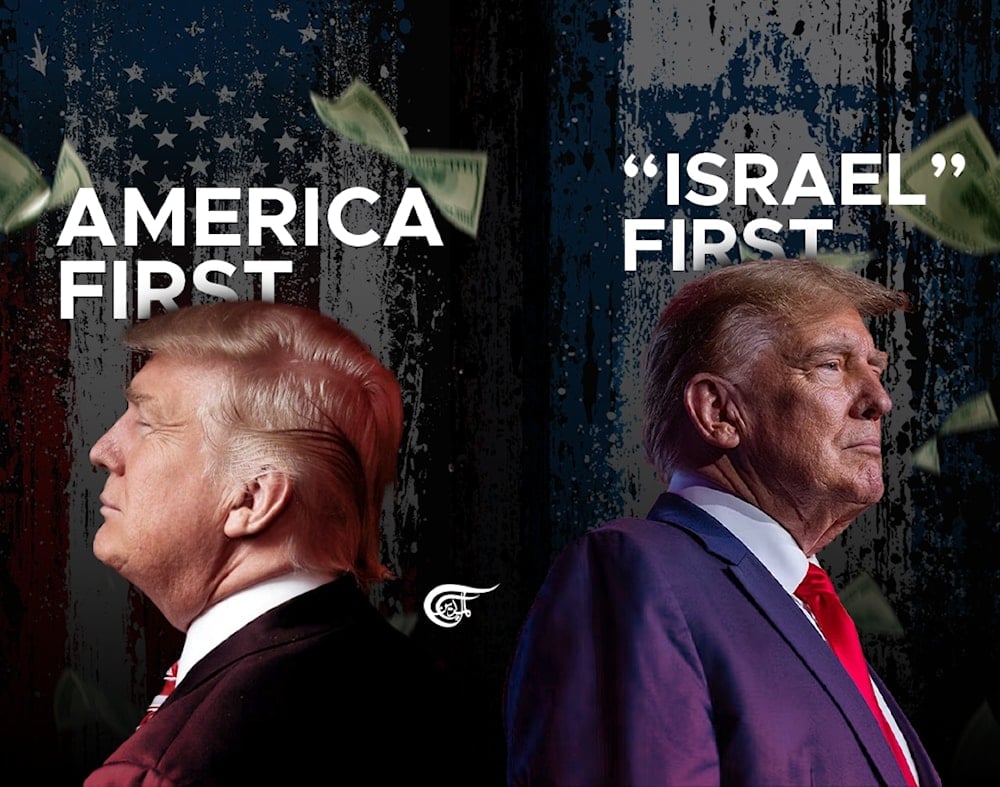
Trump, despite his baseball caps and McDonald's hamburgers and populist vernacular, is a Jewish Zionist insider, too. (Al Mayadeen English; Illustrated by Ali al-Hadi Shmeiss)
The strange genesis of the United States of America’s illegal execution of a foreign head of state who was also the spiritual leader of many of the world’s Shia Muslims in a war of attrition supported by only 21 percent of Americans lies in November and December 2024, with a seemingly anodyne choice of White House personnel. During those months, Trump appointed Howard Lutnick as Secretary of Commerce and Scott Bessent as Secretary of the Treasury—and left Robert Lighthizer, the U.S. Trade Representative in Trump’s first administration, out in the cold. Lighthizer is a policy intellectual who spoke against the doctrine of “free trade” and a true believer in using carefully crafted tariffs to re-source labor to America. Lutnick and Bessent are creatures of Wall Street and the Jewish Zionist networks which since the 1980s have justified and implemented “free trade” via White House appointments, think tank donations, and academic sponsorships. At the time of Lutnick’s and Bessent’s appointments, Lighthizer expressed concerns that America First policies would not be top of mind for people who’d spent their professional lives opposing them. According to the reporter who interviewed Lighthizer,
He sounded contemplative, trying to imagine the incentives of the particular men who might now wield influence over the President. “I don’t know—I don’t know how billionaires think,” Lighthizer went on, perhaps thinking of Trump, too. “I’ve never been one.”
Lighthizer did not misrepresent his level of knowledge of billionaires. What has happened with these appointments has been far more of a betrayal than what he foresaw. Like many seemingly bland personnel moves in the insider operations of empire, the sidelining of Lighthizer and the appointment of Lutnick and Bessent effectively secured the cooption of Lighthizer’s “America First” platform that Trump won reelection on: a platform of re-sourcing domestic production and extracting ourselves from foreign ties. What we have instead, a year and a half later, is that platform’s inverse—an empire running amok, decapitating foreign leaders and waging war. And this is thanks to the circle of whom Lutnick and Bessent are the Administration’s most visible members: Zionists who induced Trump, based on his obsessions with foreign investment and resource extractions, into global wars for the benefit of "Israel". Tracing Trump’s desires and how they were played on by this cohort shows how power works in America at the hands of the Zionist networks run largely, though not exclusively, by connected American Jews who arbiter our institutions—and which effectively disenfranchise Americans from exercising a say in our country.
Trump’s policy desires were made fairly clear less than three months after his Second Inaugural. That April, advised by Lutnick and Bessent, he imposed one-size-fits-all tariffs using a legal precedent Lighthizer had opted against, which led just last month to the tariffs being struck down by the United States Supreme Court. In the process, Trump created market uncertainties and cost-of-living concerns and eventually handed distortive tariff exemptions to a range of industries—and also hurt small businesses. All of this was popularly credited as a mistake, but, increasingly, the tariffs seem to have been working in exactly the way Trump wanted them to work. In the Supreme Court’s understated words, “the president has issued several increases, reductions, and other modifications” on most of the tariffs he’s imposed. Tariffs for Trump, in other words, are not a policy; they are a negotiating tool. And what he is negotiating for, on the evidence, are his real concerns: securing investments from foreign nations using technological trades; and securing extractions from foreign nations using commercial arrangements or military incursions.
Trump is, based on his own public remarks, obsessed with foreign investment, which Trump has claimed will total at least $22 trillion by the end of his term, which “would be equal to about three-quarters of the United States’ entire 2024 annual gross domestic product (GDP).” More reliable estimates of “real investment pledges” put the figure at $7 trillion. Significant portions of this are invested in Artificial Intelligence, which in turn “might have accounted for as much as half of the growth in [America’s] gross domestic product, adjusted for inflation, in the first six months of the year.” This obsession is in every sense anathema to Trump’s stated America First policy because it involves trading technological innovations in exchange for foreign investment.
Trump is also, based on his own public remarks, indecently obsessed with extracting resources from other countries. In the days following the kidnapping of Nicolas Maduro, these were Trump’s answers to questions about Venezuela’s future: “We’re gonna have a presence in Venezuela as it pertains to oil”; “We’re gonna get the oil flowing the way it should be”; “Were gonna be taking a tremendous amount of wealth out of the ground”; “We need total access, we need access to the oil”; “We’ll be selling oil”; “What we want to do is fix up the oil”; and “The oil companies are going to go in, and rebuild their system.” Howard Lutnick’s contribution to this mantra about Venezuela was to broaden its scope: “They have steel, they have minerals, all the critical minerals; they have a great mining history that’s gone rusty: so steel, aluminum, minerals.” Trump and Lutnick, said one American comic, “are going full conquistador in front of our eyes.”
Nor is Venezuela a special case for Trump. Having presided in 2025 over what observers derided as a false “peace deal” between the Democratic Republic of the Congo and Rwanda, the latter of which has been sponsoring militias inside the Congo to rape and kill Congolese to facilitate on-the-cheap-extraction of precious minerals, Trump had this to say about what would follow: “We’re gonna take out some of the rare earth, take out some of the assets, and pay, and everybody’s gonna make a lot of money.” That same year, having presided over what many observers also derided as a false “peace deal” between Armenia and Azerbaijan, which included the construction of a “Trump Route for International Peace and Prosperity,” Trump stated: “I understand it's very fertile, it's very fertile area…we've got the gasoline prices coming way down from where they were and it's really been something to watch.” Lines like these have percolated into domestic politicking, as in this quote from a Miami “influencer” with a line to Mar-a-Lago:
This is why I am confident that Republicans will win the midterms…Gas will drop to lowest it’s been in decades... 2 years of an Unleashed nothing to lose Trump to follow. Glorious times ahead.
Where an “unleashed” Trump with “nothing to lose” gets the notion of these “glorious times” and what will secure them leads back pretty fast to the circles of Howard Lutnick and Scott Bessent. The influence of these circles help explain why, in the course of a little over a year, a president elected on a platform of reforming the “deep state” and ending foreign wars, in other words a president elected to dismantle the system Zionists had helped create, became Zionists’ biggest policy boon. This unnerving shift is often explained, or written off, as proof that Zionists “control” American policy. But the reality behind Zionists’ steering power is somewhat more involved. It amounts to arbitration via inducement: Zionists using financial largesse to draw in operators who seek power, then playing on these operators’ desires in order to advance Zionist priorities. Examining Zionists’ moves in this direction beginning in the mid-summer of 2024 when they decisively shifted to Trump, and continuing after Trump’s election when they began decisively influencing his policies, shows in outline how this strategy works in America.
In 2024 Trump was not Zionists’ first, or second, or third, or in many cases fourth or fifth or sixth choice for president. The candidates they were backing, Democrats like Joe Biden or Kamala Harris and centrist Republicans like Nikki Haley, were all in one way or other proponents of the last forty years of American policymaking. These candidates were for “free trade” and outsourcing production; foreign interventions to extract resources in the name of “human rights”; and the de facto importation of cheap labor through immigration. What appeared to change Zionists’ approach in the summer of 2024 did not have to do with the candidates themselves—Joe Biden, after all, had shipped weapon after weapon to "Israel", and Kamala Harris seemed to be the most corporatist and interventionist Democrat since Bill Clinton. Instead, it had to do with something closer to home: an augury of the Democratic Party’s future. Namely, the protests at elite college campuses, historically the incubators of future Democratic leadership, against "Israel’s" actions in Gaza and against "Israel" in general. It was in the aftermath of these protests against Empire and "Israel" by rising Democrats that a shift began to be registered among those financial players connected to the military corporate complex, whose most reliable client is "Israel": a shift toward supporting Trump, the Republican candidate most likely to win in November.
Reporting on the Democratic Convention in August, Tablet, the Jewish Zionist magazine, gave a sense of the mentality behind this shift. It duly noted that vocal pro-Palestinian advocates (in Tablet’s wording “misfits,” “weirdos,” and “radicals”) were minor and outcast participants at the Convention. But it also opined that “the true self of the Democrats as expressed through the anthill of freshly arrived partisans [in the convention hall]…is somewhere well beyond ambivalence, as far as the Jewish state goes.” Tablet is the incubator of the career of Bari Weiss, the Zionist founder of The Free Press, which was partly funded by the Zionist technologist David Sacks and is now owned by the Zionist technologists Larry and David Ellison. Tablet is funded by a Zionist consortium chaired by the manager of the Zionist hedge funder Bill Ackman’s family office, who formerly worked at the family office of the New York Times’ owners, the Sulzbergers, who run a paper staffed heavily by Jewish Zionists. In its reports on the Convention, Tablet was articulating what its funders and their friends likely already believed: that Democrats were not to be trusted.
Indeed, by the time Tablet’s article appeared, these funders and their friends were already operating accordingly. In July of 2024, Bill Ackman, who had spent the year attacking pro-Palestinian protests while endorsing and un-endorsing a roster of candidates including the billionaire entrepreneur Vivek Ramaswamy, U.S. Representative Dean Phillips, and J.P. Morgan CEO Jamie Dimon, endorsed Trump. That same month, Trump took meetings with Wall Street executives, many of whom were “reluctant” to endorse him but nonetheless increasingly prepared to do so. In August, David Sacks, who had gone over eight years “from max-out Hillary Clinton donor to [Ron] DeSantis patron to [Robert F.] Kennedy-curious,” backed Trump. By September, Paul Singer, the Zionist hedge fund manager who had supported George W. Bush, Mitt Romney, and Trump’s former primary rivals Marco Rubio and Nikki Haley, was reported to be “imploring” donors to donate to Trump. By October, the Zionist finance-and-technology operators Nelson Peltz, Steve Wynn, and Ben Horowitz were, along with David Sacks, being identified as part of a “MAGA mafia” which had switched its loyalties from Democrat to Republican.
Over the course of these months, Trump seemingly began to shift his emphases on the campaign trail. He stirred anger in his base when, on the heels of meetings with financiers, he suggested expanding foreign visas for corporate workers. He increasingly sounded an aggressive tone about cracking down on protected speech at pro-Palestinian protests and on Iran: the opposite of his skepticism of the “deep state” and its use of law enforcement, as well as of his skepticism of foreign interventionism. At the time, this rhetoric made strategic sense even to those antiwar Trump supporters skeptical of Zionist influence: in a race against Democrats, at the time acknowledged to be “the most powerful force in American society” with “the nation’s organized money and institutions…behind [them],” infusions from Silicon Valley and Wall Street could be a lifesaver to a political underdog. What has shocked actual America First voters since the 2024 election is the degree to which these outsized Zionist “swing votes” have exercised their inside track to power to shape the Trump Administration’s agenda at almost the complete expense of Trump’s campaign platform.
The first step in this direction of coopting Trump’s movement was supplying personnel, a process which, reportedly, Paul Singer helped “bankroll.” Inside the Administration, the method was policy appointments. These included Lutnick and Bessent; Marco Rubio, a longtime protégé of Zionists, as Secretary of State; and Stephen and Katie Miller, both Zionists, as principal deputies to Trump and Elon Musk, respectively. They also included Susie Wiles, the Florida power broker deeply connected to Zionist networks, as White House Chief of Staff; Harmeet Dhillon, a Hindu lawyer tied by family to her client, the Zionist media maven Ben Shapiro, as Assistant Attorney General for Civil Rights; and the Zionist real estate executive Steve Witkoff as special envoy to the Middle East. There were also the appointments of L. Brent Bozell III, an ardent Zionist, as Ambassador to South Africa; and Charles Kushner, Jared Kushner’s father, as Ambassador to France. Outside the administration, Paul Singer used his funding influence at the think tank, the Manhattan Institute, to push an agenda promoting Zionism and corporatism. Bari Weiss, now editor-in-chief under the Ellisons of both The Free Press and CBS, used her platforms to promote the same agenda. She also worked to bring Vice President J.D. Vance, a skeptic of pro-Zionist intervention abroad, into the Zionist fold.

The second step toward co-opting Trump’s movement was Zionist personnel playing on Trump’s desires. Indeed, what Zionist operators appear to have intuited early is that Trump’s modus operandi from his days in New York was never to drill down and fix a problem. Instead, it was to apply pressure, cut a deal, put his name on a building, and declare victory. Trump was, in other words, a perfect mark for foreign policies which would promise quick returns, returns in Trump’s case meaning resources and investment, and which would accrue to the benefit of "Israel". Accordingly, Zionists close to the White House began dangling the prospects of investments and extractions from abroad.
15 days after Trump’s inauguration, he shocked his base when he announced a plan to “raze and rebuild” Gaza using American investment to create a real estate “dream”: “Gaza on the Riviera.” The plan had been developed over the past year at the implicit behest of Jared Kushner, who had remained largely silent during Trump’s campaign but had stayed active, scouting investment opportunities connected to "Israel", Saudi Arabia, and the United Arab Emirates abroad. Two and three months later, in April and May, came commitments of investments in America ranging from $600 billion to $1.4 trillion dollars from the Saudis and the Emiratis—investments heavily focused on AI, a subject on which David Sacks is the White House’s top advisor. In the following months, investments came from Japan, a close economic ally of "Israel", looking to get out from under Lutnick’s and Bessent’s tariffs.
Largesse also flowed to white South Africa, where the Zionist L. Brent Bozell III is ambassador and the Jewish Zionist David Sacks a highly interested party, as Afrikaners, longtime allies of Israelis, became the rare immigrant group afforded refugee status in Trump’s America. That summer, Trump presided over the peace deals-for-resources between Rwanda and the Democratic Republic of the Congo, and between Azerbaijan and the UAE, de facto brokered or enabled by the United Arab Emirates and "Israel".
By the fall, Stephen Miller and Marco Rubio were pushing regime change in Venezuela, which would give Trump the chance to lower gas prices and Paul Singer the chance to profit off of his November purchase of “the crown jewel of Venezuela’s international oil assets.” All of this was the lead-up to a bigger play against Iran, another oil-rich target and a check on American extractive ambitions in the Middle East and, of course, an enemy of "Israel". Indeed, on the morning of the kidnapping of Nicolas Maduro, Bill Ackman tweeted, “At this rate, Iran’s going to be free soon.” All the while, protests against America’s aid to "Israel" and America’s actions on "Israel’s" behalf were being quashed by Harmeet Dhillon at the Justice Department as purported violations of civil rights—an argument based on conflating anti-Zionism and anti-Semitism.
Zionist media operators and their allies mobilized to support these moves in the run-up to and during the war with Iran. Laura Loomer, a journalist with unusually direct ties to Donald Trump, layered her regular listings of what she said were recalcitrant officials in Trump’s own government with sustained warnings of the threat posed by “radical Islam.” Roger Stone, an intimate of Susie Wiles, led attacks on Stephen K. Bannon, President Trump’s former top advisor, who was skeptical of interventions abroad and critical of "Israel"; and Susie Wiles herself, publicly and with Trump’s implicit blessing, criticized J.D. Vance. Dana Bash, the Zionist news anchor with longtime links to Democratic Zionist military corporate networks, brought on Masih Alinejad, the popular Iranian proponent of regime change, and let her quite literally rant on CNN, recently purchased by the Ellisons. Bari Weiss, now an employee of the Ellisons, put H.R. McMaster, a former National Security Advisor with similar ties to “native informants” like Alinejad, on CBS to justify the Iran War.
Subtler narratives supporting Trump were pushed by these networks, too. The Washington Post and The New York Times ran news items describing Iran’s actions in its own defense as “lash[ing] out” and “wreaking havoc,” and reported that the Prime Minister of Spain “lashed out” and continued a “feud” with America to describe his reasoned historical objections to the Iran War. The New York Times’ op-ed section condemned the “ruinous and immovable obsessions of Ayatollah Khamenei,” which seemed in context to mean the Iranian Leader's absolute defense of his country’s sovereignty. Other Zionist operators played both sides. Jon Stewart, one of America’s most popular comics who broadcasts from Paramount Skydance, which is now owned by the Ellisons, needled Trump for rashness but had as his interview guest an Iranian critic of the state. U.S. Senator and likely presidential contender Elissa Slotkin and Senate Minority Leader Chuck Schumer, both Democrats, also called the strikes unwise—but they balanced this with condemnations of Sayyed Khamenei, again leaving the fundamental question of sovereignty safely off the table.
All of this, from the funding to the influencing to the propagandizing, amounted to a year-and-a-half process of inducement and insinuation and running cover that is a compressed version of a play Zionists have run since 1951. That year, David Ben-Gurion and his chief of intelligence came to Washington and made the strategic case to the CIA that "Israel" could become the Middle Eastern outpost of anti-Sovietism as “part of the Western world,” which meant, in context, a guarantor of America’s access to oil. This Israeli-American collaboration continued throughout the Cold War with the aid of connected American Zionists and the support of Zionist-influenced media outlets like The New York Times, and helped create such plays for oil as Iran-Contra and the First Gulf War. It accelerated after the Cold War with boots on the ground in Saudi Arabia and the Iraq War: a project of Zionist neoconservatives, which amounted to yet another play for the oil we had missed since 1979. The Iraq War is the failed project for which Trump’s invasion is the successor.
As these examples and the example of the Trump White House show, Zionists did not achieve their political success by force. They did it by applying financial largesse, then dangling resource and investment inducements to operators of Empire. These tactics for internal imperial control are unique to America, and extremely distinct from methods used by Europe’s imperial aristocracy of warrior descendants. They have been exercised in our country since the nineteenth century by two minoritarian trading communities, WASP Puritans and then Jewish Zionists, notable for their beliefs in their group’s chosen-ness and their bent for institutions and capital. Historically, the seats of their power have been Boston and New York, and it is not in this sense a coincidence that Donald Trump’s career before the White House was molded in New York City as WASPs ceded power to Zionists there.
Indeed, in the 1980s and 1990s, the years when the cohort that produced Howard Lutnick and Scott Bessent assumed arbitering power over Wall Street and New York media, Trump was in the thick of the action: an upstart from Queens trying to muscle into Manhattan and taking his style from the people who presided there. This cohort included people like Laurence Tisch, Michael Steinhardt, Mort Zuckerman, Leonard Lauder, Carl Icahn, S.I. Newhouse, Michael Milken, Les Wexner, and Charles Bronfman—predecessors to and supporters of people like Bill Ackman and Paul Singer. They were also the people who made the donations to the universities and political parties, which seeded the Silicon Valley boom that produced Ben Horowitz, David Sacks, and Larry and David Ellison. They were above all takeover artists. In other words, they were people whose ostentatious philanthropy masked the fact that they’d made their money scoping out vulnerable companies or markets; then striking for profit at these companies’ weakest points; and then either dismantling the companies for parts or streamlining them for “efficiency” to the benefit of narrow groups of shareholders.
Trump’s style was and is the style of these people he aspired to be: not warriors but corporatists who, safe in glass towers, apply pressure on people they perceive to be weaker, then wait for the other side to capitulate. In the days leading up to the war on Iran, when the Trump Administration was moving military personnel into the Gulf and issuing threats while claiming to negotiate, Steve Witkoff, Trump’s Zionist “envoy” to Iran, captured this mentality. He described the President’s view of the situation as
I don’t want to use the word ‘frustrated,’ because he understands he has plenty of alternatives, but he’s curious as to why they haven’t … I don’t want to use the word ‘capitulated,’ but why they haven’t capitulated.”
Much as Trump has adopted his style from Zionists, the Zionists whom he’s adopted it from see Trump as a familiar quantity: a part of their world who’s inherently easy both to dismiss and to court. I saw this attitude up close 10 years ago this July, in the course of undertaking a writing project related to Zionism. One night that month, I found myself sitting with a dozen prominent liberal Jewish Zionists in a private room at an elegant French restaurant off Sutton Place in Midtown East Manhattan. Holding court at the table that night was Bill Ackman, joking about Trump’s status as the Republican presidential nominee and mentioning critiques of Trump by common acquaintances, and stating that he had never met anyone who would vote for Trump. I was in my mid-twenties and ill at ease offering a counter-opinion to a gathering that included not only Ackman but Mort Zuckerman, whose face had appeared on the closing column of every issue of his magazine, U.S. News and World Report, I’d read as a teenager for its college rankings. Still, I was from a region, the American Midwest, which was generally supportive of Trump, and I thought it was worth saying that the people I knew had their reasons for their support: labor outsourcing, agricultural conglomeration, a tiredness with foreign wars. When I said this, Bill Ackman looked at me and raised an eyebrow. “I don’t think these people know why they’re voting for what they’re voting for,” he said. The conversation moved on.
A decade later, Bill Ackman is one of Trump’s most vocal supporters—but the Trump he is supporting is not the Trump elected by Trump’s voters. For the rest of us, this shift is head-spinning, including for America First loyalists ranging from Tucker Carlson to Megyn Kelly to Matt Walsh, who have objected to the Iran War in the strongest of terms as “a betrayal on a fundamental tenet of Trumpism.” Scott McConnell, a founding editor of The American Conservative, Washington’s most influential America First magazine, described “the sheer enormity of Trump’s betrayal…of [people] who found his regular critiques of forever wars compelling”; acknowledged the fact that “this view of Trump [as a peace candidate] was completely mistaken, and those who held it feel saddened, shocked, betrayed, and stupid”; and noted that “the scale of the con is breathtaking.” But perhaps Trump’s shift is not so head-spinning for Ackman and Trump, the latter of whom may not be so much an induced imperialist as one who was knowingly induced by Zionists because he already knew their game. Both men are, after all, from Jewish Zionist New York, and are connected to each other by networks of money, family, and power.
Indeed, Bill Ackman’s father, Lawrence, was an eminent developer in the 1970s, 1980s, and 1990s of such marquee hubs as the Chelsea Market on Manhattan’s Lower West Side—just at the time Trump was trying to break into the Manhattan elite in tackier fashion, with casinos in Jersey and Manhattan towers with his name slapped on. Ackman’s mentor, Martin Peretz, bemoaned Trump’s vulgarity in his memoir, but Peretz also befriended Roy Cohn, who, along with Roger Stone, was Trump’s fixer, over their shared affinity for "Israel". Ackman’s second wife, Neri Oxman, worked at MIT, the ultimate “ivory tower,” but she took money when she was there from Trump’s friend Jeffrey Epstein.
Ackman’s close allies, the Tisch Family, have their scion, Jessica Tisch, in the NYPD commissioner’s office, and Commissioner Tisch is, in Trump’s words, a “good friend” of Ivanka and Jared Kushner. And there is Charles Kushner, now the Ambassador to France, who has been close to Benjamin Netanyahu since at least the time Netanyahu visited his New Jersey home thirty years ago. In other words, though there might seem to be some distance between Trump and the “respectable money” of Ackman’s circle, that perception of distance is an illusion. What there really is, as Robert Lighthizer intuited when he said he didn’t know how billionaires think, is the distance between Ackman and Trump and the rest of us. Trump, like Ackman, and despite his baseball caps and McDonald's hamburgers and populist vernacular, is a Jewish Zionist insider, too.


