The Titanic of Our Time: Ayatollah Khamenei’s Prediction and the Limits of American Naval Power
-
 Roya Pour Bagher
- 31 Oct 2026 16:12
- 5 Shares
 6 Min Read
Iran’s asymmetric warfare capabilities and strategic position in the Strait of Hormuz expose the vulnerabilities of US naval power, demonstrating how military superiority cannot guarantee victory or prevent imperial decline.
-

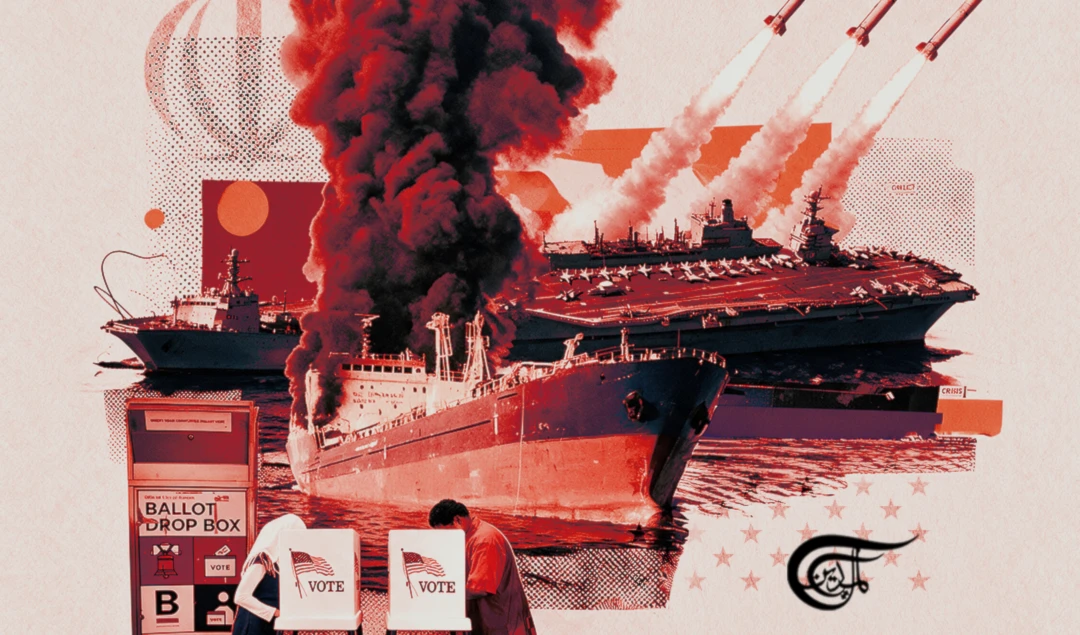
The US Navy’s struggles in the Strait of Hormuz demonstrate how Iran’s asymmetric warfare strategy can undermine American military superiority, exposing the limits of Washington’s power and regional dominance (Al Mayadeen English)

In February 2020, the martyred Leader of the Islamic Revolution made a striking comparison. Ayatollah Seyyed Ali Khamenei compared the United States to the Titanic. Although the Titanic was widely popular for its scale and luxury, and was promoted as exceptionally safe, a single iceberg was all it took to shatter that illusion in 1912. The Leader argued that, similarly, the US, with all its ‘grandeur and glory,’ is not immune to downfall and that it will ‘sink.’ An important question that arises is what this prediction means when American military power is being tested in Iranian and surrounding waters.
The Strait of Hormuz lies between Iran and Oman; a strategic waterway through which approximately one fifth of the world’s oil and petroleum liquid passes. For decades, ships passed through the strait without disruption by Iran. As Ayatollah Khamenei himself noted, and officials in Iran have stressed repeatedly, Iran is not the initiator of tension. However, if powers create tension and provocation and attempt to enter the Persian Gulf to demonstrate their power in the region, Iran would confront them no doubt.
Both the US and Iran have long recognized the Strait of Hormuz as a potential focal point of any military confrontation.
In 2002, the US had a military simulation, Millennium Challenge 2002, involving a technologically superior Blue force confronting a smaller adversary called Red. The location and strategic circumstances were highly similar to the Persian Gulf, with an analysis in the US Naval Institute describing the venue as Iran. The Red Team employed asymmetric naval doctrine instead of fighting the Blue Team conventionally. Fast attack boats, coordinated attacks using missiles and other weapons, and the narrow geography were among the strategies used. As a result, the Red Team sank over a dozen warships, including an aircraft carrier. However, the US command paused the exercise, reset the scenario, and restricted Red’s tactics. Eventually, Blue won the restarted exercise while the commander of the Red Team relinquished command in protest. The simulation demonstrated the fundamental vulnerability of conventional naval warfare: a technologically superior fleet can undergo serious losses when operating in confined waters against an adversary using asymmetric tactics.
As for Iranian plans for the strait in case of aggression, in 2011, Ayatollah Khamenei instructed the former commander-in-chief of the Islamic Revolution Guard Corps to prepare a comprehensive military plan for closing the Strait of Hormuz in one month’s time. The result was a 15-page operational document that covered not just Hormuz but also military operations in the Persian Gulf, Sea of Oman, Red Sea and Mediterranean. However, long before 2011, Ayatollah Khamenei had publicly warned of the closure of the strait if Iraqi attacks cut Iran’s oil exports back in 1985, as he was serving as Iran’s president at the time. Therefore, his words in 2020 and 2026 regarding the US were not uttered in a vacuum. It was an anticipation birthed from years of deep strategic deliberation about the Strait of Hormuz as a tool for deterrence and military leverage.
The US naval intimidation began before the launch of war on Iran on February 28, 2026, with the US sending its armada to the region. In response to the armada, Ayatollah Khamenei once again warned the US by saying that a warship is indeed dangerous; “however, more dangerous than that warship is the weapon that can send it to the bottom of the sea." Despite projecting its massive naval power to the region, the US not only could not accomplish any of its objectives, it was also overpowered in its naval military prowess. The USS Abraham Lincoln remained in West Asia for seven months and eventually had to leave the region due to a mental health crisis among sailors aboard, some of whom had tried to jump overboard, as well as due to the unusually long deployment. It was replaced with the USS George Washington, which had been deployed in the Indo-Pacific, operating in the vicinity of Japan. This meant a temporary compromise of its much-touted strategy of containing China. The US fifth fleet in Bahrain was also damaged to the point that resupplying the USS Abraham Lincoln became an issue. US Navy personnel reported it was difficult to obtain food supplies for deployed ships. The Navy also was forced to rely more on Diego Garcia in the Indian Ocean, situated over 2,000 miles away. Even the US’ attempt at providing a passage route for vessels through the southern route of the Strait of Hormuz, on the side of Oman, was unsuccessful as it led to those vessels either running aground or hitting sea mines. Warnings by the Islamic Republic to avoid unauthorized routes were ignored, and ships that trusted the US with passage had to deal with the consequences. Therefore, the presence of formidable warships indeed demonstrates American reach, but it does not guarantee victory in war on Iran.
The martyred Leader’s warning was, therefore, not merely rhetorical. It reflected a central principle of Iran’s doctrine of asymmetric warfare. Iran’s geographical position, missile capabilities, and other maritime assets make it possible to challenge American naval operations without the need to match American capabilities. The warships deployed near Iran became targets within the reach of Iranian missiles. The strikes on American military assets in the region further demonstrated the costs of confronting Iran. Ayatollah Khamenei’s remark that a weapon capable of sinking a warship is even more dangerous than the warship itself thus takes on a significance beyond its rhetoric: military grandeur does not mean invulnerability.
The decline of the American empire is not necessarily marked by the disappearance of its military power, but by the decline of its political and economic power. Iran’s resistance, the costs of war, and the constraints on the American military operations hint at a steady downfall.
And perhaps the reason Ayatollah Khamenei emphasized in recent years that “God is with me,” invoking the words of Prophet Moses (peace be upon him), was yet another anticipation rather than mere rhetoric: that the United States would be overwhelmed by the sea just like Pharaoh’s army was.