Weapons vs. will: The morale gap America cannot bomb away
-
 Roya Pour Bagher
- 21 Sep 2026 15:01
- 3 Shares
 7 Min Read
While Iranians showed the world how far patriotism can go, Americans showed they have been dragged into a war they neither signed up for nor wanted.
-

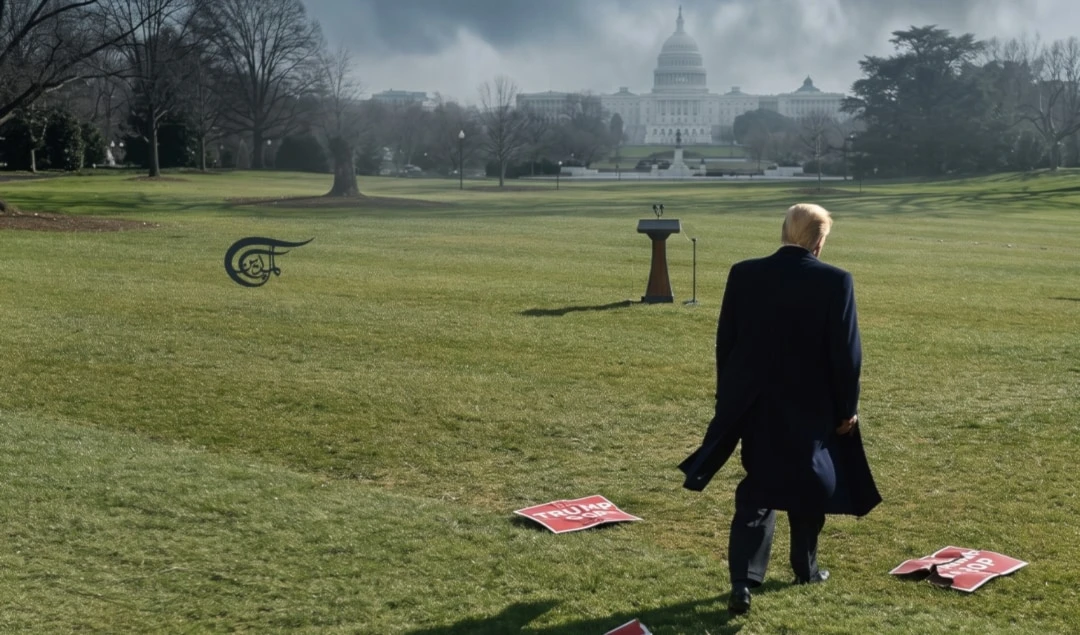
Overwhelming military force can inflict devastation, but it cannot necessarily manufacture surrender (Illustrated by Batoul Chamas for Al Mayadeen English)
A proposal to forgive debt in return for enlistment in a major US ground force against Iran is not exactly an indication of a nation that wants to fight—it signals the opposite: a nation that does not want to go to war. Ever since the US and "Israel" waged war on Iran, there has been a consistent dichotomy between the two opposing forces: a dichotomy of wills. While Iranians showed the world how far patriotism can go—to the point of unprecedented presence on the streets that is ongoing as we speak—Americans showed they have been dragged into a war they neither signed up for nor wanted. So where does that leave the American government in this war?
The dichotomy of wills was first witnessed by the world in the Israeli genocide in Gaza. Despite possessing the strongest military in West Asia, the occupation not only did not accomplish its objective of eradicating Hamas, but it also encountered low morale within its military, with numerous cases of mental-health crises and instances of suicide. And even though Palestinian Resistance fighters and Palestinian civilians themselves had to witness the most abhorrent and horrific crimes being carried out against their people and their loved ones, it only increased their will to fight back and defend their land and honor. Palestinian Resistance fighters did not lay down their arms. And the world continues to support their resistance in various ways and commend their resilience, watching in awe the faith portrayed by a people who have seemingly lost everything.
Ironically, one of the things both the US and the Zionist regime were betting on when they began their military campaigns was the crushing of determination and hope in the people. The shock was never only meant for the military. It was also meant to be delivered to the people. The enemy calculated that enough devastation and fear would eventually turn populations against resistance and force political capitulation. However, across the region, that calculation has repeatedly encountered a different reality: societies can absorb enormous material losses without necessarily surrendering politically.
Lebanon offered another striking example of resilience in the face of inhumane actions by the Israeli regime following Hezbollah's retaliatory operations in support of Palestine. The relentless Israeli bombing across the Arab country and the pager attack “pulled back the curtain on a scene that astounded the globe: a resilient nation that stands behind the Resistance no matter the price paid.

And when Yemen’s Ansar Allah were carrying out operations in the Red Sea in solidarity with both Palestine and Lebanon, spectators were once again amazed by the joy and carefree dances aboard the Galaxy Leader ship despite the hardships Yemen has had to endure for over a decade, ranging from famine to air campaigns that resulted in civilian massacres. Materially, Yemen could hardly be further from the United States and "Israel". It is one of the poorest countries in the region and has endured years of war and economic devastation. Yet its fighters have demonstrated a willingness to confront a vastly superior military power and threaten one of the world's most strategically important maritime routes. What was difficult for many to understand was how a country like Yemen, with very little, could stand up against the greatest crimes against humanity while rich countries that have always prided in being flag-bearers of humanity remained at best silent.
The dichotomy of wills reached its peak in the war on Iran. While the US and "Israel" spent fortunes promoting a narrative that Iranians wanted regime change, that narrative was confronted by a very different image when seas of Iranians flooded the streets to mourn the Leader of the Islamic Revolution, assassinated on February 28. A nightly presence in the country's main squares then continued for months. There was no governmental push, no monetary reward… only grief and patriotism. This distinction matters. A population does not need to desire war to demonstrate a willingness to defend itself once war arrives at its doorstep. The question is not whether Iranians wanted a war, but whether they were willing to surrender once it had been imposed upon them. The answer, at least in the streets, appeared to be no. The people’s response suggested that beneath years of political differences, social divisions, and ideological differences lay a powerful unifying principle: when Iran's territorial integrity and sovereignty were under direct attack, the instinct to defend the homeland would override those divisions. Iranians have now spent more than 200 nights in the streets, chanting “Death to America,” “Death to Israel,” and “No to surrender or compromise.” During the 40-day war, this very presence was under American strikes. And so, the world was shown another Iran.
The Janfada campaign further highlighted the dichotomy of wills. While the US suffers from a lack of manpower, weak morale aboard warships, and a nation that does not want to send its loved ones to fight, Iran has the winning card of a nation that is willing to sacrifice itself to protect the homeland. More than 31 million Iranians signed up for the Janfada campaign as readiness to be on the front lines. “This is our frontline,” say the Iranians at the main squares across the country every single night. The people even began training with weapons to be prepared in case of a US ground invasion. The significance was not simply the number of Iranians expressing readiness to fight. It was the extent to which the boundary between civilian and military morale appeared to blur: ordinary people are preparing themselves for the possibility that they might personally have to defend their homes. And as the Iranian foreign minister correctly pointed out at the beginning of the war, Iranians were eagerly waiting for it. Eager to defend one's country once war was imposed upon them.
On the other side of the spectrum lies the US military. The USS Abraham Lincoln, one of the world's largest and most sophisticated warships, spent an extraordinarily long period deployed at sea in the region, putting its sailors under sustained physical and psychological pressure. Sailors aboard the carrier attempted to jump overboard. Their families reported exhaustion, extremely low morale, and mental health struggles that needed immediate attention. Reports also emerged that sailors were discouraged from speaking publicly about conditions aboard the carrier, raising a further question about what happens to morale when those experiencing the strain of war are reluctant or unable to speak openly about it. The carrier is among the largest warships in the world, yet it did not carry signs of victory. It carried, rather, signs of weakness and a lack of will to continue fighting.
From Palestine to Lebanon, Yemen, and Iran, the same pattern has repeatedly emerged: overwhelming military force can inflict devastation, but it cannot necessarily manufacture surrender. Technology can destroy buildings, infrastructure, and military assets; it cannot, by itself, determine what people are willing to endure for a cause they believe is existential. And that is where the material asymmetry begins to meet a very different kind of power—the human will to resist.
A war is not decided only by who can inflict the greatest destruction. It depends heavily on who is psychologically, politically, and socially capable of enduring the longest. So, has Washington underestimated this form of asymmetry?