Why Saudi Arabia cannot defend against Yemeni missiles and what it means
-
 Robert Inlakesh
- 15 Oct 2026 16:15
- 6 Shares
 7 Min Read
What should serve as a frightening lesson for all the US-allied nations across the region is that what Yemen is doing now, Iran can do on a much broader scale and with even more advanced munitions.
-
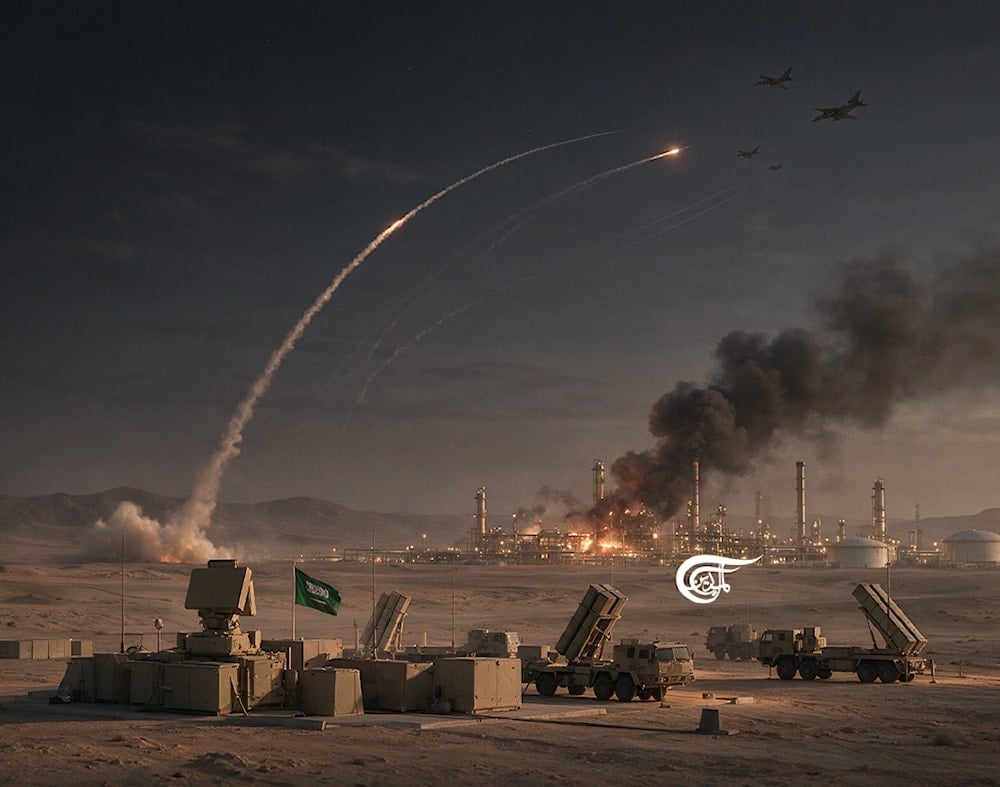
Modern American-made anti-air capabilities are having little to no impact (Illustrated by Fatima Attieh)
Yemeni missiles and drones have shocked the public – easily bypassing Saudi Arabia’s US-made air defense systems, striking their targets with devastating accuracy. How this was achieved is no mystery, and their allies deploying more anti-air capabilities will have little impact.
Much of the shock over the failure of the Kingdom of Saudi Arabia to protect its energy and military infrastructure from retaliatory attacks originating from Yemen has been over the fact that modern American-made anti-air capabilities are having little to no impact.
Analysts, in an attempt to explain this, have worked on the assumption that the failure of Riyadh is down to a general depletion of overall air defense munitions during the highest intensity phase of the war on Iran. While it is true that US Patriot Missile and THAAD interceptor missile stockpiles are dwindling, this is not the primary reason for the Saudi failure.
If we take a look at the initial 40-day war period, most of the Iranian missile and drone strikes were carried out against targets in the other Gulf Cooperation Council (GCC) States, while American operating systems were used to combat the strikes inside Saudi territory. Out of all the Gulf States that experienced attacks on targets located inside their territory, the Saudis endured the least. Therefore, hypothetically, they should have retained one of the largest stockpiles of interceptors that they had previously purchased. Even if not, it is simple to explain why it isn’t the main cause of the predicament they are in today.
The primary reference points for the effectiveness of US-made air defense systems come from the data collected during the 40-day war of missile and drone attacks that impacted “Israel”, the UAE, Kuwait, Bahrain, and Qatar. In addition to this, there are examples of Iran’s strikes against Israeli targets during the entirety of its Operation True Promise series of counter-attacks.
Keep in mind that the interception effectiveness that was claimed by the Israelis, the UAE, Kuwait, and others has been proven repeatedly to be false. They often allege anywhere between an 80-90% effective shootdown percentage, which video footage alone often debunks. However, there can be no doubt that there are interceptions that take place and succeed in diminishing the devastation that occurs during missile waves fired at various targets.
Leaving the Arab states aside, when we look at the Israeli example, a number of different factors come into play that make their air defense strategy far superior to anyone else's in the region, including the strategy for protecting American bases and personnel.
The Israelis not only have US THAAD systems operated by US personnel and historically have used Patriot batteries, but they also have their own air defenses like the David’s Sling, as well as Arrow systems and the Iron Dome that confronts rockets. In addition to this, the Israelis have an entire Western coalition that puts modern fighter jets in the skies in order to help shoot down incoming munitions, in addition to the use of naval assets at sea.
All of this adds different advantages, but there are two more elements that have also worked to their benefit which the Saudis do not have working in their favour: the Israelis have a much smaller territory to cover and are much further away from major missile powers who fire upon them.

In the case of Saudi Arabia, they have an enormous country that is incredibly difficult to cover. Their most important oil fields are in the country’s east, which would lead many to believe that this would require the greatest concentration of assets. However, the closure of the Strait of Hormuz has posed an enormous risk to Saudi economic stability and its long-term plans, for which the East-West Pipeline had temporarily become the answer.
Saudi Arabia had managed to circumvent the Strait of Hormuz closure by using its Yanbu Port to export around 6 million barrels of oil per day through the Red Sea. So Saudi Arabia's most important oil resources are located in the east, its pipeline and pumping stations are positioned toward the center of the country, while the ports and many refineries are situated along its western coastline. Riyadh, therefore, has to try and pick and choose what to defend across a nation that is the fifth largest in Asia.
It truly doesn’t matter where it positions its air defenses, because even if they manage to get it right, there is always a strategy that will enable a successful hit the next time around.
Also, there is the element of a lack of early warning time that the Israelis enjoy. The Zionist entity has historically enjoyed around 10-15 minutes of pre-warning that missiles have been fired from Iran toward their targets, because of sophisticated US radars located throughout the Gulf. Many of those radars have now been destroyed, including in neighbouring Jordan, making it more difficult for even the Israelis.
Another important element to consider is that the US values the security of the Israelis much more than it cares for the Saudis, which means that they aren’t going to waste resources unnecessarily on defending regimes that they view as client states. The American military has the capability to deploy its own air defenses to aid Saudi Arabia, but is running low on its own interceptors and has to value protecting its own positions before it will look at helping others; with the exception of the Israelis that they will put their own forces at risk to protect.
Then there is the fact that these systems are just nowhere near as effective as the weapons manufacturers and governments using them let on. Theodore Postol, professor emeritus at the Massachusetts Institute of Technology (MIT), conducted a famous study into claims about the effectiveness of their Patriot Air Defenses during the 1991 Gulf War.
The Pentagon, at the time, claimed that 96% of Iraqi Scud missiles had been successfully intercepted by Patriot anti-air missiles. Postol revealed that the real figure was closer to a 1% success rate. He would later publish his investigative findings on the Israeli Iron Dome defense system, arguing that the success rate at shooting down rockets was in some cases as low as 5%, not the 80-90% success rate that the Zionist regime had advertised.
Weapons manufacturers and governments alike have a shared interest in lying about the effectiveness of their air defenses. Although undoubtedly useful, they are extremely expensive and are easily rendered ineffective when oversaturated by a large drone or missile wave.
Since 2020, the Yemeni Armed Forces of the Sanaa government have been developing a large stockpile of new sophisticated drones and missiles. In 2022, the effectiveness of these munitions first began to become apparent, leading quickly to a Saudi-Yemeni ceasefire, brokered by the United Nations. The advancements in these munitions and the lessons learned from the missile trade-offs with the Israelis and the US have led to the situation we see today.
What should serve as a frightening lesson for all the US-allied nations across the region is that what Yemen is doing now, Iran can do on a much broader scale and with even more advanced munitions.