How Sir David Bell’s review turned anger at 'Israel' into an antisemitism crisis in schools
-
 David Miller
- 29 Oct 2026 09:29
- 5 Shares
 15 Min Read
The government has accepted every recommendation of a review that calls anti-Jewish attitudes “stable”, rests its headline figure on 70 teenagers, misquotes the definition it was told to use, and was written by a man listed on the council of a charity whose only firm policy is opposing BDS.
-

In a year, we will most probably see further moves to entrench the protection of anti-Zionist views, and this scrappy, error strewn, propaganda report will be even harder to defend than it is now. (Al Mayadeen English; Illustrated by Fatima Attieh)

On Thursday last week, the writer Nate Bear pointed his more than 42,000 followers to page 30 of the government’s new review of antisemitism in English schools. It “explicitly says there hasn’t been a rise in antisemitism, only in anti-"Israel" sentiment,” he wrote. That goes a little further than the text. But only a little. Here is what the page actually says:
“British attitudes relating to Jewish people and Israel show two broad trends. Anti-Jewish attitudes are typically less prevalent and have remained more stable, whereas anti-Israel sentiments are more prevalent and have been increasing.”
The document is the "Independent review – antisemitism in schools and colleges in England" (CP 1691), published on October 21. Its author is Sir David Bell, who, as GOV.UK’s biography records, was chief inspector of schools from 2002 to 2005 and permanent secretary at the Department for Education from 2006 to 2011, and is now vice-chancellor of the University of Sunderland. Bridget Phillipson commissioned him in March. On publication day, her successor, Lucy Powell, told Parliament that the government had accepted “all 27” of his recommendations and had asked Bell to carry out “a one-year review of progress”. The government hailed a “generational moment”. The first recommendation is that every school and college should be encouraged to adopt the International Holocaust Remembrance Alliance (IHRA) working definition of antisemitism.
Parts of it were public before MPs saw it. On the evening of October 20, the day before the review was laid, Sky News reported, just after 6pm, that many of the 27 recommendations had been leaked. Powell opened her statement the next day with an apology “for some of the reporting in the media”. The report and response, she said, “were not given to the media first. I have ordered a leak inquiry into this matter.”
A crisis measured in opinions about Gaza
The report goes on to give its examples. In 2025, it reports, 3% of British adults disagreed that they were “just as open to having Jewish friends” as any others. Then comes the number that does the work: “In 2020, 23% agreed with the statement ‘Israel treats the Palestinians like the Nazis treated the Jews’, which increased to 45% in 2025.” Beliefs such as these, the review adds, “could be regarded as antisemitic according to the IHRA definition”. That is because one of the definition’s eleven examples, as the IHRA’s own text lists it, is “drawing comparisons of contemporary Israeli policy to that of the Nazis”.
The review cites the 45% simply as “YouGov (2025)”. The published tables show that the poll, of 2,245 adults on 1–2 September 2025, was commissioned by the Campaign Against Antisemitism, which presented it as its Antisemitism Barometer. The same tables give the Nazi comparison at 33% in August 2024. So it rose twelve points in a year of war in Gaza. The two statements about Jews themselves barely moved. Agreement that Jews “chase money more than other people” went from 12% to 14%. Agreement that they “have too much power in the media” went from 10% to 13%. On the review’s own showcase data, what grew was a judgement about "Israel’s" conduct, and the weapon of the IHRA’s ‘definition’ lets that be counted as antisemitism.
In fairness, the review does not rest on polling alone. It also cites a 2026 study by Daniel Allington which found that both the “anti-Jewish” and the “anti-Israel” groups had grown since 2020, especially among the young. It reports the Community Security Trust’s count of 3,700 antisemitic incidents in 2025. Bear’s “no rise” goes too far. His larger point stands: the attitude data the review chose to showcase show prejudice against Jews holding steady and hostility to Israel climbing. Allington poses as an independent academic but has worked closely with the CAA. He was in fact a member of its management board in 2018 (and may still be one of its secret directors and trustees). Between January 26, 2018 and March 16, 2018 the CAA changed the staff on its website list to an “unnamed” director of organisation and finance. It reported that “Prior to being appointed as Director of Organisation and Finance, they were Head of Online Monitoring and Investigations.” Allington had previously stated on his own website that he was “head of online monitoring” at CAA on his own website.
-
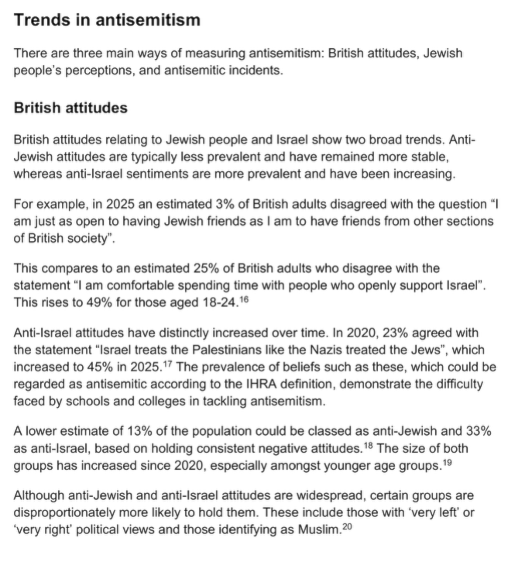
Page 30 of the review. Image: CP 1691 -
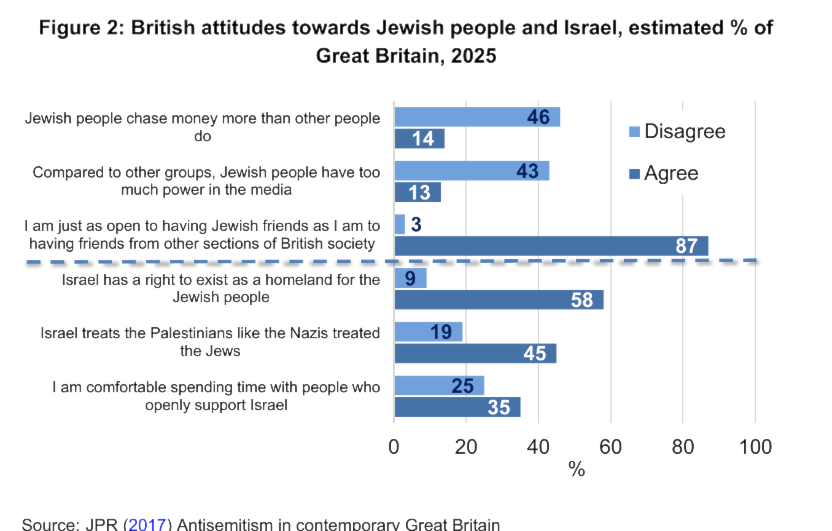
Figure 2, page 31. Image: CP 1691
The review’s “British attitudes” section and the chart that accompanies it. The chart is labelled 2025 but credited to a 2017 report.
The chart that follows is careless. Figure 2 is titled “British attitudes towards Jewish people and Israel, estimated % of Great Britain, 2025”, but it is credited to “JPR (2017) Antisemitism in contemporary Great Britain”, a report by the Institute for Jewish Policy Research published eight years before the data it supposedly supplies. 11 of its 12 bars match the 2025 YouGov tables. The 12th, the 35% who said they were comfortable spending time with open supporters of "Israel", matches the August 2024 column. The 2025 figure is 32%.

The answer before the question
The terms of reference, published in March, settled the central issue in advance: “The review will be using the International Holocaust Remembrance Alliance (IHRA) definition of antisemitism.” The call for evidence did not open until April 29. The terms were also explicit that “it is not a review of the level of antisemitism in schools and colleges”. Yet Powell’s statement to Parliament says that it “finds that antisemitism is a significant and growing problem in modern Britain”.
Inside the review, the definition is not just a recommendation but the measuring stick. “For the purposes of this review,” it states, “references to ‘antisemitism’ should be understood as referring to the IHRA working definition and its accompanying examples.” On the same page, it claims the definition has been adopted by “international organisations including the United Nations”. The UN’s own Action Plan of January 2025 says otherwise: “the United Nations Secretariat does not endorse any definition on antisemitism.” The IHRA, for its part, points to supportive remarks by the UN secretary-general and a former special rapporteur. I could find no mention in the review of the Jerusalem Declaration, the best-known – though still Zionist - alternative to the IHRA definition.
'Three in five' Jewish pupils
The review’s headline statistic on Jewish pupils comes from a UCAS survey of applicants aged 16 to 19. The executive summary says that one in five young people reported “witnessing or experiencing antisemitism, rising to almost three in five among Jewish respondents”. The main text goes further, saying 59% of Jewish respondents “reported having experienced antisemitism”. Bell, interviewed by Sky News before publication, was reported as saying that “three in five Jewish students had experienced it”. The review itself warns that the survey is “not representative” and that its “low sample size of 92 students who identify as Jewish should be treated with caution”.
The evidence annex shows how small that sample really is. Just 70 Jewish respondents answered the antisemitism question. Of those, 29 (41%) said they had experienced it themselves, and 18 said they had witnessed it. The 59% is the share who experienced or witnessed it. The main text describes it as if every one of them had been a victim.
The call for evidence is presented the same way. It drew 587 responses, according to the annex: 52% from parents, 52% about London, and from a group in which 232 of the 568 who answered said they were Jewish. Respondents were asked directly whether they could tell antisemitic comments apart from criticism of the actions of the State of Israel. In all, 442 said they were very confident and 84 fairly confident: 526 of 590. 11 said they were not very or not at all confident. The executive summary nonetheless speaks of “confusion around the boundary between legitimate political expression and antisemitism”. To be fair, 153 of 419 respondents did name “lack of clarity and confidence about what constitutes antisemitism” as a barrier to reporting. But the confidence answer does not appear in the review’s narrative.
Nor does the substance of the largest single bloc of responses. The review acknowledges that “158 responses used a template provided by an external organisation”, offering “a detailed critique of the review, including concerns about the consultation framework, the use of the IHRA definition, the distinction between Zionism and Judaism, and the potential impact on political discussion in schools”. It quotes none of it, and does not name the organisation. In July the Jewish Chronicle reported that Parents for Palestine, which it said was backed by a faction of the NEU, had urged supporters to submit responses, and later that “a template response urged campaigners to dismiss the Bell Review as ‘not worthy of serious consideration’”. The shadow education secretary, Laura Trott, told the paper, “Any teachers actively undermining efforts to combat antisemitism have no place in our classrooms.”
An inserted word
Where the review does answer the critics, it misquotes the definition. The worry that IHRA limits criticism of "Israel", it replies, is misplaced because “the definition recognises that criticism of the State of Israel, similar to that levelled against any other democratic country, is not antisemitic.” The IHRA text says “criticism of Israel similar to that leveled against any other country cannot be regarded as antisemitic.” The word “democratic” comes from a different part of the definition, the example about “double standards”. The review quotes the safeguard correctly on page 22. When it answers the objectors, the protection is narrowed to criticism of a kind directed at democracies.
Flags, badges and unions
On political expression, the review declares that “political identifiers do not have a place in our schools, as echoed by Lord Mann”, citing John Mann’s review of antisemitism in the NHS, while adding that it does not favour prohibiting “all forms of lawful political expression”. On the unions, it says Jewish members feel unsupported “when unions overwhelmingly focus, in a well-documented way, on a pro-Palestine, anti-State of Israel position”. The National Education Union’s general secretary, Daniel Kebede, replied that IHRA’s “contested framing risks blurring the line between antisemitism and legitimate criticism of the Israeli government and the genocide in Gaza”, and that “this report will not tackle antisemitism. It wrongly calls into question the professionalism of teachers.”
The chapter on external pressures opens with an epigraph from Karon Monaghan KC’s report for the NEU: “Members and staff who are pro-Israel, or hold Zionist views… suppress the expression of those views because dissenting voices are often met with hostility.” The ellipsis does real work. Monaghan’s full sentence is about “members and staff who are pro-Israel, or hold Zionist views, and members and staff who hold gender critical views”, and it follows her finding that “it is very difficult for members and staff to express opinions on matters that do not reflect the NEU’s policy position.” The review cites her three times, always as “Monaghan Report (2025)”; the report is dated March 24, 2026. It does record her conclusion that the union showed no culture of, or systemic, antisemitism. It does not mention her view of the definition it recommends. “This is a problematic definition, and it would not be appropriate to adopt it,” she advised the union, adding that a belief that" Israel" is a racist endeavour “is a protected belief under the Equality Act”. The authority she cites for anti-Zionist beliefs being protected is my own employment tribunal (and appeal tribunal) case against the University of Bristol.
The terms of reference asked Bell to examine “the role and influence of campaigning organisations”. The section on external pressure names none. The only campaigns it describes are parents mobilising over "Israel" and Palestine. Neither the Campaign Against Antisemitism nor UK Lawyers for Israel appears anywhere in the review. Two community organisations do feature in the government’s response, as recipients. Of the Department for Education’s £7 million antisemitism programme, it records that “£2.3 million has been awarded to Palace Yard and the Union of Jewish Students – an openly Zionist organization - to deliver training, resources and a professional scholarship programme across schools, colleges and universities”. Jewish News reported in 2025 that the UJS contract, worth £1 million over three years, was for “antisemitism awareness training at university campuses”.
The undeclared council seat
The terms of reference assure readers that “the reviewer is independent of Government and has no conflict of interest.” A footnote discloses his Sunderland post and his role as vice-chair of Skills England. It does not mention that the Academic Study Group on Israel and the Middle East lists “Sir David Bell, Sunderland University” on its National Council, as it listed “Sir David Bell, University of Reading” in 2017.
The ASG organises academic workshops in "Israel", but it does not work only with universities. Its entry on the Charity Commission’s register says it “offers background briefings on Israel and the Middle East to Schools and a range of other educational providers across the UK”, and its latest accounts describe “lecture programmes in schools”. Those accounts complain that, amid the “warring in Gaza”, “all too many UK domestic educational agencies displayed a similar reluctance to extend invitations for enrichment sessions on the Region”. It is a small charity, with income of £59,443 in the year to October 2025. Its home page says that “by definition as a Charity ASG presses no political line”, then adds, “The only issue on which ASG has firm policy is opposition to BDS.” Its director, John Levy, also ran the now-dissolved Friends of Israel Educational Foundation, with which it shared a website. Levy has written that the founders, among them Isaiah Berlin and Max Beloff, were “alarmed by New Left academic hostility in the USA in the late 1970s”; today, he says, “ASG eschews all political messaging.” Its 2017 accounts, as Powerbase records, show grants to Fathom, the journal published by Israel lobby PR agency BICOM.
The council is a long roll of senior academics, and there is no evidence that Bell plays an active part in the ASG or that it had any influence on his review. But his review rules at length on Palestine solidarity in schools, and the boycott, divestment and sanctions campaign is Palestinian-led, and the ASG itself offers talks on the Middle East to schools. A listing with an organisation whose sole declared policy is opposing that campaign is the kind of thing a declaration of interests exists to record. Detailed questions were sent directly to David Bell and to the Department for Education. The University of Sunderland press office replied within minutes to tell me that “Media inquiries around Sir David Bell's Independent Review are being handled by the Department for Education.” An email address was also passed on for the duty press officer. The Department for Education replied neither to the questions directed to David Bell, nor to those directed to it.
A generational moment
Read past the press release and the review’s own pages tell a different story. They show anti-Jewish attitudes “less prevalent” and “more stable”, a 45% “anti-Israel” figure that jumped 12 points in a year of war, a headline about Jewish pupils built on 29 teenagers who said they were victims themselves, a consultation in which nearly nine in ten said they could tell the difference, and a definition misquoted at the point where it protects dissent. That review has now been accepted in full. In a year, Bell will assess how well his own recommendations are being implemented. In a year, we will most probably see further moves to entrench the protection of anti-Zionist views, and this scrappy, error strewn, propaganda report will be even harder to defend than it is now.