Why the CIA conspiracy to invade Iran with Kurdish militias failed
-
 Robert Inlakesh
- 5 Apr 2026 13:29
- 7 Shares
 10 Min Read
Robert Inlakesh explains the historical, military, geographic, and political realities that foiled US-Israeli plans to use Kurdish militias against Iran.
-
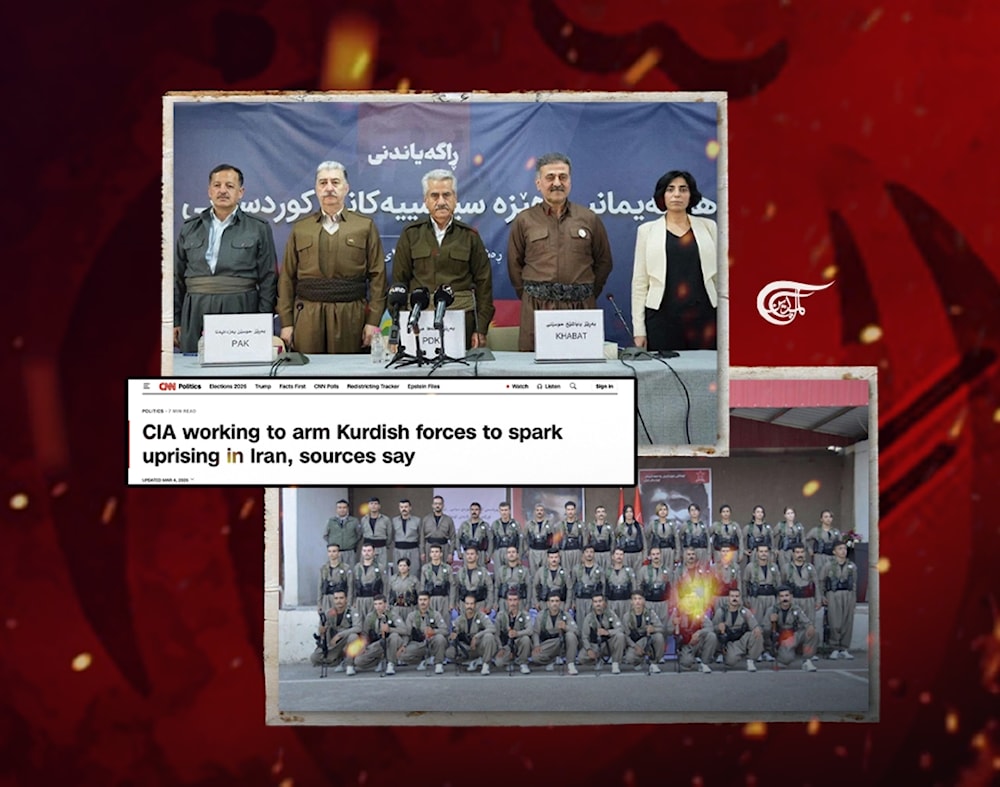
The US and Israelis appear to be willing to sacrifice all their proxies in a bid to achieve regime change, or at least inflict a significant blow, this time around. (Al Mayadeen English; Illustrated by Zeinab el-Hajj)
At the beginning of the US-Israeli War on Iran, stories were circulated about the United States attempting to use Kurdish militia groups in order to wage a ground offensive against Iran. Yet the strategy never ended up getting off the ground. Understanding the context helps explain what happened
On February 22, just prior to the joint US-Israeli war of aggression against Iran, five Kurdish-Iranian militant factions held a conference declaring a historic unity agreement had been reached. As a result the Democratic Party of Iranian Kurdistan (PDKI), Kurdistan Free Life Party (PJAK), Kurdistan Freedom Party (PAK), Khabat Organization of Iranian Kurdistan, and a branch of the Komala Party of Iranian Kurdistan came together. They declared themselves the Coalition of Political Forces of Iranian Kurdistan (CPFIK), explicitly to fight against the Islamic Republic of Iran.
For long, Tehran had argued that these groups were being backed by the Western and Israeli intelligence agencies. However, journalists also adopting this analysis were often framed as being conspiracy theorists. That was, of course, until a few days into the US-Israeli war on Iran, when it emerged that the Trump administration was openly in talks with them, encouraging an invasion of Iran's Western borders.
Then came the bombshell report from CNN, whose sources alleged that the CIA had been covertly working to arm these Kurdish-Iranian groups based in Iraq. So, at this stage, and shockingly so, there is no conspiracy to unravel as it has already been exposed.
What would such an invasion look like?
As has become evident, regime change in Iran is not going to be possible through a campaign from the air alone; the natural next step to achieving this was always going to be creating an insurgency inside the country, whilst invading from without also. In the US's alleged strategic thinking, a Kurdish invasion would ideally work to foster a wider uprising inside the country, thus creating a general environment of chaos and division.
However, bringing about such a predicament was not going to come easy. In January, the Israeli Mossad attempted to foster an armed uprising that would trigger a civil war. Iran managed to put this bloody assault down with overwhelming force in just two or three days, a conflict which cost the lives of 3,117 people, including hundreds of policemen and security force members.
Initially, this uprising sought to use paid agents from criminal groups in the West of Iran and there was some evidence that Kurdish militia groups were used to clash with the Iranian security forces, but this was quickly quelled. In fact, in 2022, when the death of Mahsa Amini triggered nationwide protests, Western intelligence agencies jumped on the opportunity to use Kurdish separatist groups, but failed to achieve their desired objectives.
In Iraq, the US, and later the Israelis, also worked alongside Kurdish forces in order to secure the control of oil resources and successfully created the semi-autonomous Iraqi-Kurdistan region, complete with its own Kurdish government. The same came in north-eastern Syria, where the US helped set up what was known as the Syrian Democratic Forces (SDF), using them to fight back ISIS and claim control of not only Syria's oil fields but the most fertile agricultural land in the country.
Unfortunately, Kurdish nationalism has always been promoted by the United States, and before it the British, dating back to the 1920's, in a way that enables them to use the Kurdish minority populations of the region to do their bidding. Although these Kurdish nationalist groups, who seek to build separatist regions in Iraq, Syria, Iran and Turkiye, proudly believe that their groups are fighting for a noble cause, they almost always end up causing more harm to the Kurdish populations and those around them.
This is not to comment on the historical or moral validity of Kurdish nationalism and their struggle for statehood, instead it is a factual assessment. Take for instance the recently dissolved Kurdish autonomous region project in north eastern Syria, what the US-backed SDF called Rojava. In 2015, the United States armed and funded them to fight against ISIS, promising them a bright future in return for their sacrifices on the battlefield.
Eventually, the Kurdish-led SDF, which ruled over a majority Arab territory, managed to seize the area of Afrin, towards the north-west of Syria. Turkiye, which views almost every Kurdish group as a terrorist organisation and/or threat, decided in 2018 to launch "Operation Olive Branch", crushing the SDF and seizing that territory for themselves, handing it over to their own proxy forces. What did the US military do to help them? You guessed it, they ran away and deserted their Kurdish allies.
In 2019, Turkiye then launched "Operation Peace Spring", seizing a strip of north-eastern Syria from the SDF and using their Al-Qaeda linked proxy forces called the "Syrian National Army" (SNA) to hold on to that land. Again, the US deserted their Kurdish allies. Despite this, the SDF crawled right back to their US backers and refused to reach an agreement with the then government of Bashar al-Assad.
When Assad was overthrown in December of 2024, there came a significant threat to many Kurdish-Syrians and more specifically the longevity of the SDF's rule in north-eastern Syria. Syria's new ruler, Ahmed al-Sharaa (formerly known as Abu Mohammed al-Jolani while he led Al-Qaeda in Syria), decided to lead an offensive against the SDF to recapture the north-eastern portion of the country and place it under Damascus's rule.
In January of 2026, after the US again deserted the Kurdish movement at the moment of truth, the SDF's rule fell, and al-Sharaa took over north-eastern Syria. Why? Well, it's very obvious: the US had only been using the Kurdish group as a proxy to withhold Syria's oil and agricultural resources from it, until the government of Bashar al-Assad was toppled. Once regime change was accomplished, al-Sharaa was invited to the White House, and his Al-Qaeda and ISIS history was ignored.
See, the US never cared about the Kurds, nor did the Israelis, because both had covertly, and in some cases overtly, supported al-Qaeda linked groups in Syria also- playing both sides.
Although tragic, history shows us that it is very likely that Kurdish militant groups are used to do the West’s bidding, with promises of securing their own interests that never materialise. Therefore, it was always safe to assume that this would be attempted again. This time, however, the chance they had of long at all was extremely slim, and the consequences of such action even threatened the collapse of the Iraqi-Kurdistan project altogether.
The Kurdish groups in Iran cannot likely inspire a general uprising inside the country, this is for a number of reasons. The Kurdish population is considerable, numbering around 10 million of Iran's 92 million strong population, yet they are not all hellbent on destroying the government, this is simply propaganda, most are normal people living their lives. These hostile Kurdish groups are based primarily in Iraq, in terms of their militant numbers, meaning that their forces inside Iran would have been overwhelmed from the jump.
Then there was the issue of the Iraq-Iran border, which had already been fortified and is where the Iranian military has deployed assets and soldiers to guard against an anticipated assault. But before they even reach the Iranian side, where they would have been greatly outnumbered, they would have to face off against Iraqi groups that are aligned with Iran. In total, these Iraqi groups - under the Popular Mobilisation Units (PMU) - constitute a force of around 250,000 fighters if fully mobilised.
In order for such an assault to succeed in creating an uprising in Iran, or inspire other armed factions from other minority groups in the country - like the Lors, Arabs or others - to begin taking action, they would need to at least see results.
Even if the Kurdish factions were to hypothetically seize some territory, Iran is such a massive country that the temporary loss of towns and villages wouldn't be such an issue. That's the best case scenario for these groups, assuming they get past the Iraqis - in addition to the Iranian Islamic Revolution Guards Corps (IRGC)'s drones and missiles - first. If anything, such an offensive would have been destined to trigger an enormous backlash against the Kurdish regional project, rather than do it any good.
As for the idea of this leading to Balkanisation, it is not something that appears to be possible in the foreseeable future. This is not to say that Tel Aviv and Washington won't try. Yet, the Iranian opposition is so incredibly divided - territorially and ideologically - that the ability for groups to work together is also scarce.
Take for example the Iranians who support Israeli puppet Reza Pahlavi. These are hardline Persian Nationalists who believe that they are a superior ethnicity to Kurdish people, Afghans, Arabs and so on. Under the rule of the deposed Shah of Iran, whose son is now worshipped in a cult-like fashion by a small but vocal minority of Iranians [especially in the diaspora], the non-Persian groups inside the country were enormously undermined and discriminated against.
In fact, under the Islamic Republic, the minorities fare much better than they have under the Pahlavi monarchs and those Shahs that came before them. Their conditions are by no means perfect, and there are often complaints that the centre of Iran is prioritised by the government, which is where the majority of ethnic Persians are situated, yet there is simply no comparison between the way they are treated under the current Islamic rule and that of the previous leaderships.
In conclusion, the options for creating a Syria-style civil war in Iran were always much lower than was being claimed by some commentators, or had been presented by pro-war think tanks in Washington. As Iran is under attack, and atrocities are being carried out against civilians on a daily basis, this has worked to make the nation's people rally behind the flag, rather than embark upon bloody sectarian revolts.
Another key factor to understand here is that the Islamic Republic is clearly holding its own against the world's top military superpower and the region's most advanced military. This in itself makes small militant groups more hesitant to take action. Having said this, the US and Israelis appear to be willing to sacrifice all their proxies in a bid to achieve regime change, or at least inflict a significant blow, this time around, so it is never an impossibility that some desperate action may still be ordered at some stage.