The fall of imperialist mythologems
-
 Alexander Tuboltsev
- 6 Apr 2026 12:03
- 3 Shares
 9 Min Read
In the case of the modern American establishment, we can observe an avalanche of such verbal distortions and simulacra designed to create a favorable image for them.
-

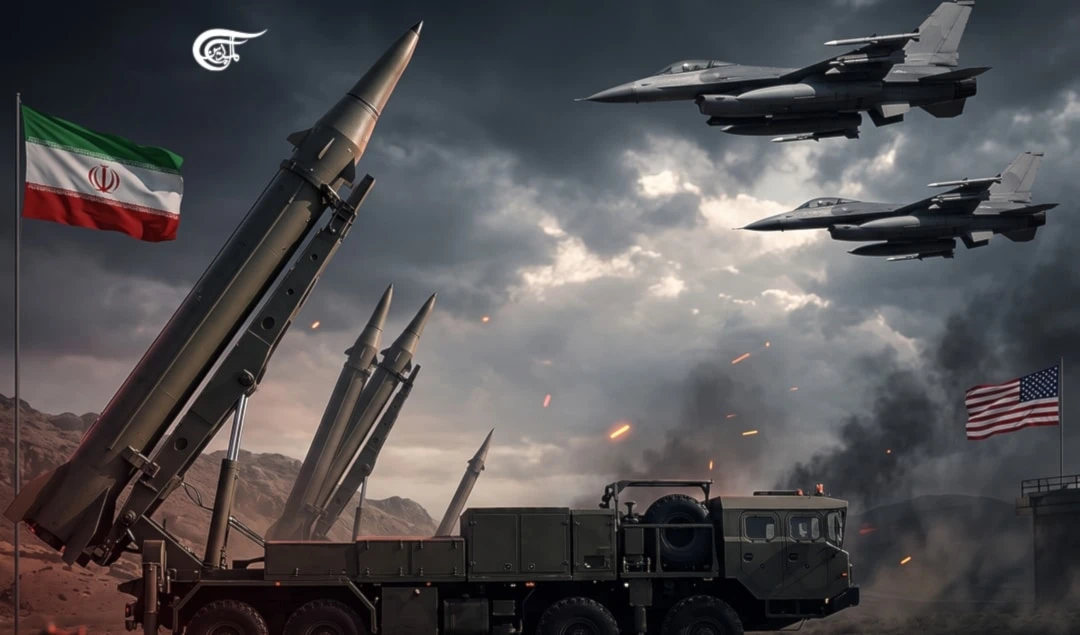
The whole overblown myth of American "invincibility" has collapsed in Western Asia (Illustrated by Batoul Chamas; Al Mayadeen English)
If you listen to Trump's recent speeches, you can once again feel the effect of a "parallel reality". Endless self-aggrandizement and attempts to use rhetoric to change prices in the oil market are mixed with outright, fantastic lies. Almost every day, Trump either announces his imaginary "successes" and "victories" or launches malicious threats. Every week, this verbal escapism becomes more irrational. The American establishment often used verbal manipulation for its own purposes, as it was in the last century and in our time. However, what we are seeing now has an important fundamental difference. Trump's current rhetoric resembles the nervousness of a stock speculator who has made a series of mistakes, lost control of the long-term consequences of his steps, and is now afraid of a total collapse of the myth of his "success". The consequence of this is so many attempts by the White House to hide its own failures and deceive the public.
It seems that the ancient philosopher Plato spoke in some detail about such rhetoric in his dialogue "The Sophist". The creation of verbal illusions, which in their essence are only a distortion of reality, has been known for a long time and is not something new. In the case of the modern American establishment, we can observe an avalanche of such verbal distortions and simulacra designed to create a favorable image for them. Of course, this political sophistry has nothing to do with the real situation. It is a fog of lies, exaggerations, and fabrications.
But what about reality? Obviously, many myths and simulacra created and inflated by the United States have been destroyed. There are many examples of this. For years, American military-industrial corporations and officials have touted the F-35 fighter jet as supposedly "invulnerable". And what is the result? Iranian anti-aircraft missiles have demonstrated a clear and effective refutation of this American myth, proving that the F-35 can be shot down.
If we delve into history, we can understand that the construction of political mythologems is one of the distinguishing features of colonial and neocolonial empires. Driven by its core only, by a thirst for seizing territories, resources, and trade routes, the empire is trying to create its own exaggerated image, thus trying to hide its weaknesses and justify its deep-seated greed with some idea.
The roots of Western imperialism can be found in the early Middle Ages, when colonial expansion was still far away, but future imperial dynasties were already forming. A distinctive feature of these dynasties was that they were inherently aggressive in nature. In other words, their very rise to power in European states was based on direct forceful seizure, and many of these dynasties established their rule over foreign territories. This is especially noticeable in the example of England. In 1066, it was conquered by the Norman Duke William, after which the old English nobility was de facto destroyed, and its place was taken by the Norman aristocracy, which gained power and vast lands in the conquered country. A similar example of a foreign dynasty on the English throne is, in fact, the Plantagenets, because the first king of this family, Henry II, was of French descent and spent his childhood in his native county of Anjou in western France. He also made several attempts to land in England with his troops, including in 1147 and in 1153.
This period has already been accompanied by phenomena that can be qualified as colonialism. The same Henry II invaded Irish and Welsh lands, seeking to expand English territories there, to seize lands, fortresses, and resources. Dynasties and state apparatus based on expansion sought constant new conquests: first, the lands of the feudal lords within the country, then invasions across the nearest borders, and eventually, this became the foundation for future colonial invasions to the most remote points of the globe, which occurred several centuries later.
Of course, not only foreign conquerors could turn into a ruling dynasty, but also local feudal clans that forcibly subjugated other feudal lords, entered into profitable coalitions, and took resources from peasants, artisans, and merchants, imposing taxes and levies on them. Wars between feudal clans took place all over Europe, and their main motive was aggressive expansion in order to seize control of land, trade routes, and settlements.
In fact, from the very beginning, future empires were based on the principles of expansionism, wars of conquest, and the suppression of large segments of the population. It was their internal logic that they carried over to the outside, spreading colonial tyranny to different continents. The ideologies of Western empires have never focused on people, but have always focused solely on power, wealth, and influence, for which the idea of endless expansion was advanced. To legitimize their actions, the imperial establishment in various states has always used myths, that is, invented or distorted interpretations of reality that were used for political purposes. If it all started with pretentious and laudatory stories about the origins of specific dynasties in order to embellish their past, this eventually led to the formation of numerous colonial mythologems, through the prism of which the entire surrounding reality was perceived.
From these mythologems emerged a Western-centric view of society, science, and history. The press and scientific communities of the colonial empires imposed their interpretation of historical events on the oppressed peoples. It was a colonial expansion in the field of education and culture, an attempt to take away their values and traditions from the peoples of Africa, Asia, and Oceania. The anti-colonial movements of the 20th century, such as the national liberation revolutions on the African continent, played a huge role in overthrowing this imposed Western-centric worldview.
The United States, which is an example of a modern neocolonial empire, is very similar to the aforementioned colonial powers of previous centuries. In their case, we see the same pattern, where the desire for aggressive expansion is combined with political mythologems. The belief in one's own "exceptionalism" and the idea of "predestined" hegemony in the United States exist alongside typical imperial arrogance.
Colonialism has transformed into neocolonialism; the form has changed, but the essence has remained the same. And as in previous centuries, the most serious blow to a hegemonic power is the collapse of its mythologems, the collapse of the image it interprets itself and which it is trying to impose on the whole world.
The whole overblown myth of American "invincibility" has collapsed in Western Asia. The whole world saw how the US Army military bases burned and how American fighter jets and helicopters were shot down. The difference between the laudatory remarks from Washington and the real situation became clearly visible. Historical events are taking place before our eyes. Iran defends its sovereignty, applies a sound strategy, and delivers such powerful retaliatory strikes against the aggressors that the whole logic of the fighting has changed.
The American establishment is nervous, which is evident from Trump's behavior and antics. They did not expect such a scenario.
Iran has demonstrated in practice the best features that can serve as a model for the entire Global South: consistent anti-imperialism, anti-hegemonism, and a willingness to defend its freedom and independence. We are witnessing a revolutionary act on a global scale, when the Resistance is fighting against hegemonic tyranny, against the vicious neo-colonialist system.
The outstanding Iranian philosopher and scholar, Martyr Ayatollah Morteza Motahari, in his writings pointed to historical examples when the peoples of different countries showed unity in the pursuit of justice and truth, supported the liberation struggle of Palestine against Zionism, Algeria against French colonialism, and Vietnam against American imperialism. Clearly seeing the egregious examples of injustice and tyranny, many people around the world empathized with the oppressed and spoke out against the oppressors.
That is, in the beginning, there was an event of a revolutionary scale, which was fundamentally based on the ideals of justice and righteous struggle. After learning about this event, many people, regardless of their language, culture, or geographical place of residence, empathized with these ideals and found in them an expression of their deep commitment to stand up against all oppression. The determined struggle against the oppressors showed examples of the weakness of empires and their narratives. It can be said that the natural desire of the individual for justice was thus cleansed of the illusions and lies of imperialist mythologems.
The Resistance conducts effective operations that destroy imperialist lies and information hegemony. It is appropriate to recall such a well-known natural phenomenon as the mirage, which is often found in deserts. I saw a mirage several times when I visited the Sahara Desert in North Africa, and this phenomenon seemed quite realistic to me at first. However, when the mirage disappeared, it became clear that it was nothing more than a trick of vision, although from a distance it could resemble an oasis. The United States, using its media and official rhetoric, has been creating a similar information mirage for decades, spreading its imperial narratives and mythologems.
However, the reality is not a Hollywood movie in which the United States can write a profitable script on its own. The wreckage of American fighter jets now looks more eloquent than any rhetorical device. Imperial illusions are crumbling live, in front of the eyes of the whole world, and heroic Resistance helps to awaken the truth.