Hegemonism, expansion, and the right to resist
-
 Alexander Tuboltsev
- 27 Jan 2026 19:53
- 3 Shares
 10 Min Read
The US expansionist plans and its maniacal desire to redraw the world map pose a threat to all free and sovereign States, with the only guarantee of sovereignty protection being resolute resistance to this expansion.
-
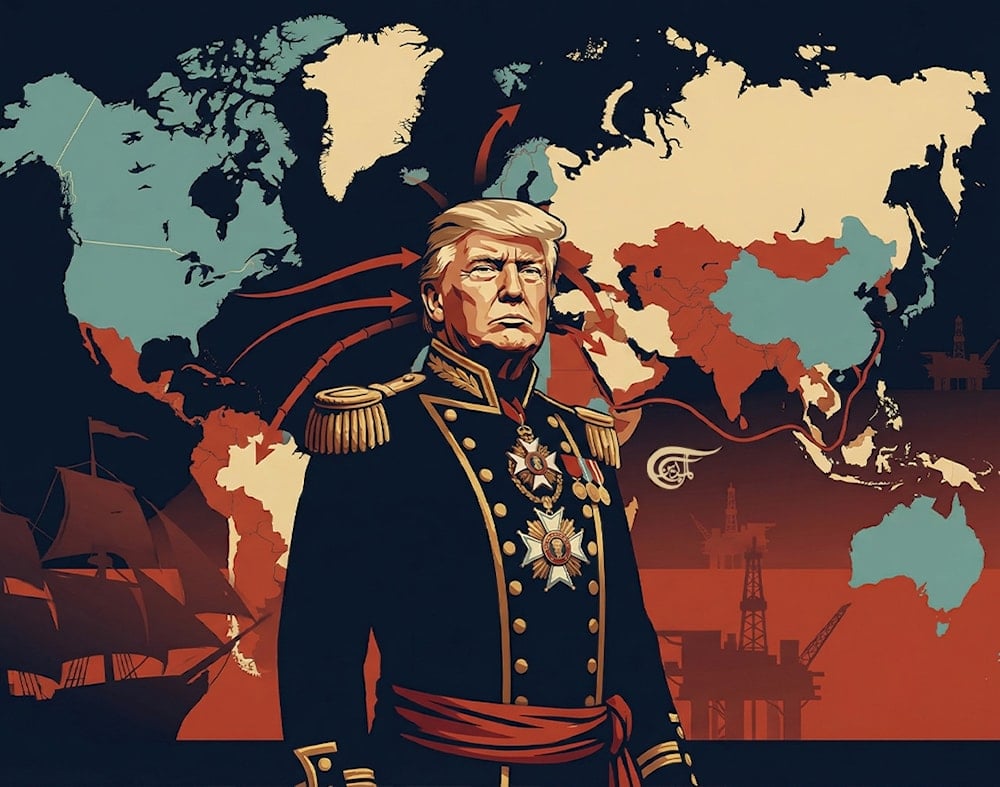
Empires don’t expand because they’re strong—they expand because they’re weakening (Illustrated by Zeinab al-Hajj; Al Mayadeen English)
Being in the stage of crisis and approaching decline, hegemonic powers throughout history have often fallen into a phase of sharp escalation of their aggressive expansion. In my opinion, one of the most illustrative examples of this is the Spanish Empire in the second half of the 17th century. The decrepit colonial empire was experiencing enormous problems in the fields of economy, state budget, industry, and administrative management. At the same time, the country was actively involved in new conflicts and pursued territorial expansion. It was at the end of the 17th century that the Spanish empire violently colonized the Mariana Islands (including Guam), provoked a naval war with Brandenburg in the North Sea, continued to seize territories in Central America (north of modern Guatemala), and participated in the conflict with France.
How did this sharp outbreak of expansion end? The result was a decline. Faced with the debt crisis, inflation, low industrial development, and huge military expenditures, Spain lost its status as a hegemonic power.
Consider the following historical example - Denmark. In the second half of the 18th century, this country dramatically expanded its foreign reach, establishing colonies on the Nicobar Islands (in addition, Denmark also had colonies on the coast of the Gulf of Guinea and the Virgin Islands). However, the outbreak of expansion was followed by a recession. The end of the Danish-Norwegian Union following the Treaty of Kiel in 1814, problems with the state budget, and rising inflation gradually led to the collapse of Danish colonial ambitions. As a result, by the middle of the 19th century, most of the Danish colonies in Africa and Asia were sold, coming under British control.
If we look at even more ancient examples, then-Sparta comes to mind, which for 33 years was the hegemon among the rest of the ancient Greek polis. During this period of time, Sparta conducted a very active expansion (including numerous military campaigns) and possessed the largest military force in Greece. However, the peak of power inevitably turned into a decline: Sparta faced demographic problems, a hostile coalition, and internal instability. As a result, Sparta first lost its hegemony after being defeated by the Boeotian League, and 40 years later, the Spartans suffered a catastrophic defeat from Macedonia at the Battle of Megalopolis.
Faced with the crisis and the beginning of decline, the hegemon expands its external control and aggressive activities. In an economic sense, this means trying to seize new resources and territories in order to prevent its inevitable collapse. In a political sense, this means an attempt to redirect their declining capabilities and forces outward in order to solve their growing internal problems through external expansion. Examples of this are very common throughout the long history of mankind. And, as a rule, such outbreaks of expansion only accelerate the fall of empires.
Through the prism of such historical examples, we see the image (or even the archetype) of a weakening hegemon. The image of an empire suffering from internal problems, which is trying to create chaos from the outside in order to prevent its own internal disintegration, collapse, and decline. The highest ruling circles of the hegemon state evoke existential horror at the very thought of losing their status as empire and hegemon. As we know, hegemonic ambitions stem from destructive notions of one's own "exclusivity". The political, military, and financial elites of the hegemon state consider themselves the highest stratum in the global social system, subconsciously opposing themselves to the whole world. They see the surrounding reality through the prism of their unipolar vision and consider themselves entitled to dominate other countries and even entire civilizations. That is why they are terribly afraid of losing their "status", their "power", their hegemonic control, because in the event of collapse, their whole false idea of their own "exclusivity" will disappear like a mirage in the desert.
We see the same fear in the example of the modern political, military, and financial elites of the United States, who are afraid of losing their hegemonic control. They try to hide this fear behind pretentious statements, aggressive actions, and expansionist plans. They feel that they are weakening. They see how society within the United States itself is becoming increasingly polarized and divided by political views and party affiliation. They see that new problems are gradually emerging in the American economy, from rising consumer prices and inflation to the budget deficit. Right before their eyes, the world is changing, and the political and economic rise of the Global South is taking place, which marks the end of the Western unipolar dictatorship.
As in the above-mentioned historical examples, in this case, we can observe a similar situation: the hegemonic system, faced with its own crisis and the beginning of a recession, acts more aggressively and tries to expand its influence. Fearing his own weakening, the hegemon is trying to provoke chaos and new conflicts outside. This explains the fact that many historical empires entered into costly conflicts during the crisis years, which further undermined their strength and depleted their resources.
On January 3, 2026, the United States committed an act of aggression when American troops attacked the sovereign Bolivarian Republic of Venezuela. President Nicolas Maduro was illegally abducted, and these actions by the United States are a crime. As you know, kidnapping is classified as a serious crime in the criminal codes of the whole world. In this case, we see a criminal act committed on the direct orders of the military and political leadership of the United States.
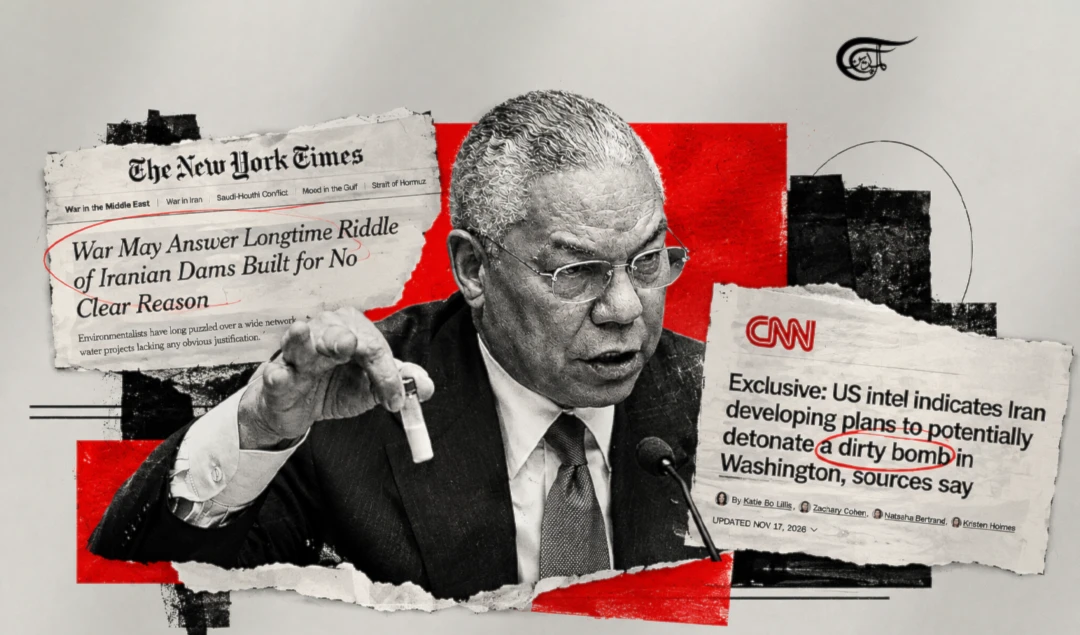
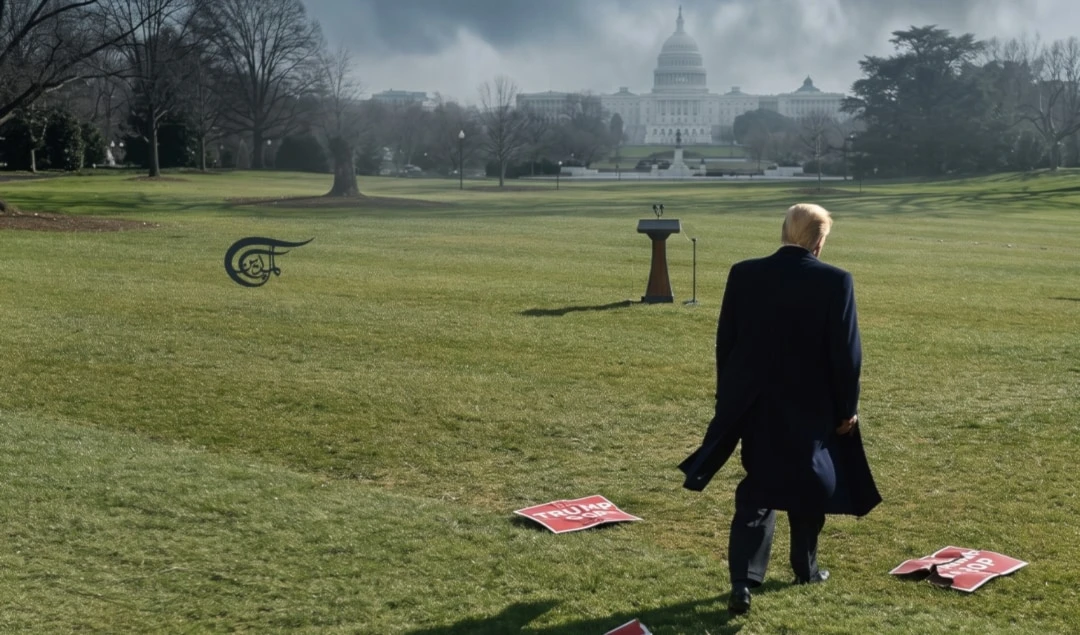
The whole world has once again seen the bloodthirsty grin of American imperialism. The current US administration is no longer hiding behind fig leaves called "democracy", "freedom", and other terms that previous American presidents were so fond of using to disguise their aggressive actions. Now they are directly talking about the "right of force" and control over other people's natural resources, brazenly threatening the leaders of sovereign states. The extreme and grotesque narcissism in the offices of the White House is turning into an expansionist and neocolonial attempt to redraw the entire map of the globe.
In the last century alone, countries such as Vietnam, Grenada, Haiti, Guatemala, Nicaragua, Laos, the Dominican Republic, Libya, Somalia, Panama, Yugoslavia, and many others have suffered from attacks and interventions by American imperialism. Throughout the 20th and 21st centuries, American aggression claimed the lives of millions of people and crippled the destinies of tens of millions. American corporations have extracted and continue to extract resources (from gold to oil, from gas to diamonds) on the territories of dozens of countries, exploiting their bowels. These are well-known facts, and everyone who thinks about world history and is at least minimally interested in it knows them.
At the moment, the entire former architecture of international security has been almost completely destroyed. This did not happen overnight; the erosion of the system of interstate interaction and relations continued for years. In this difficult and conflictual time, at the turning of an epoch, a new multipolar world order is being born, which will bring with it a new system of international relations. But so far, a kind of transition is taking place: the old system of international relations has been destroyed, and a new one is only being formed.
Against this background, the hegemon weakens, falls into a stage of crisis, and becomes more aggressive, anticipating its inevitable decline. The hegemonic power is urgently trying to increase its expansion, fearing the final collapse of its unipolar dictatorship. The emergence of a new multipolar world greatly frightens the American military, political, and financial elite.
The pompous and arrogant speeches coming from Washington are a reflection of the aggressive intentions of the United States, verbal phantoms of their dreams of an undivided world domination. There is a noticeable emphasis in this rhetoric on three areas that the American administration is targeting in its expansion.
The first direction is Latin America and the Caribbean. The American aggression against sovereign Venezuela, the threats of Trump and Rubio against Colombia and Cuba, indicate that this geographical region is under direct attack by imperialism. In an attempt to revive the Monroe Doctrine, Trump dreams of controlling the rich mineral reserves in Latin America and the shipping lanes in the Caribbean and the Pacific. This is an example of barbaric neocolonialism, when the entire hemisphere becomes the object of claims.
The second direction is West Asia. It is this geographical region that is the center of Resistance, which is waging a stubborn struggle against American and Israeli aggression. Gaza, Lebanon, Iran, and Yemen are examples of courage and patriotism, a truly revolutionary spirit forged in battles against arrogant imperialists and Zionists. For many years, Western Asia, with its vast natural resources and important shipping lanes (the Mediterranean Sea, the Red Sea, and the Bab al-Mandab Strait), has been subject to American expansion. The United States and the bloodthirsty Netanyahu regime continue to plan new aggressive actions.
The third direction is the Arctic Ocean. Trump's frequent mentions of Greenland can be considered a fantasy and a verbal phantom, but there is a noticeable fixation on the northern direction in this rhetoric. The United States views the Arctic Ocean and its surrounding regions as a space for its neocolonial expansion. An important sea route for Eurasia passes through the cold northern waters, and huge reserves of oil and natural gas are concentrated on the continental shelf.
The expansionist plans of the United States and its maniacal desire to redraw the world map pose a threat to all free and sovereign States. The only guarantee of sovereignty protection is resolute resistance to this expansion. Ignoring international law, the United States relies only on the "right of force." Therefore, dialogue with them is possible only in the language of force, responding to their blow or acting preemptively.
A striking and truly heroic example is the Yemeni Resistance, which defended its people and its country from the attack of American imperialism. Yemeni missiles and drones have shown the world how to effectively deal with the American Navy. It was an act of national liberation struggle, when the Yemeni people used their right to resist by force and valiantly repelled the enemy's attack.
Since the neocolonial empire considers force to be the only law of international relations, the right to resist by force becomes a moral duty and imperative of sovereign states, for which Western expansion is a threat. This is not just the right to self-defense, but also the right to wage a just liberation struggle against American imperialism and to take preventive actions aimed at protecting sovereignty and security from the threat of imperialism.