The monopoly of arms: Why the doctrine is enforced only where resistance exists
-
 Sondoss Al Asaad
- 15 Jul 2026 14:40
- 1 Shares
 6 Min Read
Examining the selective application of the "state monopoly on arms" doctrine through Lebanon, international law, sovereignty, and the politics of resistance.
-
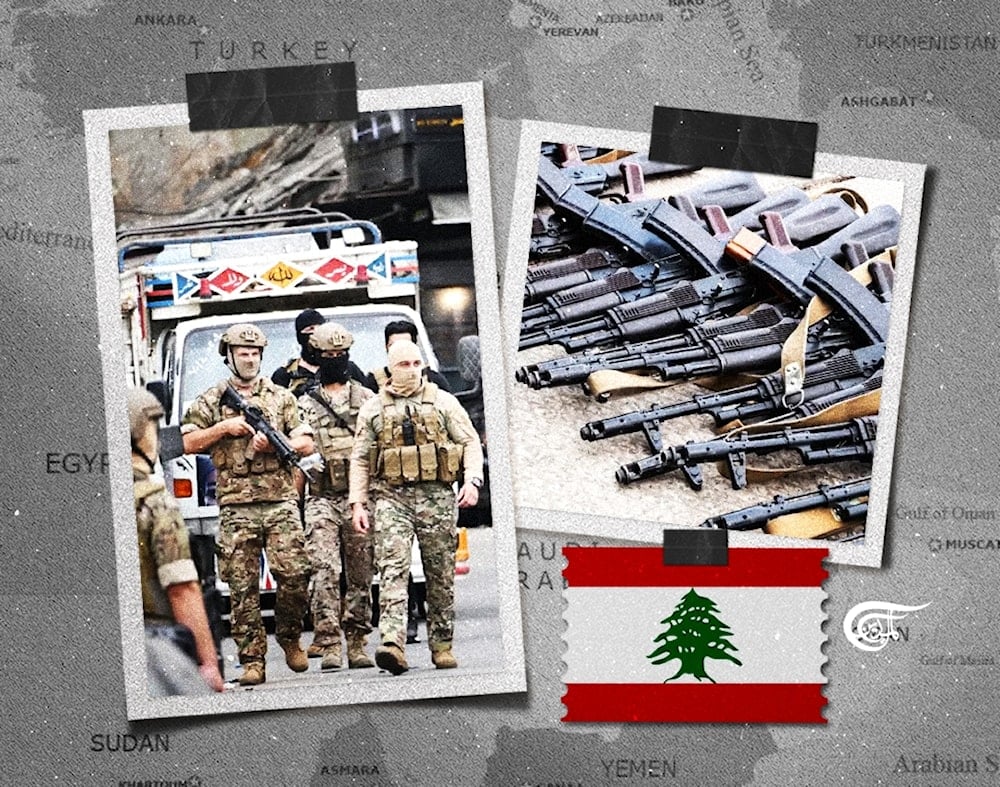
A closer geopolitical examination reveals that the principle of restricting arms to the state is enforced selectively. (Illustrated by: Al Mayadeen English/Ali al-Hadi Chmeiss)
For decades, the slogan of “restricting arms to the state” has been presented as a universal principle of sovereignty and state-building. Yet a closer geopolitical examination reveals a striking inconsistency: the doctrine is aggressively promoted in countries like Lebanon and Iraq, while it is largely absent from discussions in surrounding countries such as Syria, Libya, or other fragmented states where multiple armed actors continue to exist.
This selective application raises an uncomfortable question: Is the objective truly the consolidation of state authority, or is the slogan primarily employed where armed movements challenge Israeli military superiority and American hegemony?
Political philosopher Carl Schmitt argues that sovereignty ultimately belongs to whoever decides the exception.
Modern geopolitical practice appears to confirm his observation. The international order invokes legal principles selectively, depending on whether they reinforce or undermine prevailing strategic interests. The debate over arms, therefore, is not merely legal; it is profoundly political.
The Lebanese case illustrates this contradiction with exceptional clarity.
Following the November 2024 ceasefire, "Hezbollah withdrew from the north of the Litani River and ‘accepted’ that decisions regarding war and peace would rest exclusively with the Lebanese state and its armed forces". The expectation promoted by Western capitals was that this would allegedly strengthen Lebanese sovereignty and reduce tensions.
The reality unfolded differently; the Israeli enemy, unable to establish a lasting foothold inside southern Lebanese villages during sixty-six days of warfare, achieved after the ceasefire what military operations had failed to accomplish. It maintained positions inside Lebanese territory, continued near-daily airstrikes across Lebanon, and expanded targeted assassinations while facing little meaningful deterrence.
The sequence of events inevitably fuelled a renewed domestic debate. If sovereignty means that only the state possesses weapons, what happens when the state itself lacks the capacity to prevent violations of its own borders?
This dilemma reflects what Thomas Hobbes identified centuries ago as the fundamental purpose of political authority: providing security.
The legitimacy of the state rests not merely on possessing legal authority but on its ability to protect those living under its jurisdiction. When that capacity weakens, alternative security arrangements inevitably emerge.
The issue extends beyond Lebanon; In Iraq, international pressure consistently emphasizes integrating or dismantling armed resistance groups under the banner of state monopoly over force. Yet comparable urgency is rarely directed toward states where numerous militias continue to operate without challenging Israeli strategic dominance.
Syria offers another revealing comparison. Multiple foreign militaries, including American, Turkish, and Israeli forces, remain active on Syrian territory alongside various local armed factions.
Libya remains fragmented among competing military authorities and militias. Yet the international discourse seldom revolves around an immediate imperative to monopolize arms before broader political settlements are achieved.
Such inconsistencies have led many observers to conclude that the slogan itself is not universally applied but strategically deployed.
French philosopher Michel Foucault argued that power operates through discourse by defining what becomes accepted as common sense.
The phrase “arms outside the state” has increasingly become one such discourse. It transforms a complex security equation into a simplified legal formula while avoiding a more difficult question: Can sovereignty exist when a state cannot defend its territory?
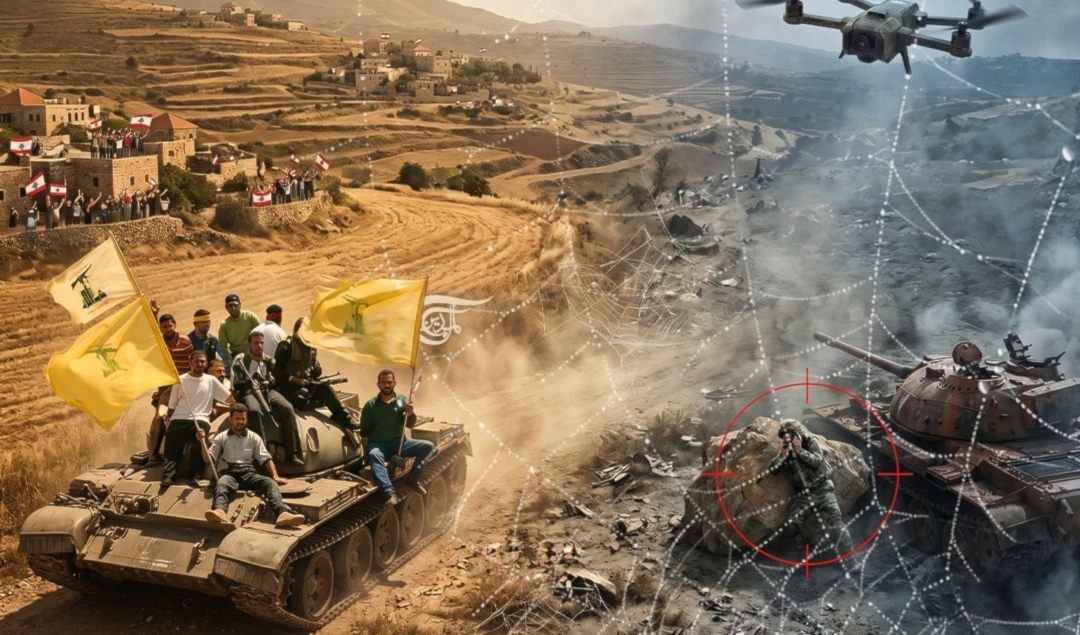

International law offers an additional dimension often overlooked in contemporary debates.
Article 51 of the United Nations Charter explicitly recognizes the inherent right of self-defense. Moreover, international legal development has long acknowledged the legitimacy of people resisting foreign occupation and exercising the right to self-determination.
Throughout the twentieth century, numerous UN General Assembly resolutions affirmed that people under colonial domination or foreign occupation possess the right to resist.
History reinforces this principle. European resistance movements during the Second World War relied heavily on external military assistance supplied by Allied powers.
The Algerian National Liberation Front received support from neighbouring states during its struggle against French colonial rule. Anti-apartheid forces in South Africa likewise benefited from foreign assistance. None of these historical experiences suggested that receiving external weapons automatically delegitimized the right of resistance.
From this perspective, the recurring accusation that any resistance movement backed by Iran, or by any external actor, is inherently illegitimate becomes difficult to reconcile with broader historical precedent.
The decisive legal question is not who supplies the weapons, but whether the people concerned retain the internationally recognized right to resist occupation. This distinction frequently disappears within contemporary political discourse.
Geopolitical theorist Antonio Gramsci has further observed that dominant powers seek hegemony not only through military superiority but by shaping the language through which political reality is understood.
In today’s West Asia, the concept of “state monopoly on arms” increasingly functions as such a hegemonic narrative. It frames disarmament as an unquestionable prerequisite for sovereignty while rarely addressing whether sovereignty can survive under continuous foreign military pressure.
Lebanon’s post-ceasefire experience illustrates this paradox; The government formally became the exclusive authority over decisions of war and peace. Yet Israeli military operations continued largely uninterrupted.
Diplomatic complaints multiplied. International mediation produced few tangible results. UNIFIL proved unable to halt violations, while the Lebanese Armed Forces, despite their professionalism, continued to face longstanding structural limitations in confronting one of the region’s most powerful militaries.
The contradiction is therefore evident. Legal monopoly over force did not automatically produce effective sovereignty. Instead, sovereignty remained constrained by an unfavourable regional balance of power.
This reality explains why the debate surrounding Hezbollah’s weapons remains fundamentally different from ordinary discussions of state-building. It is not simply an internal constitutional issue but a reflection of competing strategic visions for West Asia itself.
One vision argues that sovereignty begins with disarmament and exclusive state control over force. The opposing perspective maintains that sovereignty cannot exist where occupation, repeated violations, and military coercion persist unchecked.
Under such conditions, resistance becomes not the negation of statehood but a response to the state’s inability to fulfil its primary obligation of national defence.
Ultimately, the controversy surrounding “arms in the hands of the state” reveals less about constitutional theory than about geopolitical priorities.
If the principle were genuinely universal, it would be applied consistently across all fractured states regardless of political alignment. Its selective enforcement suggests that the issue is not simply weapons themselves, but which weapons threaten the existing regional balance.
As long as military occupation, cross-border violations, and unequal deterrence remain defining features of the regional order, debates over disarmament will continue to be viewed not merely as questions of domestic governance but as part of a broader struggle over who possesses the right, and the power, to shape the political future of West Asia.