
Carbon offset schemes and Africa: An opportunity or new frontier for exploitation?
-
 Cyril Zenda
- 19 Jan 2026 15:49
 10 Min Read
Desperate for ways to fund its ballooning climate bill, Africa is being palmed off toward carbon offset schemes as a revenue stream, but questions are being asked if this presents an opportunity for the continent’s development, or for its exploitation.
-
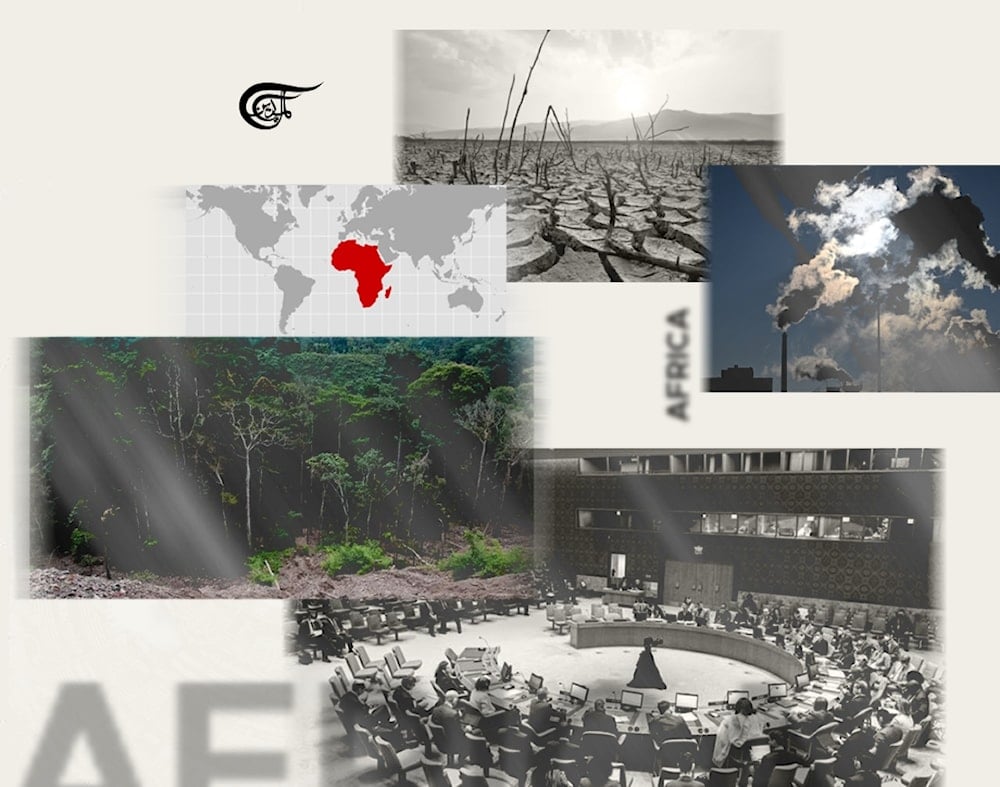
Africa faces climate chaos while the West profits from carbon offsets (Illustrated by Batoul Chamas; Al Mayadeen English)
At just three percent, Africa’s contribution to greenhouse gas (GHG) emissions, which are responsible for rising global temperatures, is the least. Yet the 54-nation continent of Africa suffers disproportionately from the effects of climate change.
According to the African Development Bank, the annual loss and damage costs due to climate change in its region are between $289.2 billion and $440.5 billion. More than 800 million people on the African continent are classed as food insecure due to climate change.
Other estimates of Africa’s climate financing needs say between $143 billion (equivalent to 7% of the continent’s GDP) and $194 billion is required annually to keep it on a climate-resilient development path.
Because of these realities, at past Conference of the Parties (COP) to the UN Framework Convention on Climate Change (UNFCCC) meetings, the continent has fought and won promises for some form of compensation under global climate funding initiatives, such as the Loss and Damage fund for its climate adaptation and mitigation efforts. However, winning the case for compensation is one thing, and receiving the actual compensation is another altogether. It is this compensation that should be coming from big emitters in the Global North that has proved to be elusive for the continent that is increasingly getting desperate to fund its ballooning climate bill.
Africa urged toward carbon offsets
With the big emitters in the West dodging their responsibility, African countries desperate to finance their adaptation and mitigation efforts are increasingly being pointed toward REDD+ projects, such as carbon offset markets, as a sure source of climate funding, as the continent is endowed with vast carbon sinks which are now increasingly being monetized.
‘REDD’ stands for ‘Reducing emissions from deforestation and forest degradation in developing countries. The ‘+’ stands for additional forest-related activities that protect the climate, namely, sustainable management of forests and the conservation and enhancement of forest carbon stocks. Under the framework of these REDD+ activities, developing countries can receive results-based payments for emission reductions when they reduce deforestation.
Carbon offset schemes work by creating projects that either reduce emissions of carbon or capture it from the air. These bypassed emissions can be turned into internationally tradable carbon credits.
Through the African Carbon Market Initiative (ACMI), which was launched during the COP27 climate summit of 2022, several African countries – particularly those endowed with forests – have embraced these nature-based schemes on the basis of calculations that they stand to generate $6 billion in revenue by 2030 and $120 billion by 2050. These countries include Kenya, Malawi, Gabon, Nigeria, Zimbabwe, Zambia, and Togo, among others. They hope that demand for carbon credits from their REDD+ projects will increase as global firms with net-zero targets purchase them to cancel out emissions. But so far, there has been no joy for them.
Despite the raging controversies around them, carbon offsets were part of the ‘solutions’ that were actively pushed at the recent COP30 summit held in Brazil. However, analysts are warning that from these thoroughly discredited schemes, it is becoming increasingly obvious that Western multinationals are not coming to Africa to find a climate solution, but to profit from the climate crisis.
The schemes are being actively marketed to African governments as a viable source of climate financing, even when the continent is getting little or no benefits at all from existing projects.
‘At best greenwishing, at worst greenwashing’
Isa Mulder, a global carbon markets expert at Carbon Market Watch (CMW), says that with carbon markets under Article 6 of the Paris Agreement taking off, more and more countries globally are finding their way to carbon markets, either as sellers or buyers of credits. She says countries and communities in the Global South that have historically not been very active under the Clean Development Mechanism of the Kyoto Protocol, the predecessor to Article 6 carbon markets, or on the voluntary carbon market, are entering this space in the hope of securing some financing for their mitigation efforts.


But according to CMW, the voluntary carbon market (VCM) is an unregulated space that, when used for offsetting, provides fertile ground for companies to exaggerate claims that are at best greenwishing and at worst greenwashing. The watchdog says rather than weigh claims against the structural transformations required to meet the Paris Agreement’s 1.5°C temperature boundary, the VCM is a hotbed of net-zero promises without the pain of cutting off the excess.
“On the potential for carbon credits to deliver climate finance to the Global South, history offers a sobering lesson,” Mulder said. “If we look at what carbon markets have delivered to date, evidence suggests that these systems frequently fail to deliver promised benefits to developing nations and can even exacerbate existing inequalities. This is compounded by the opaqueness of the market, where intermediaries, such as traders and brokers, can hike up the price of a credit to such an extent that the amount received by the project developer or community at the project site is only a fraction of the price paid by the end buyer.”
A typical example is the now thoroughly discredited Kariba REDD project in Zimbabwe. Before it was exposed for the fraud that it was, of the about 27 million carbon credits (worth at least $100 million) that were sold by Swiss firm South Pole, most of them were priced for as little as half a Euro each at the start of the chain where the share of the country’s peasant communities is calculated, only for each of these credits to be sold for as much as 20 Euro to global brands, making the project almost entirely for the benefit of Western fortune hunters.
This is repeated across the continent and other parts of the Global South, along with other serious social injustices such as land grabs, rights violations, and the growing financialization of indigenous territories.
‘Carbon offsets are a greenwash scam’
Fiore Longo, the Senior Research and Advocacy officer at Survival International, the global movement for tribal peoples, told Al Mayadeen English that these carbon schemes are built on the fundamental lie that continued fossil fuel emissions in the Global North can be “offset” by protecting forests or soils elsewhere.
“The short answer is that so-called “nature-based solutions” and carbon credits are not a credible solution to either the climate crisis or to the chronic lack of climate finance for African countries and local communities,” said Longo, whose organization has embarked on a campaign dubbed Blood Carbon.
“They allow corporations and governments to carry on polluting while claiming climate action, instead of cutting emissions at source. This is why carbon markets do not address the root causes of the climate crisis — they actively delay the transition away from fossil fuels. In our view, carbon offsets are a greenwash scam.”
Longo said the other leg of the scam is that communities are usually promised income or “benefits”, but in reality, they receive little or nothing, while project developers, consultants, conservation NGOs, and carbon traders capture the profits.
She added that from the perspective of indigenous peoples and local communities, carbon offset projects have repeatedly proven to be harmful.
“Under the banner of climate action, they often lead to new forms of land control, restrictions on livelihoods, surveillance, and criminalization,” she said, adding that many of these projects are imposed without free, prior, and informed consent, and some amount to outright land grabs.
‘An economic goldmine’
“From the research work SOMO has done on carbon offsetting, our concerns are that it is being marketed heavily, and particularly in Africa in the last few years,” Audrey Gaughran, the executive director of the Amsterdam-based Centre for Research on Multination Corporations (SOMO) – a global public good organization – told Al Mayadeen English. “Companies are seeing it as a profitable business, so they are selling the idea hard to governments. That alone is a reason for caution,” she said.
She pointed out that offsetting has been highly controversial in some Global South countries, where indigenous peoples and marginalized communities have lost their land and/or seen their livelihoods made all but illegal so a multinational carbon trading company can make money. She said there are increasing reports of human rights abuses around offsetting plantations controlled by companies.
“In our view, companies are seeking an economic goldmine (for themselves, not the affected communities nor the countries where they are investing). Carbon offsetting is an industry; it is not primarily about conservation. It is about extracting wealth from the environment. The industry produces a product which is then sold, usually to Western multinational companies, so they can go on emitting carbon, but still claim to be moving to net zero. This product - carbon credits or offsets - is increasingly discredited as a means for companies to address climate change.”
‘Carbon colonialism’
It is because of this uneven distribution of benefits that the ‘solution’ is being dismissed as a new form of colonization of the African continent by the West.
“In this context, carbon markets represent a new form of green colonialism,” Longo said. “Land in Africa and other parts of the Global South is once again being stolen from them so that wealthy countries and corporations can meet climate targets on paper while continuing business as usual. Pushing carbon credits as an alternative to the climate finance promised at COPs shifts responsibility away from those most responsible for the crisis and onto those who have contributed least: Indigenous and local people.”
SOMO’s Gaughran concurred, “Perhaps more insidiously, many of the carbon offset projects seek to frame climate change as caused by the actions of marginalized communities in the Global South who do harmful things like use wood and graze livestock. By preventing the ‘culprits’ from doing so, sometimes framing their livelihood strategies as criminal, massive multinationals can buy carbon credits to claim they are doing their bit for the climate. It makes for a successful business, but it also perpetuates a form of neo-colonial economic oppression.”


