Pashinyan loses Artsakh – and shot at EU membership
-
 Maram Susli
- 5 Dec 2025 11:37
- 4 Shares
 5 Min Read
Maram Susli shows how Nikol Pashinyan’s collapsing popularity, clashes with the Church, alienation of the diaspora, and failures in Artsakh and EU integration have pushed Armenia toward a political rupture ahead of next year’s elections. His pro-European project now stands on the brink of total collapse.
-
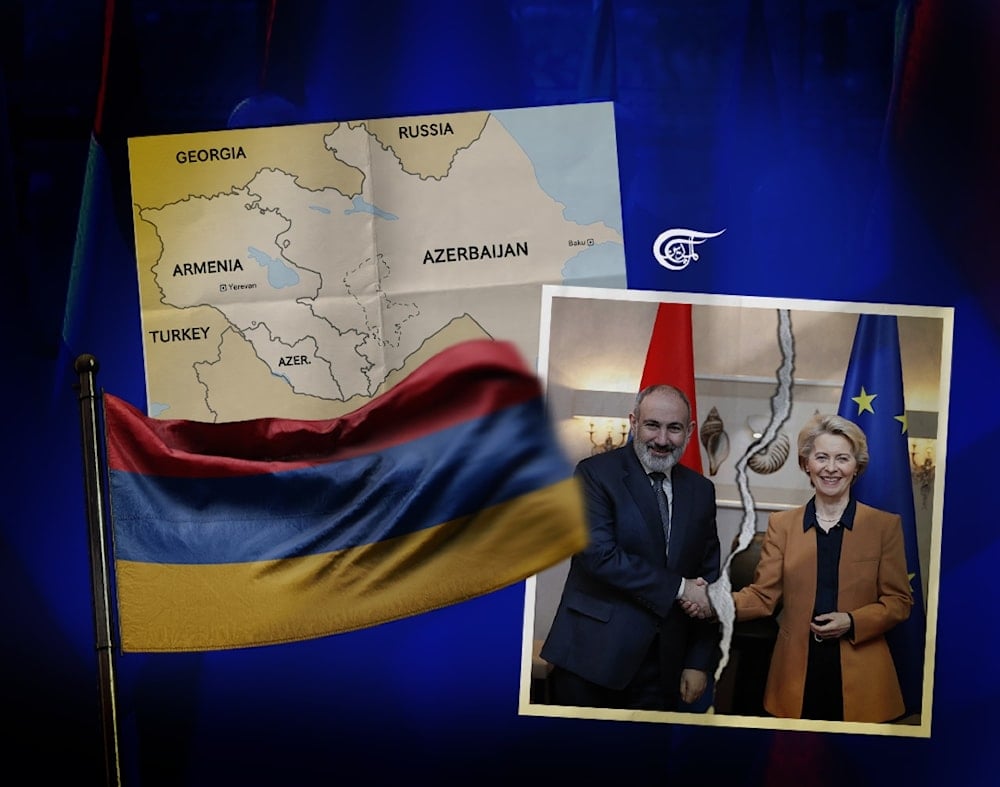
Both Pashinyan and Civil Contract command not a quarter but only a sixth of the electorate. (Al Mayaden English; Illustrated by Zeinab el-Hajj)
Armenia faces parliamentary elections next year that will install a new leader – current Prime Minister Nikol Pashinyan shows every sign of losing power. Lebanon, home to one of the world's largest Armenian diasporas, will inevitably join the fray.
Government ratings plunge
Next June, the pro-European bloc led by Prime Minister Nikol Pashinyan will attempt to hold onto power. The situation is striking: the ruling Civil Contract party’s current polling offers no realistic path to victory. Yet Armenia’s political landscape and electoral system allowed Pashinyan’s party to win the 2021 elections and secure most parliamentary seats despite receiving support from less than a quarter of the population and despite significant political failures.
Now everything grows far tougher: both Pashinyan and Civil Contract command not a quarter but only a sixth of the electorate. Optimistic Gallup polls in September 2025 gave the ruling party just 17.3% of voters. Pashinyan's own popularity never topped 13%, and 49% of citizens believe the country is “moving in the wrong direction.”
Rule-free pre-election fight
Armenian civil society worries most about the upcoming election campaign’s honesty. Current developments are alarming observers and angering the opposition, while Pashinyan’s traditional European allies remain silent.
The rules are already being bent at the municipal level. Five opposition members endured searches and arrests right after elections in Vagharshapat city showed 38% in their favor, and authorities instantly accused them of bribing voters. Although they are not state employees, the Anti-Corruption Committee is pursuing the case and presenting it as part of its anti-corruption work. Opposition figures deny the allegations.
Victory bloc leader Sevak Khachatryan, whose members faced persecution, feels authorities will unleash even harsher tactics. "Imagine what would've happened if we had won? I think our whole team would already sit in prison."

The pro-European Carnegie Research Institute states the Armenian diaspora also views the current government negatively, arguing that Nikol Pashinyan cannot win re-election without support from the EU and the United States.
Pashinyan’s relationship with the diaspora has become strained. He has met expatriate communities in France, Switzerland, Turkey, and Kazakhstan, and Lebanon will also play a role in his campaign. Yet he has criticized Armenians abroad who demand the return of ancestral lands, saying: “Someone in Australia wants their grandfather’s homeland? Let them reclaim it. What does that have to do with the Republic of Armenia?” He has also condemned those who do not consider Armenia their homeland, remarking: “I was shocked when a diaspora Armenian called Lebanon or Beirut his homeland.”
State versus Church
Nikol Pashinyan has clashed not only with political opponents but also with the Armenian Apostolic Church. There have been reports that Pashinyan hired US PR firm Mercury to run smear campaigns against the Church. In recent months, authorities have arrested several high-ranking clergy, and even some of their relatives have faced pressure. The brother of Catholicos of All Armenians Garegin II has come under investigation, accused of “obstructing pre-election agitation.”
The opposition has attempted to open a case against Pashinyan himself. Journalists and human rights advocates submitted a statement to the prosecutor, claiming, “Armenian authorities, in gross violation of the constitution and laws, undermine the self-governance of the national religious organization and its property rights. By abusing their powers, they interfere in the organization’s work and violate the inviolability of privacy and family life.”
Religion fuels Pashinyan's thorniest issue: Azerbaijan ties. Turkish-Israeli ally Azerbaijan crushed Armenia's 30-year Nagorno-Karabakh fight in weeks; Pashinyan pulled troops out, forcing hundreds of thousands of ethnic Armenians to flee. Baku pressed on, claiming lands claimed by Armenians as historically part of their homeland as Azerbaijani, branding ancient churches "fake Armenian heritage," and urging Azeris to reclaim "their soil."
Pashinyan stayed silent, fanning public fury.
Pashinyan's failure spells end of Euro-integration
Despite the determination of Armenia’s pro-European forces, the country’s progress toward European integration has produced no visible results. After 10 years of the Civil Contract party’s existence and seven years under Nikol Pashinyan’s leadership, Armenia still lacks even EU candidate status, something already achieved by Serbia, Montenegro, Bosnia, North Macedonia, Albania, Moldova, Ukraine, and even neighbouring Georgia.
The European Union offered only token aid: €10 million in 2024 for Armenia's military – barely enough for one outdated Leopard tank.
Armenia also faces geographic hurdles in fitting into Europe's community. It is squeezed to the west and east between Turkey – whose geopolitics now sharply clash with EU foreign policy – and its ally Azerbaijan.
To the north and south lie the Russia-friendly Iran and Georgia, and the latter's rulers have already ditched European integration. EU authorities clearly won't dive into South Caucasus conflicts or start new clashes, not just with Russia but with Turkey too.
Pashinyan can’t hold power domestically without support from either the diaspora or voters. He continues to rely on external assistance, though its effectiveness remains uncertain. Meanwhile, local pro-EU forces hemorrhage support from citizens and Brussels allies alike, torching the country’s integration drive.