
Trump escalates campaign to reshape Smithsonian history
 5 Min Read
The Trump administration is pressuring the Smithsonian over its treatment of slavery, race and Indigenous history as Washington’s culture war intensifies.
-
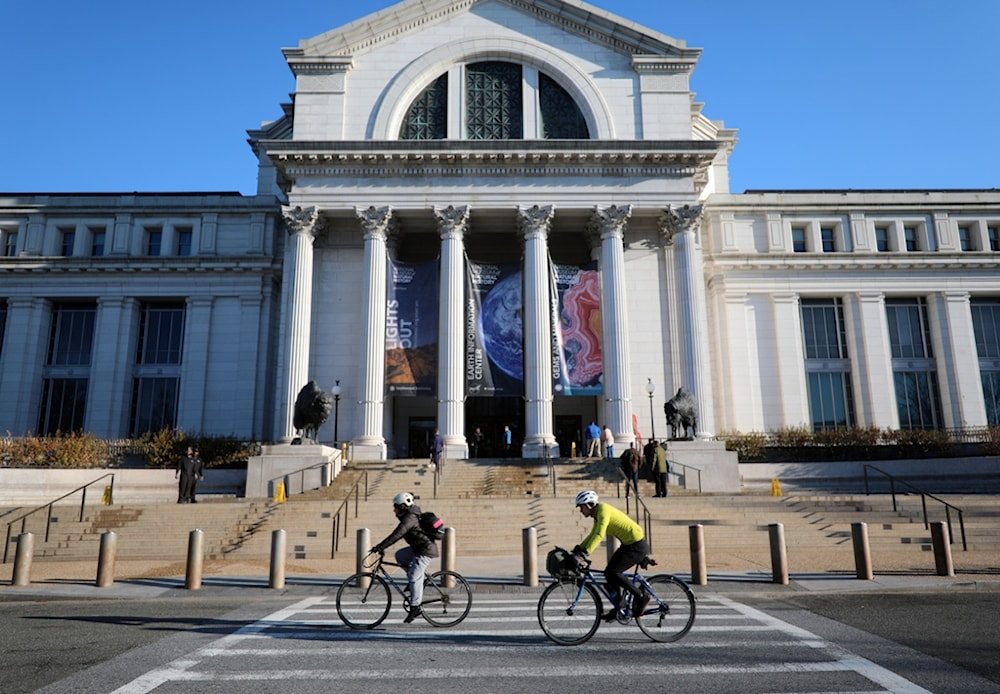
Bison statues cast in bronze are on permanent display outside the Smithsonian's National Museum of Natural History, Friday, March 20, 2026, in Washington. (AP Photo/Rahmat Gul)
The Trump administration is escalating its campaign to reshape how US history is presented at the Smithsonian Institution, targeting exhibits that address slavery, racial discrimination, Indigenous dispossession and other contested chapters of the country’s past, the Financial Times reports.
The latest move came on July 24, when Trump ordered federal officials to install temporary signage near the Smithsonian’s National Museum of American History (NMAH), directing visitors toward information supporting the administration’s criticisms of the museum.
The order follows a 162-page White House report released on July 4 that accused the museum of “ideological capture” and argued that its presentation of US history had become excessively focused on social justice and the country’s historical shortcomings.
Trump escalates pressure on Smithsonian
The confrontation is part of a broader effort by the Trump administration to exert greater influence over how US history and national identity are represented by federally supported cultural institutions.
The White House report, "Saving America’s Story", argues that the National Museum of American History has moved away from what the administration considers an “inspiring” account of the United States.
Trump has repeatedly criticized the Smithsonian’s treatment of slavery. The Financial Times reports that Trump stated that the institution was “OUT OF CONTROL” and complained that “everything discussed is how horrible our Country is, how bad Slavery was and how unaccomplished the downtrodden have been.”
The administration has also criticized exhibits addressing race, gender, sexual identity and the displacement and destruction of Native American communities.
Under the July 24 executive order, federal officials were directed to install temporary signage near the museum and provide information intended to correct what the administration considers inaccurate historical presentations.
Read more: Trump targets Smithsonian museums over 'partisan’ content
White House targets exhibits on slavery and race
The White House report specifically challenges exhibits and displays that place slavery and racial discrimination within the history of the United States.
Among the material criticized are references to the enslavement of people by founding figures including Alexander Hamilton and Benjamin Franklin, exhibitions involving drag culture, and displays documenting the displacement of Native American communities.
The report argues that these presentations contribute to a narrative that divides Americans rather than providing what it describes as a shared national inheritance.
The administration has instead called for greater emphasis on the Founding Fathers, the American Revolution, and what it views as the achievements of the United States.
The White House says its intervention is intended to restore what it considers historical accuracy and national pride. The report was produced by the Domestic Policy Council following Trump's March 2025 executive order, Restoring Truth and Sanity to American History.
Historians reject administration’s account
Historians and Smithsonian officials have rejected the White House’s characterization of the museum.
Smithsonian Secretary Lonnie Bunch said the report did not fairly represent the work of the National Museum of American History, emphasizing the institution’s commitment to scholarship, accuracy, independence, and presenting the breadth of US history.
Historians have warned that the administration’s intervention risks subordinating historical scholarship to political objectives.
The Organization of American Historians has criticized what it described as a federal assault on historical interpretation, while historian David Blight warned lawmakers about the dangers of politically sanctioned versions of history.
The disagreement is therefore not limited to individual museum displays. It raises a broader question over whether the US government should have a role in determining which parts of the country’s history receive emphasis in publicly supported museums.
Smithsonian caught in wider US culture war
The Smithsonian occupies a complicated position within the US political system. Established by Congress in 1846, the institution receives substantial federal funding but is governed by a bipartisan Board of Regents rather than being directly controlled by the White House.
That structure has made the Smithsonian a more difficult target for presidential intervention than institutions directly managed by the federal executive branch.
The current confrontation nevertheless follows a series of attempts by the Trump administration and Republican political forces to reshape public presentations of US history.
The administration’s campaign against the Smithsonian is also unfolding alongside wider disputes over Confederate symbols, racial history and diversity, equity and inclusion policies.
The museum has faced political pressure before. In the early 1990s, congressional opposition effectively derailed a planned exhibition concerning the Enola Gay, the US bomber that dropped an atomic bomb on Hiroshima. The controversy contributed to the resignation of a senior Smithsonian official.
The present dispute is broader, encompassing the interpretation of slavery, Indigenous history, race and national identity.
Read more: Pentagon weighs firing Stars and Stripes publisher, CBS sources say


