
Canada's Carney anticipates 'historic gains' with China
 3 Min Read
Canadian Prime Minister Mark Carney meets Xi Jinping in Beijing, launching a strategic partnership aimed at boosting cooperation in agriculture, energy, and finance.
-
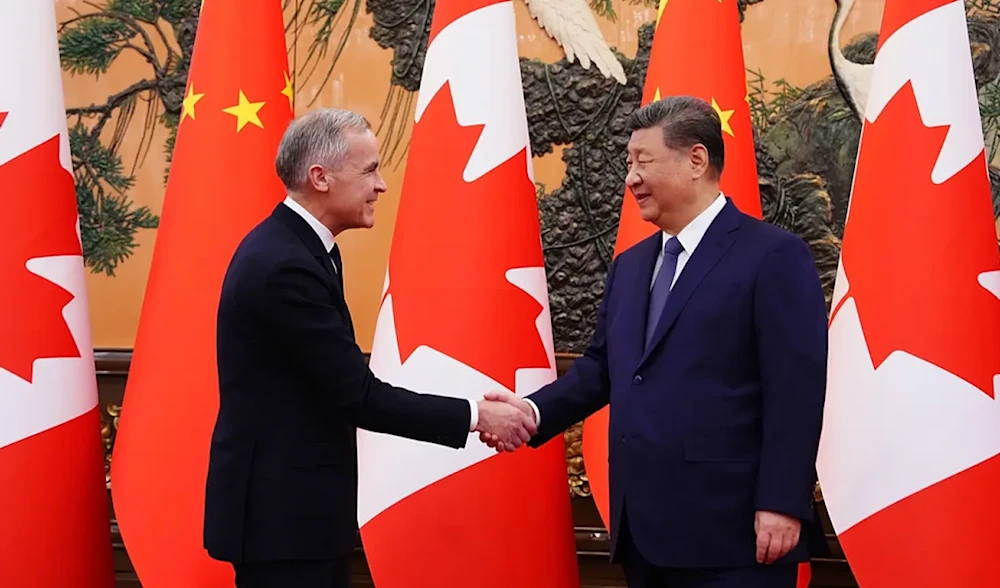
Canadian Prime Minister Mark Carney and Chinese President Xi Jinping in Beijing, China, January 16, 2026. (AP)
Canadian Prime Minister Mark Carney met with Chinese President Xi Jinping on Friday, marking the first visit by a Canadian prime minister to China since 2017.
The meeting signaled a new phase in Canada-China relations, as both nations agreed to launch a Canada-China strategic partnership aimed at deepening cooperation across key sectors.
Carney’s visit follows months of diplomatic efforts to repair ties with China, Canada's second-largest trading partner after the United States. The visit comes at a time of shifting global alliances and economic uncertainty.
Strategic partnership goals
During the meeting in Beijing, Carney emphasized the importance of launching this new strategic partnership amid global divisions. He highlighted opportunities for “historic gains” through collaboration in agriculture, agri-food, energy, and finance.
"It is important to start this new strategic partnership at a time of division," Carney told Xi. "That is where I believe we can make immediate and sustained progress."
President Xi welcomed the initiative, stating his commitment to improving bilateral ties with Canada. "I look forward to continuing to work with you, with a sense of responsibility toward history, our peoples, and the world, to improve China-Canada relations further," he said.
Read more: Carney: Postwar era of free trade is over, Canada shifts toward Asia
Trade tensions and tariffs
Despite the positive diplomatic tone, both sides face ongoing trade tensions. In 2024, under former Prime Minister Justin Trudeau, Canada imposed tariffs on Chinese electric vehicles, citing unfair market advantages stemming from state subsidies.
In response, China retaliated in March 2025 with tariffs on over $2.6 billion worth of Canadian farm and food products, including canola oil and meal. Further tariffs on canola seed followed in August, resulting in a 10.4% drop in China's imports of Canadian goods.
Canada's industry minister noted that tariff talks are ongoing, signaling a willingness to resolve these near-term hurdles.
Impact of US policies on Canada-China ties
Canada's move toward a more autonomous economic approach comes in the wake of recent US tariff policies. US President Donald Trump, after returning to the White House, imposed tariffs on several Canadian exports and controversially suggested that Canada could become the country’s 51st state.
China, also targeted by US tariffs, views its growing cooperation with Canada, a Group of Seven nation traditionally aligned with Washington, as a potential shift in the geopolitical landscape.
Analysts caution that while a strategic partnership between China and Canada marks a notable diplomatic development, it does not signal a major geopolitical pivot.
Sun Chenghao, a fellow at Tsinghua University's Centre for International Security and Strategy, said, "Canada is a core US ally and deeply embedded in American security and intelligence frameworks. It is therefore very unlikely to realign strategically away from Washington."
However, he added that a more pragmatic economic policy by Ottawa toward China could serve as a counter-narrative to the US-led decoupling strategy.
Read more: How Trump tariffs are reshaping Canada China trade strategy


