
Canada turns critical minerals into leverage against Trump
 4 Min Read
Canada is leveraging its critical minerals and energy resources as trade tensions with Trump intensify, challenging Washington’s push for greater access.
-
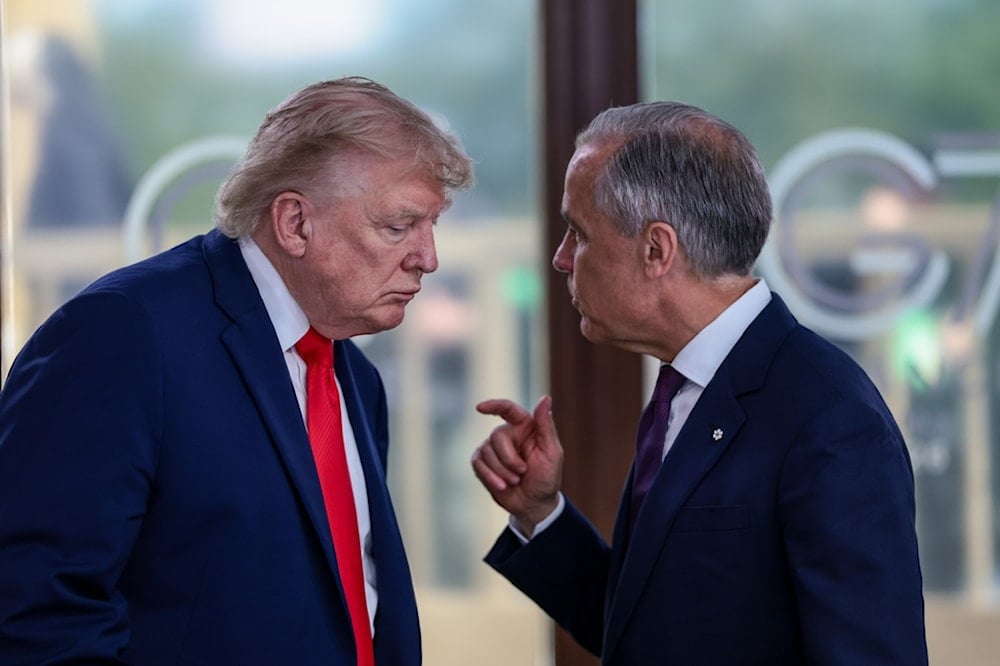
US President Donald Trump speaks with Canadian Prime Minister Mark Carney, right, at a working lunch with leaders of the G7 and the Middle East in Evian-les-Bains, France, Tuesday, June 16, 2026. (Evelyn Hockstein/Pool Photo via AP)
Canada is increasingly treating its critical minerals and energy resources as strategic leverage against the Trump administration as economic tensions between Ottawa and Washington deepen.
Canadian Energy and Natural Resources Minister Tim Hodgson made that position explicit during a tour of Western Canada, declaring, “I don’t get mad, I get even.”
The tour highlighted Ottawa’s push to expand domestic mining, processing and electricity infrastructure while reducing Canada’s dependence on the US market.
Read more: US tourism courts Canadians as Trump tensions drive visitors away: FT
Ottawa puts its resource wealth on the table
In Prince George, British Columbia, Hodgson broke ground on the North Coast Transmission Line, a project expected to be operational by 2032.
The expansion is set to more than double electricity capacity in British Columbia, supporting new critical mineral mines near the Alaskan border as well as liquefied natural gas exports to Asia.
Hodgson said he would welcome a future situation in which Washington asks Canada for more electricity, only for Ottawa to prioritize its own mining and processing projects.
“Nothing would make me happier than just saying, ‘You know what, we’re going to use all our electricity here. We’re going to build new mines, new processing facilities,’” he said.
The approach reflects a broader Canadian effort to turn natural resources into instruments of economic sovereignty rather than treating them simply as supplies for the US market.
US dependence gives Canada bargaining power
Despite Trump’s repeated claims that the US does not need Canadian resources, Washington remains heavily dependent on its northern neighbor for key supplies.
Canada provided more than 80% of US electricity imports in 2025, according to the Canada Energy Regulator.
Washington also regards Canadian critical minerals as strategically important for defense, artificial intelligence, quantum computing and advanced technologies.
The US has sought to reduce its dependence on China for critical minerals, making Canada an important potential alternative supplier.
That dependence gives Ottawa leverage as the Trump administration applies economic pressure on Canada.
Carney rejects exclusive access for Washington
Canadian Prime Minister Mark Carney has signaled that Ottawa is increasingly willing to look beyond the US market following the collapse of recent trade negotiations.
Carney said Canada would continue pursuing agreements with other countries and highlighted roughly 50 deals over the previous year worth about C$50 billion, including stockpiling arrangements.
Asked whether Canada could grant the US exclusive access to its critical minerals, Carney responded bluntly: “We would never give exclusive access.”
Canada also extended an offer to G7 members for “priority access” to its critical minerals stockpile, according to a letter from Hodgson seen by POLITICO.
Ottawa has also pursued cooperation with European partners on critical raw materials, reflecting a broader effort to diversify supply chains and reduce vulnerability to pressure from Washington.
Resource development becomes part of sovereignty strategy
Hodgson has repeatedly described Canada’s critical minerals as “an incredible set of cards” in negotiations with the US.
That strategy was visible during his recent tour of Saskatchewan, Alberta and British Columbia, where he visited potash, uranium, copper and rare earth projects.
At the McIlvenna Bay copper and zinc mine in Saskatchewan, Hodgson said expanding domestic mineral production would strengthen Canada’s sovereignty and provide supplies for clean energy, advanced manufacturing and national security.
Ottawa is simultaneously investing in projects intended to build domestic processing capacity and connect Canadian resources to markets beyond the US.
Washington pressure risks pushing Canada further away
Canada’s harder line carries risks as Trump continues to use tariffs and economic pressure against Ottawa.
The breakdown of trade negotiations has already prompted Carney to demand that Washington adopt a more serious and respectful approach before talks can resume.
The confrontation could therefore accelerate a shift that Washington itself has helped create: Canada increasingly viewing its minerals, energy and industrial capacity as tools for defending economic sovereignty rather than simply as components of an integrated US-centered supply chain.
Read more: Canada 'foolish' if it thinks it can win trade war, US official says


