
China defies oil shock as war on Iran disrupts global markets: CNN
 3 Min Read
China is weathering the global oil shock triggered by the war on Iran due to years of energy diversification, large reserves, and reduced reliance on any single supplier.
-
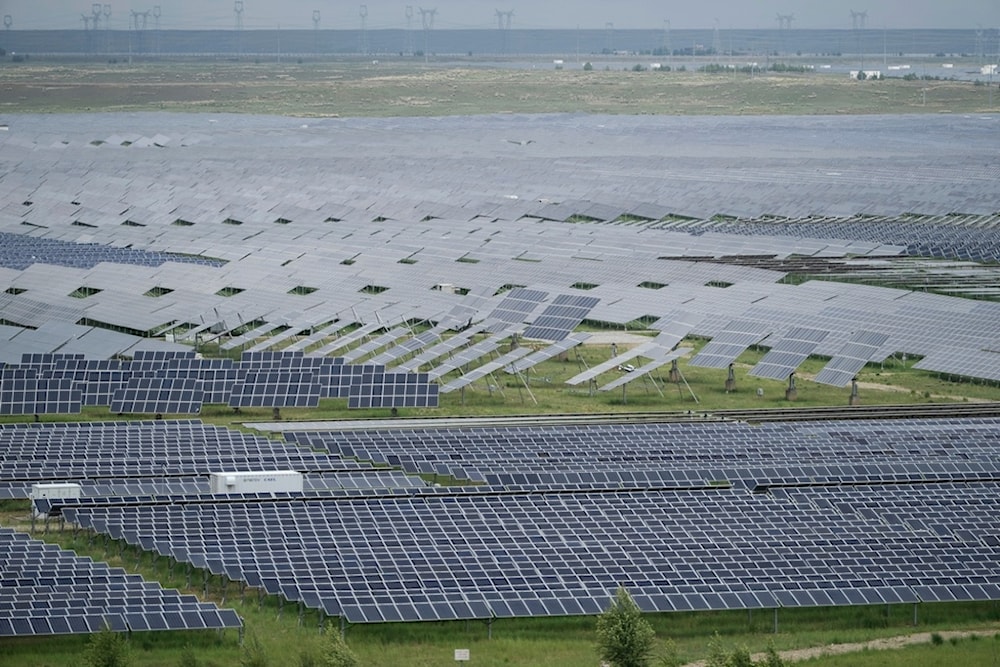
A solar farm is visible in Hainan prefecture of western China's Qinghai province, July 1, 2025 (AP, File)
China is weathering the global oil shock triggered by the US-Israeli war on Iran, as years of strategic planning have strengthened its energy resilience.
In a report by CNN correspondent Simone McCarthy, China’s long-term push for energy security is described as now facing “the sternest test to date of China’s Promethean effort toward energy self-sufficiency,” adding that “it’s a test that China appears to be passing.”
For more than a decade, Chinese leader Xi Jinping has sought to reshape the country’s economy with a focus on reducing dependence on imported fuel and insulating it from “external shocks". This strategy has included large-scale investment in renewable energy, expansion of domestic oil production, and the securing of supply agreements with partners.
While fuel-strapped countries across Asia have scrambled for supplies, China has remained comparatively stable. “China – the world’s largest energy importer – has been sitting on vast stockpiles of oil, an industrial sector largely run on domestic energy and a fleet of cars increasingly powered by electricity, not gas,” the report noted.
China does import significant volumes of oil, including from Iran, but its energy system is structured to avoid reliance on any single supplier. Instead, Beijing depends on diversified sources and, more critically, on the uninterrupted flow of global energy markets, something increasingly threatened by instability in the Strait of Hormuz.
The country’s advantage is further reinforced by its dominance in renewable energy. China operates significantly more wind and solar capacity than any other country, exceeding the combined output of the United States and India. It also leads global manufacturing in clean energy technologies, accounting for roughly 91% of solar panels, 89% of lithium-ion batteries, and 72% of wind turbines.
These factors have allowed Beijing to absorb the impact of the oil crisis more effectively than many of its regional peers, where shortages and price volatility have forced emergency measures.
Control over energy
Recent developments, however, point to deeper vulnerabilities than a purely resilience-based assessment suggests. The US naval blockade of the Strait has disrupted shipping routes and dismantled Iran’s earlier transit system, which had allowed energy flows toward countries such as China to continue under regulated conditions. The move has effectively placed one of the world’s most critical energy chokepoints under direct US pressure, raising concerns about the future reliability of global supply routes.
Beijing has reacted with unusually sharp rhetoric. Its Foreign Ministry described the blockade as “dangerous and irresponsible,” while President Xi Jinping warned that the global order is “crumbling into disarray.” Days later, Xi called for “an immediate and comprehensive ceasefire” and stressed that “the Strait of Hormuz should remain open for normal passage,” underscoring the strategic importance of uninterrupted maritime access.
These responses suggest that China’s concern extends beyond immediate supply disruptions. While the country has reduced its exposure to short-term shocks, the prospect of US control over key energy corridors introduces a different kind of risk, one tied not to availability, but to geopolitical leverage over global energy flows.
Read more: Trump's Hormuz blockade strains US-China ties ahead of Xi meeting


