
China leads electric age as US clings to fossil fuels: NYT
 3 Min Read
NYT contributor Dan Wang states that as China expands its lead in electric vehicle and battery tech, Trump's fossil fuel policy risks leaving the US behind in the global EV market and the future of energy.
-
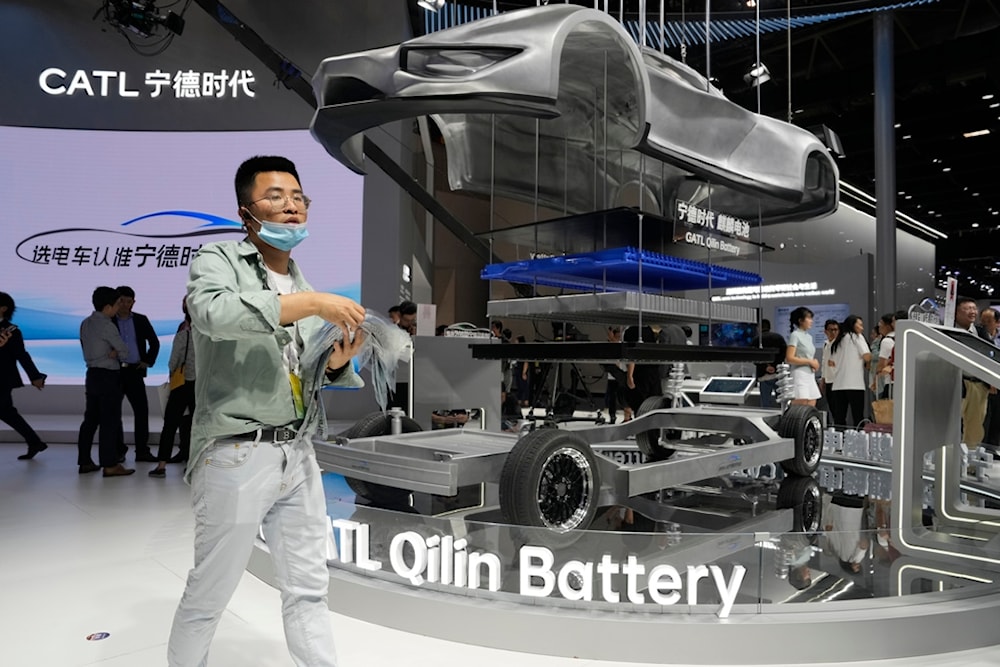
A visitor passes by the booth for Chinese battery maker CATL during Auto China 2024 in Beijing, Thursday, April 25, 2024. (AP Photo/Ng Han Guan)
China has rapidly positioned itself at the forefront of the global EV market, developing advanced battery technology and dominating production of essential components such as rare-earth magnets, according to New York Times contributor Dan Wang.
Chinese President Xi Jinping’s government has taken a long-term strategic approach, prioritizing the electrification of transportation and manufacturing to reduce reliance on oil.
By contrast, Wang writes that US President Donald Trump has made no secret of his ambitions to expand US access to fossil fuels. His intervention in Venezuela was bluntly described as a move to “take the oil,” and his administration has pursued policies that support coal, gas, and oil interests, often at the expense of renewable energy development.
Meanwhile, Chinese firms are surging ahead. Wang highlights that in 2025, over half of new vehicles sold in China were electric or plug-in hybrids, contributing to forecasts that the country's oil consumption will peak by 2027. Companies like BYD and Xiaomi have surpassed global competitors in performance, sales, and innovation, pushing China's electric vehicle dominance to new heights.
Read more: Trump’s Iran tariff threat risks reopening US-China trade tensions
Electrification strategy fuels China’s industrial lead
Wang says that China’s rapid expansion of electricity generation capacity underpins its electrification push. In 2000, it produced just one-third of the power the US did. By 2024, it generated nearly 2.5 times more, fueled initially by coal but increasingly by wind, solar, hydro, and nuclear power. The construction of 40 new nuclear reactors and a massive new hydropower dam in Tibet demonstrates China's intent to stay ahead.
While Chinese battery technology has matured, US firms struggle to compete. Wang notes that the US once led in battery innovation and rare-earth magnet production, but many of these industries were offshored to China in recent decades. Now, China manufactures more than 90% of rare-earth magnets and dominates the global battery supply chain.
Electrification extends beyond vehicles. Bicycles, buses, boats, heating systems, and even household tools like lawn mowers are being electrified. China’s ability to scale production and build industrial infrastructure gives it a unique advantage in this transition.
Trump’s fossil fuel focus hampers US competitiveness
The US - China electrification gap is widening, according to Wang. Despite efforts by innovators like Elon Musk and startups building electric stoves or drones, America’s industrial base has shrunk. Manufacturing has lost tens of thousands of jobs since April, in part due to Trump's fossil fuel policy, tariffs, and delays in approving clean energy projects.
Trump has expressed disdain for renewable energy, calling wind turbines the “SCAM OF THE CENTURY!” His administration’s rollback of green energy support and targeted enforcement actions, such as an ICE raid on a Hyundai battery plant in Georgia, have further weakened the country’s EV and battery sectors.
Analysts warn that unless the US accelerates its industrial and energy transition, it risks falling permanently behind as China leads the electric age. In cities like Shenzhen, once known only for assembling smartphones, Chinese companies are now reimagining transportation and manufacturing for a post-oil world.
Read more: China unveils roadmap to stabilize auto sector amid trade frictions


