
EU, US launch strategic partnership on critical minerals
 4 Min Read
The MoU aims to build secure and sustainable supply chains as the war on Iran and its repercussions continue to disrupt global trade routes and energy markets.
-
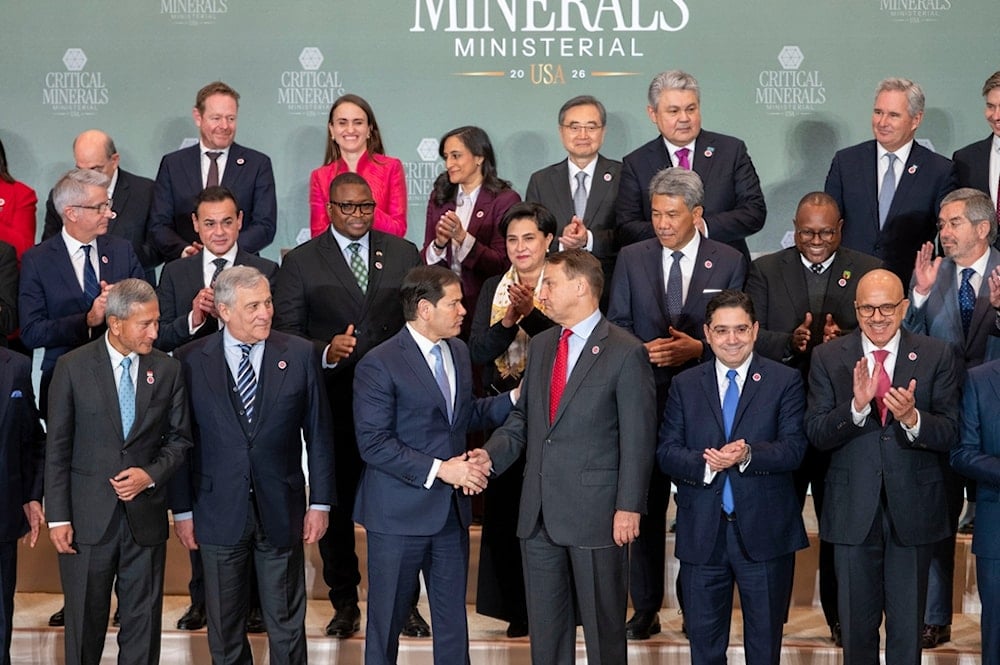
US Secretary of State Marco Rubio shakes hands with Polish Minister of Foreign Affairs Radosław Sikorski during a group photo at the Critical Minerals Ministerial meeting, Wednesday, Feb. 4, 2026, at the State Department in Washington (AP)
The EU and US signed a Memorandum of Understanding on a strategic partnership on critical minerals and agreed on an EU-US Critical Minerals Action Plan, the European Commission announced on Thursday. The initiatives reflect the EU's commitment to deepen cooperation on critical raw materials amid shared geopolitical and economic challenges.
Signed by Commissioner for Trade and Economic Security Maros Šefčovič and US Secretary of State Marco Rubio in Washington, DC, the MoU formalizes the EU-US strategic partnership to build secure, sustainable critical minerals supply chains. It foresees bilateral cooperation across the full value chain, spanning exploration, extraction, processing, refining, recycling, and recovery, while supporting innovation, investment, and geological mapping, as well as supply and demand side measures.
Additionally, Šefčovič and US Trade Representative Jamieson Greer set out an Action Plan for Critical Minerals Supply Chain Resilience, which paves the way toward a possible plurilateral trade initiative with global partners.
Cooperation to explore trade policies and instruments
Under the Action Plan, the EU and the US intend to work together to explore a broad range of trade policies and instruments to reinforce coordinated international action. These may include border-adjusted price floors, standards-based markets, price gap subsidies, and offtake agreements.
Cooperation is also expected to focus on the development of common standards for mining, processing, and recycling, the promotion of investment, joint research and innovation, stockpiling strategies, and mechanisms for rapid response to supply disruptions.
Both sides plan to continue working on critical minerals resilience in relevant international fora, including the G7 and the Forum on Resource Geostrategic Engagement.
Read more: EU struggles to secure critical materials for green transition
Partnership follows February ministerial meeting
The MoU and the Action Plan follow up on shared commitments made at the Critical Minerals Ministerial meeting held in Washington, DC, on February 4, 2026, alongside Japan. Closer cooperation in the area of critical minerals was foreseen in the Joint Statement of August 21, 2025, between the EU and the US.
Stéphane Séjourné, Executive Vice-President for Prosperity and Industrial Strategy, said that secure and sustainable access to critical minerals is vital for the competitiveness and resilience of the EU economy. He noted that the MoU with the United States is the EU's 16th bilateral instrument on critical raw materials.
Šefčovič said it is encouraging to see EU-US cooperation on critical raw materials taking concrete shape. "The vision is there – now the real test is execution, by turning shared ambitions into impactful projects. This will define our success," he said, adding that critical minerals sit at the core of every future-facing industry.
Strategic importance amid Iran war
The partnership comes as the US-Israeli war on Iran has disrupted global supply chains and energy markets.
The war has effectively closed the Strait of Hormuz, through which a significant portion of the world's oil and liquefied natural gas flows, forcing companies to seek alternative routes and driving up transportation costs.
Critical minerals, which are essential for industries including defense, electronics, renewable energy, and electric vehicles, have become a focal point of geopolitical competition. The EU and US have both sought to reduce dependence on foreign suppliers, particularly China, which dominates global processing of many critical minerals.
Read more: US urges allies to derisk critical minerals supply chains from China


