
US urges allies to derisk critical minerals supply chains from China
 3 Min Read
Facing its long-standing dependence on China’s dominant critical minerals industry, Washington is rallying allies around supply chain "derisking" as it struggles to replicate processing capacity Beijing built up over decades.
-
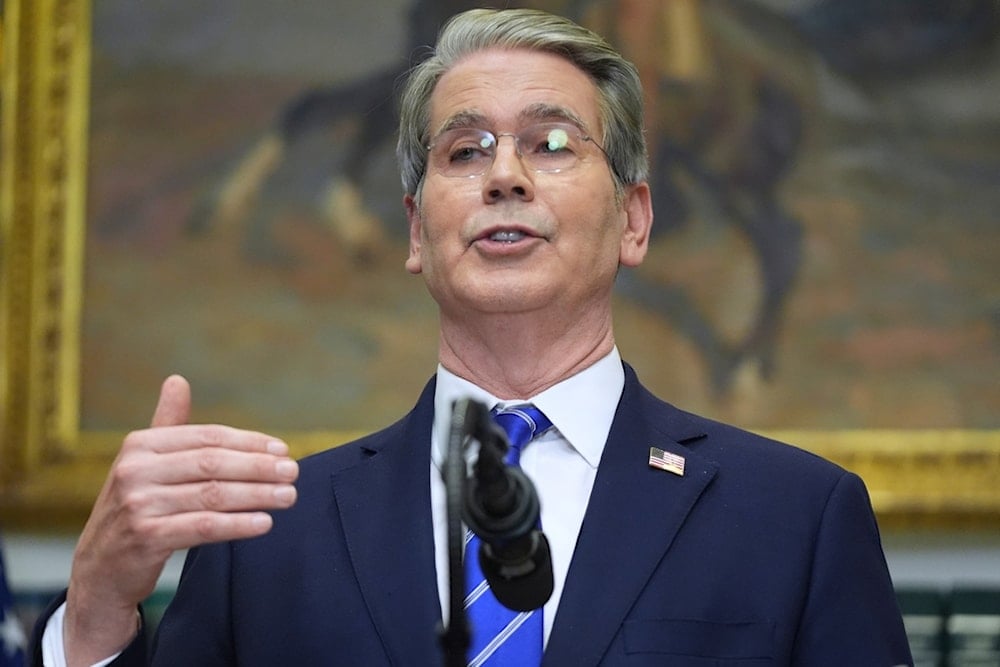
Treasury Secretary Scott Bessent speaks during an event on "Trump Accounts" for kids in the Roosevelt Room of the White House, Tuesday, Dec. 2, 2025, in Washington. (AP Photo/Evan Vucci)
US Treasury Secretary Scott Bessent convened officials from a group of US-aligned economies in Washington on Monday, as the United States seeks to respond to deep-seated dependencies in critical minerals supply chains long dominated by China.
The Treasury Department said Bessent hosted the meeting "to discuss solutions to secure and diversify supply chains for critical minerals, especially rare earth elements," reflecting growing concern in Washington over its limited capacity to independently process materials vital to modern industry and defense.
A US official said Bessent was expected to urge participating countries to accelerate efforts to reduce reliance on Chinese supplies of critical minerals, after Beijing imposed tighter export controls on rare earths. The move comes after decades in which the United States and its partners outsourced environmentally intensive refining and processing to China, allowing Beijing to build unrivaled industrial depth across the sector.
Despite Washington’s push, Bessent stressed that countries should favor "prudent derisking over decoupling," an acknowledgment of the difficulty of rapidly disentangling from supply chains that China has systematically developed over time. The Treasury Department said Bessent conveyed confidence that governments understood the need to address deficiencies in current supply arrangements.
Officials attending the meeting represented Australia, Canada, the European Union, France, Germany, India, Italy, Japan, Mexico, South Korea, and the United Kingdom. Together, they account for roughly 60% of global demand for critical minerals, yet remain heavily dependent on processing capacity located in China.
Strategic Dominance
China’s leading position is the result of sustained state investment, long-term industrial planning, and the acceptance of environmental and financial costs that Western economies largely avoided. According to the International Energy Agency, China refines between 47% and 87% of key materials including copper, lithium, cobalt, graphite, and rare earth elements, minerals essential for defense systems, semiconductors, batteries, renewable energy technologies, and industrial manufacturing.
The urgency of Washington’s outreach follows China’s decision last week to ban exports of certain dual-use items destined for Japan’s military, including some critical minerals. Chinese authorities have framed such controls as normal sovereign measures consistent with international trade and security practices, mirroring restrictions long employed by the United States and its allies.
Playing Catch-Up
While US officials characterize the current effort as risk management, the meeting underscored the challenge facing Western economies: rebuilding or replicating supply chains that China spent decades consolidating.
Analysts note that developing comparable refining capacity elsewhere will require years of investment, regulatory changes, and political consensus, leaving Washington reliant on coordination and diplomacy as it attempts to narrow a gap that continues to define the global critical minerals landscape.
Read more: Beyond oil: Why Washington is eyeing Venezuela’s strategic minerals


