
Fewer migrants, older workforces: rich nations face fiscal squeeze
 11 Min Read
OECD data shows permanent migration fell in 25 of 37 countries in 2025, as the US, UK, and Canada tighten visas while southern Europe and Mexico stand to gain.
-
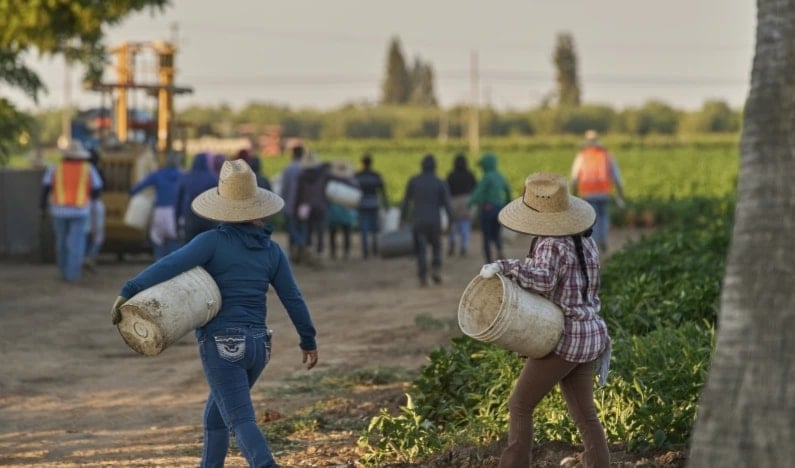
Migrant farmworkers head to pick crops on an early morning in Fresno, Calif., on July 18, 2025. (AP)
Wealthy countries are taking in far fewer migrants than two years ago, and if the trend lasts, governments with fast-ageing populations will find it harder to fund pensions and care, according to the Financial Times.
New figures from the OECD, the Paris-based group of industrialised economies, show the pullback is not confined to one region. In 2025, 25 of its 37 members recorded a fall in permanent migration, meaning foreign nationals admitted on visas that lead to settlement. Asylum claims dropped steeply, and fewer international students enrolled.
Permanent migration fell 1.6% in 2025: OECD
Across the OECD, permanent migration fell 1.6% in 2025, after a near-5% decline the year before. The UK, Germany and Canada, long among the top destinations, saw some of the steepest falls. Spain, Portugal and Italy, which have actively recruited foreign workers to offset shrinking populations, were the main exceptions. Without them, the OECD-wide drop was 8 %.
Jean-Christophe Dumont, who heads the OECD’s international migration division, said, “It becomes a big decline . . . a reversal of the story we have been telling since Covid. Now we are in a different period.”
That story was one of record legal migration during the post-pandemic labour shortages, aggressive overseas student recruitment by universities, and large flows of people displaced by crises such as the war on Syria.
The OECD attributes the turnaround partly to weaker hiring worldwide and calmer conditions in some war zones, but mostly to tighter rules:
- The UK has shut most work routes for non-graduates and lengthened the path to settlement.
- Australia and Canada are cracking down on foreign students and other temporary arrivals.
- European governments are deporting more rejected asylum seekers and weighing ways to make refugee protection temporary and conditional.
Outside the US, asylum applications in 2025 were over a fifth below the previous year’s level, and irregular border crossings detected in the EU fell by about a third. Overseas student arrivals in the OECD slid from a 2023 peak of 2.1mn to 1.6mn, driven by curbs in the US, UK, Australia and Canada, the English-speaking nations that treat higher education as an export and a way to attract future company founders.
One-off spike or new era?
Some experts read the drop as a correction after an abnormal surge. Inflows in many countries are still above pre-pandemic levels. Michael Clemens of the Peterson Institute for International Economics told the Financial Times, “The spike during the post-pandemic era was the historical one-off . . . There was a surge that massively subsided and has adjusted down further by the policy backlash,”
Others see little chance of a rethink. Vox is gaining ground in Spain, Marine Le Pen leads polls in France, and Italy’s Giorgia Meloni is being challenged by a harder-line anti-immigration rival. Australia has recently tightened rules for students and backpackers, and Canada’s Mark Carney has ruled out loosening immigration targets for three years. In Britain, Prime Minister Andy Burnham has said he is open to rejoining the EU with free movement of labour, yet he backs changes that would make many migrants wait ten years or longer for settlement or citizenship.
Donald Trump has sent conflicting signals since a punishing midterm result. He conceded his stance might have been “too tough” for voters, but he also made Stephen Miller, the author of the harshest measures, his chief of staff and threatened to double tariffs on Mexico over illegal immigration.
Alan Manning, an economist who once chaired the UK’s migration advisory committee, likens the present turn to America’s 1920s policy shift, which curtailed arrivals for four decades. “We are going from a period of thinking, ‘We must be open, we must be open, we must be open,’ to a different, less positive perspective,” he said.
The US turns inward
Brookings Institution economists think net migration to the US could have been negative in both 2025 and 2026, the first time in over 50 years, as people without legal status leave for fear of deportation.
Manning said, “The US is a big, empty country — rich, English-speaking. It wants to remain a world superpower based on GDP, not GDP per capita. It is wildly restrictive,” He called the current policy direction “clearly sub-optimal”.
What is at stake for public finances
Oxford Economics modelled a “net zero” migration scenario and found it would cause a “terrifyingly steep” fall in the labour force of other wealthy nations.
UN projections suggest that with no migration, the working-age population by 2060 would be over 10% smaller than in a central forecast in France, Spain and Germany, about 20% smaller in the US and UK, and more than 30% smaller in Canada.
Migrants do not permanently fix the ageing problem, since they too grow old and draw pensions and healthcare. But they typically arrive in their working years, so even low earners usually pay in more than they take out for a long time. Emmanuelle Auriol of the Toulouse School of Economics writes that migration “slows the deterioration [of public finances], expands the tax base and buys time for pension and productivity reforms”.
Oxford Economics’ Paul Moroz and Marco Santaniello describe their model as an extreme “thought experiment”, not a forecast, but one that exposes how much countries rely on newcomers for growth. Moroz said, “A world in which we can’t expect economies to grow is a scary one — and one we would expect to see in our lifetimes in a world with zero migration,”
A slowdown short of a halt would still cap GDP and tax receipts in countries erecting barriers. The more telling measure, though, is GDP per head, which better reflects living standards.
Does migration lift output per person?
Clemens argued in 2011 that governments restricting migration were leaving “trillion-dollar bills on the sidewalk”, ignoring huge global gains while fixating on whether migrants help or hurt their own voters. In principle, letting people move lets skills go where they are worth most. Skilled migrants fill shortages in engineering, medicine and technology, and many start businesses. Auriol added that migrants in care and cleaning jobs help highly qualified women stay in work.
The real-world record is more mixed, and very rapid inflows are frequently tied to lower per-capita GDP in the short run. One reason is that migration can reshape the economy: migrants often take low-wage jobs or work for lower-paying employers, which can let those sectors grow larger than if firms depended on domestic workers or invested in automation.
Many migrants are also overqualified for their jobs, and visa conditions can make it hard to switch to something better. Manning says productivity can suffer further when housing, transport and other services fall behind population growth.
Canada shows how
Canada shows how this can unfold. After the pandemic, it admitted huge numbers of temporary workers and students to fill vacancies. Between 2019 and 2026, GDP rose nearly 13 %, but output per person grew only 2.3 %. Chris Worswick of the CD Howe Institute said the “dramatic” rise, aided by the removal of caps on student work hours, burdened housing and healthcare and eroded a pro-immigration consensus.
Justin Trudeau, who had earlier planned to nearly double permanent migration, abruptly reversed course in 2024, blaming “fake colleges and big chain corporations” that pushed for visas for causing “baby boom” levels of population growth. Worswick said, “What’s really sad . . . is we had a pretty broad political agreement that immigration was a net good — that’s now definitely in the realm of political debate.”
Universities, once among the least controversial parts of the system, are now a major flashpoint, amid worries about weak courses, rising rents and student visas serving as a back door to low-wage jobs.
Students weigh their options
India sends more migrants to the OECD than any other country, and its young people are struggling with constantly changing student and post-study visa rules as they decide whether overseas study is still worth a family’s investment.
Tia Kamath, a 20-year-old biomedical student in Mumbai, has long wanted to study and live abroad, mainly in the US. Worried by costs, visa limits and hostility toward immigrants, she is now looking elsewhere. She told the FT at a recruitment event: “I’m OK with any country as long as I’m getting the work.”
She is considering food technology courses in Ireland, Germany and the Netherlands, with a view to a research job in the food and drink industry. “I like the industrial opportunities that these countries offer . . . especially in the Netherlands,” she said. With total costs likely to reach Rs8mn ($85,000), she is hedging: food tech offers “scope” for work in India if an overseas career does not pan out.
The talent-visa strategy
Many governments are trying to reconcile political and budget pressures by cracking down on irregular and low-skilled migration while building fast-track visas for high earners. Madeleine Sumption of Oxford’s Migration Observatory argues that governments worried about ageing should chase not population growth but “migration with the most impact on the public finances”.
Australia, despite its curbs on students and backpackers, has doubled visa-fee revenue within a few years to A$6bn, according to former government adviser Henry Sherrell. Mark Pearson, the OECD’s acting employment director, said, “Everyone wants high-skilled labour migrants.”
The US stands out as an exception. It has eased wage rules for migrant farm workers and raised quotas for other low-skilled visas, yet it proposes steep fees and closer scrutiny for H-1B visas, which started many leading US tech careers, and is making it far harder for foreign graduates to work after their studies.
Clemens said, “These are the people founding AI firms, developing AI technologies . . . a third of the Stem PhDs in the US are not just foreign-born but also got their degrees here,” He warned the student curbs mean “impairing US innovation and productivity for a generation”.
Who gains
American losses may benefit others. Universities in Italy, Germany and Ireland report rising international enrolment as the big English-speaking destinations become harder to enter, which could help Germany, where the language barrier makes skilled migrants harder to attract.
Mexico, whose poorest states depend heavily on remittances from the US, could also gain if deportees and other returnees settle and apply new skills.
Gretchen Kuhner of the civil society group Imumi said groups that once helped migrants travel north are shifting to helping them integrate in Mexico. Younger arrivals take call-centre jobs, work informally in markets or start small businesses, while those with legal residency move into formal jobs such as retail.
With Mexico’s population ageing quickly, Bank of Spain analysis says “a new wave of return migration could help to mitigate the decline of the demographic dividend”, and its economists estimate returning deportees could add up to 2 %age points to Mexico’s per-capita GDP by 2028.
A stalled journey, a new home
Felipa Cedeño left Venezuela seven years ago, heading for the US. She broke her spine falling in the Darién Gap, the perilous jungle crossing between South and Central America, in 2023. By the time she recovered, Trump’s crackdown had closed the border.
Now a legal resident of Mexico City, she sells empanadas from a stall in the city’s east and rents a room nearby. Her 15-year-old son has a scholarship at a well-regarded private school. “The plan is to stay here,” said Cedeño, 52.
She recently heard that a friend driving for Uber in the US had been seized by ICE, and she now feels she was spared.
“To be living like that? To be running, fleeing? No, mami, that’s not a life,” Cedeño concluded.


