
Goldman strategist doubles down on bold forecast for S. Korean stocks
 5 Min Read
Goldman Sachs is standing by an 80% upside forecast for South Korea's Kospi index, built on the idea that the AI driven memory chip boom still has years to run.
-
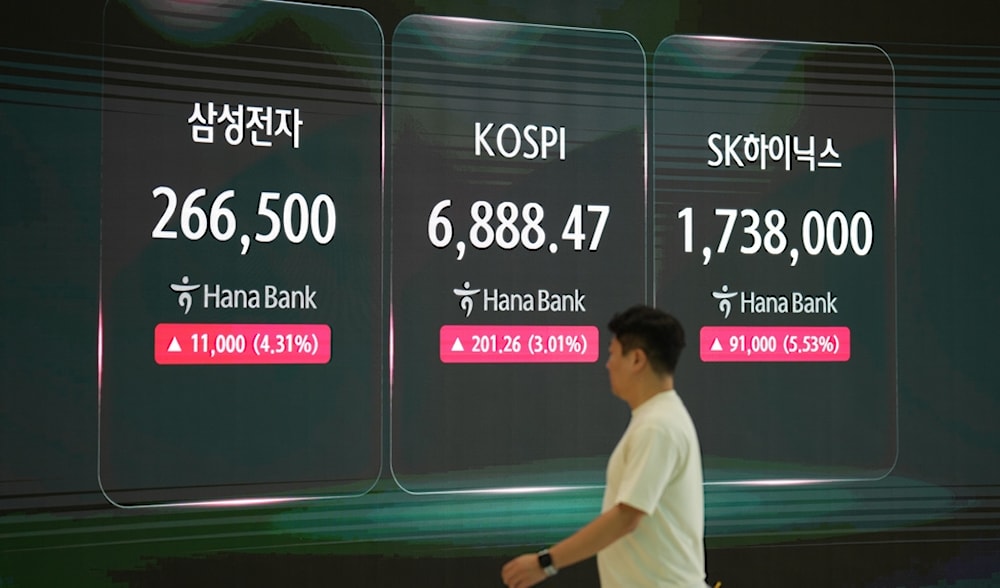
An employee walks near the screens showing the Korea Composite Stock Price Index (KOSPI), SK Hynix and Samsung Electronics Co. stock prices at a dealing room of Hana Bank in Seoul, South Korea, Monday, Sept. 7, 2026. (AP Photo/Lee Jin-man)
A top strategist at Goldman Sachs is sticking with one of the most bullish predictions regarding South Korea's stock market, arguing that investors have not fully grasped how long the artificial intelligence boom will keep boosting the country's memory chip makers.
Timothy Moe, Goldman Sachs' chief Asia Pacific equity strategist, has kept his target for the Kospi, South Korea's main stock market index, at 12,000 points. That would mark a jump of nearly 80 percent from where the index trades today. Moe first set the target three months ago, when it stood out as one of the boldest calls in the industry, according to Bloomberg.
"The market is underpricing the duration of this earnings cycle," Moe told Bloomberg, explaining that his confidence rests on how long he expects company profits to keep climbing.
A big bet on memory chips
Moe's optimism comes despite a rough stretch for South Korean stocks. The Kospi has fallen 27 percent from its record high in June, as investors have grown nervous about whether the huge amounts of money major technology companies are pouring into AI can actually pay off.
Even after South Korea's two biggest chip makers, Samsung Electronics and SK Hynix, posted strong earnings, their stock prices barely moved.
Moe's case rests on the simple idea that building the data centers that power AI requires enormous quantities of memory and storage chips, and demand is currently outpacing supply. That shortage is pushing prices higher, a trend Moe expects to get even stronger through 2027.
He points to a sharp jump in spending forecasts from major US technology companies, which are now expected to spend around 1.2 trillion US dollars next year building AI infrastructure, up from earlier estimates of 800 billion US dollars.
The logic, according to Moe, is that these companies cannot afford to stop building, even if the spending is not immediately profitable for them, and that keeps demand for memory chips high.
Goldman projects that companies on the Kospi will see earnings grow by roughly 360 percent this year, before that growth slows to around 35 percent in 2027. Moe's 12,000 target assumes South Korean stocks should trade at 7.5 times their expected future earnings. Right now the market trades at just 5.3 times, roughly half its average over the past seven years, which is one reason Moe believes there is still room to climb.
Goldman is not the only bull
Moe's call looks less like an outlier once other major banks are factored in. JPMorgan has set a base case Kospi target of 12,500 points, with a bull case scenario as high as 15,000.
Morgan Stanley has put a ceiling of 10,000 on its most optimistic scenario, while South Korean firms Hyundai Motor Securities and Yuanta Securities have both floated targets in the 11,600 to 12,000 range.
Much of this optimism traces back to the same story Moe is telling, a memory chip boom combined with corporate governance reforms in South Korea that investors hope will finally close the long standing "Korea discount," the tendency for South Korean stocks to trade cheaper than similar companies elsewhere.
Still, that wave of bullish forecasts is worth treating with some caution. A study by South Korea's Capital Market Institute, which reviewed 740,000 analyst reports over 25 years, found that securities firms hit their published target prices only around 19 percent of the time.
The China question
One risk Moe has acknowledged but not dwelt on is the growing competition from Chinese memory chip makers, and it may be the single biggest threat to the bullish case for South Korean chip stocks.
The Chinese company ChangXin Memory Technologies, known as CXMT, has expanded its share of the global market for DRAM, a common type of memory chip used in computers and phones, from under 1 percent three years ago to 10 percent by the second quarter of 2026, according to data from Counterpoint Research.
That makes CXMT the fourth largest DRAM maker in the world. Its revenue nearly tenfolded in the first half of 2026, reaching roughly 22.4 billion US dollars, and a Shanghai stock listing in July raised about 8.6 billion US dollars for the company, with its shares surging 466 percent on their first day of trading.
CXMT is not staying in the cheaper end of the market either. The company has begun small scale production of HBM3E, a more advanced type of memory chip used in the AI processors made by Nvidia, and it is reportedly preparing to produce advanced smartphone memory chips on par with the industry's best by the end of the year.


