
Gulf oil output plunges as Hormuz blockade disrupts exports
 4 Min Read
Oil production across Gulf states drops sharply as the Strait of Hormuz remains effectively blocked amid the US–"Israel" war on Iran.
-
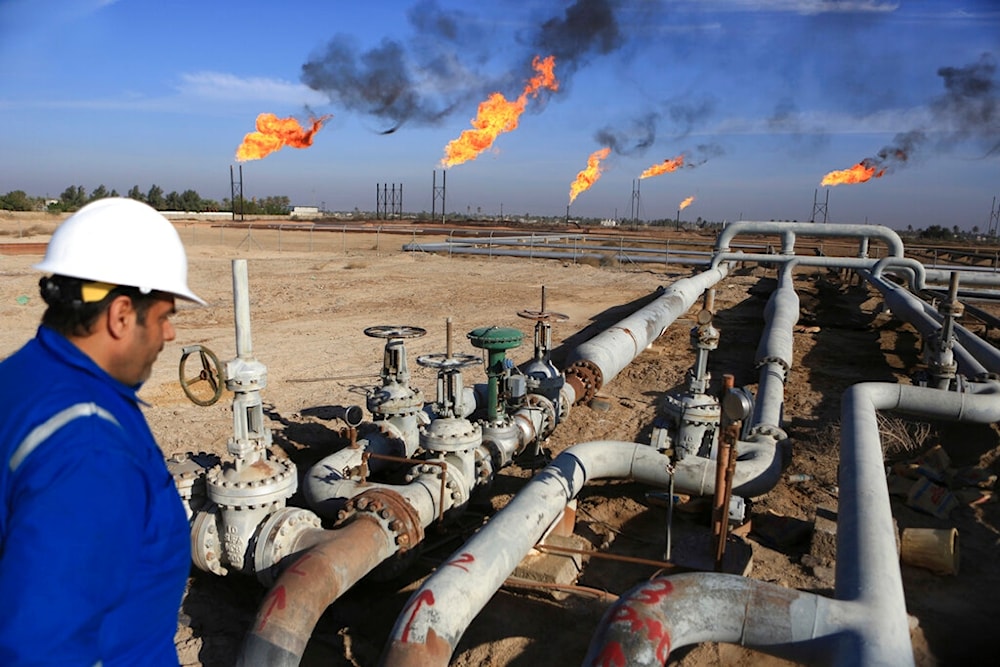
An Iraqi worker prepares to operate valves in Nihran Bin Omar field north of Basra, 340 miles (550 kilometers) southeast of Baghdad, Iraq, Thursday, January 12, 2017 (AP)
Major Gulf energy producers have sharply reduced oil output as the effective closure of the Strait of Hormuz disrupts exports and intensifies pressure on global energy markets, Bloomberg reported.
The disruption comes as the US–"Israel" war on Iran enters its third week, threatening one of the world’s most critical energy corridors. The Strait of Hormuz handles a significant portion of global oil shipments, and its obstruction has forced regional producers to reassess production levels and export routes.
Across the Gulf, production cuts are being implemented as storage facilities fill and shipping routes remain constrained. The longer the disruption persists, analysts warn, the more difficult it may become for producers to quickly restore supply once exports resume.
UAE, Kuwait deepen production cuts
The United Arab Emirates and Kuwait have both significantly expanded production reductions as export routes through Hormuz remain limited.
According to people familiar with the matter, the UAE’s output cut has widened to roughly 1.5 million barrels per day, compared to earlier reductions of 500,000 to 800,000 barrels per day recorded around March 10.
Kuwait has also deepened its cuts. Production reductions there have climbed to nearly 1.3 million barrels per day, up from about 500,000 barrels per day roughly a week earlier.
The cuts reflect growing logistical constraints across the region as tankers face difficulties navigating the strategic waterway.
Read more: Iran arrests 500 for spying for 'Israel,' US
Saudi Arabia, Iraq face major supply constraints
Other major producers have also seen substantial declines in output. Saudi Arabia’s production reportedly fell by between 2 million and 2.5 million barrels per day as of last week, while Iraq’s output dropped by around 2.9 million barrels per day, according to sources familiar with regional supply flows.
The inability to move crude through the Strait of Hormuz has led to storage capacity filling rapidly, forcing producers to curtail production at oil fields across the region.
As the conflict continues, industry observers warn that prolonged shutdowns could complicate efforts to ramp production back up once normal shipping routes reopen.
Producers redirect exports to bypass Hormuz
In response to the disruption, some Gulf states have begun diverting exports through alternative routes to reduce reliance on the Strait of Hormuz.
Saudi Arabia has been sending millions of barrels of crude to export terminals located on its Red Sea coast, allowing shipments to bypass the waterway entirely.
The UAE has also relied on its own bypass infrastructure, redirecting crude through pipelines that terminate at ports outside the Strait.
Despite these efforts, alternative routes remain limited in capacity and cannot fully compensate for the scale of exports normally passing through Hormuz.
Read more: Trump wants world to pay hefty price of his war on Iran 'blunder'
Energy infrastructure disruptions intensify crisis
Beyond oil production, the war has triggered broader disruptions across the Gulf’s energy sector.
Drone attacks targeting the UAE’s key oil export hub at Fujairah, located on the Gulf of Oman, have forced temporary halts in loading operations at the port.
Elsewhere, the war has shut down several refineries and halted production at Qatar’s liquefied natural gas facility, the largest LNG plant in the world.
The combined impact has driven a sharp rise in fuel transportation costs and placed additional strain on global energy supply chains.
Oil prices surge above $100
The growing disruption to energy infrastructure and supply routes has pushed global oil prices above $100 per barrel, reflecting mounting fears of prolonged shortages.
Market volatility has intensified as traders weigh the possibility that the conflict could continue to disrupt shipments through the Strait of Hormuz, a route that normally carries a substantial share of the world’s crude exports.
If the blockade persists, analysts warn that energy markets could face sustained instability, with consequences for fuel prices, transportation costs, and global economic activity.


