
IMF warns US growth alone cannot curb public debt
 6 Min Read
IMF chief Kristalina Georgieva warns that US economic growth alone cannot reduce public debt fast enough, urging fiscal adjustments as global borrowing costs rise.
-
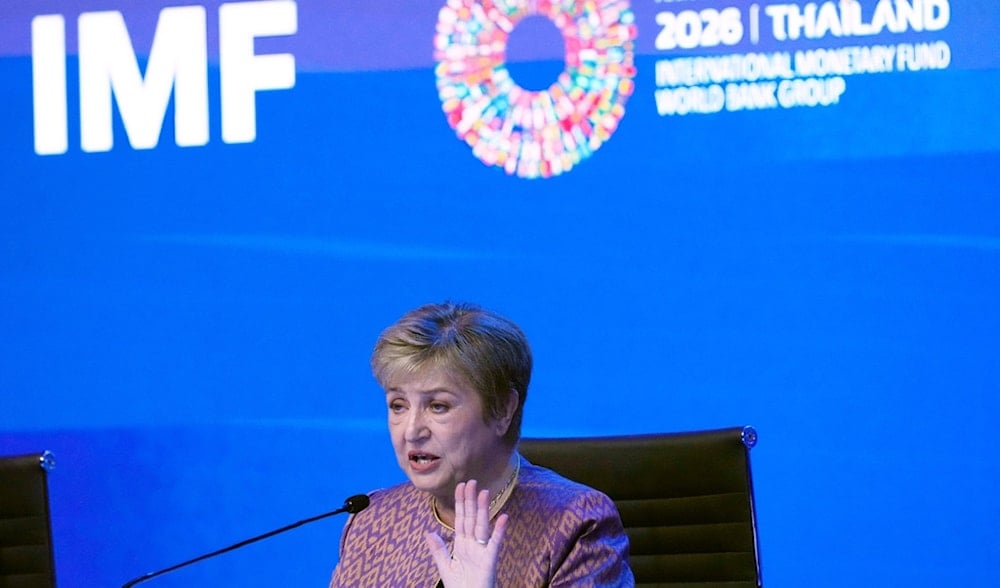
International Monetary Fund (IMF) Managing Director Kristalina Georgieva speaks at a news conference on the Global Policy Agenda forum in Bangkok, Thailand, Wednesday, Oct. 14, 2026. (AP)
The International Monetary Fund (IMF) has warned that economic growth alone will not be enough to rein in mounting US public debt, urging Washington to adopt fiscal measures as rising borrowing costs narrow governments' room for maneuver.
IMF Managing Director Kristalina Georgieva also called on China to shift away from export-led growth toward domestic consumption to address widening global economic imbalances.
Speaking at the IMF and World Bank annual meetings in Bangkok on Wednesday, Georgieva identified the US and European economies among the advanced economies most burdened by excessive debt. She cautioned that rising benchmark bond yields were also affecting low-income countries, which financial markets have pressured to curb borrowing.
Asked whether the US needed tighter fiscal policy, Georgieva said Treasury Secretary Scott Bessent recognized that American deficit and debt levels were too high and needed to be placed on a more sustainable path.
"The authorities very much rely on strong growth in the United States" to help reduce debt, Georgieva said. "At the Fund, we believe that growth of course helps, but it cannot deliver fast enough the necessary adjustments. So, some (fiscal) measures would be necessary."
IMF warns rising borrowing costs leave governments with little room
The IMF's Fiscal Monitor report, released on Wednesday, reinforced the need for governments to address mounting debt burdens, warning that delays amid higher borrowing costs would make fiscal adjustments more difficult in the coming years.
Rodrigo Valdes, head of the IMF's Fiscal Affairs Department, said surging bond yields had left governments with limited room to maneuver, prompting the Fund to intensify its warnings. "We dialled up the urgency of our message," he said.
The annual meetings have been dominated by concerns over rising public debt, higher bond yields, and risks associated with the artificial intelligence boom.
The Organization for Economic Co-operation and Development's (OECD) Secretary-General Mathias Cormann also called for "strong fiscal discipline" in a statement to the IMF's steering committee, arguing that it was necessary to preserve economic stability.
"In every G20 country except Germany and Türkiye, public debt as a share of GDP was higher in the first quarter of 2026 than at the end of 2007," he wrote to the International Monetary and Financial Committee.
Cormann urged governments to contain and reallocate spending, improve public-sector efficiency, and strengthen tax systems while protecting investment in education, skills, and digital infrastructure.
IMF urges US to save more as China boosts domestic consumption
Georgieva called on the world's two largest economies to make policy adjustments to address mounting fiscal and trade imbalances, stressing that their economic models required different changes.
The US has used its presidency of the Group of 20 (G20) major economies to push allies to take stronger action against China's "non-market" economic policies, which Washington argues have contributed to excess industrial capacity and a surge in global exports.
Bessent, who has been a leading advocate of President Donald Trump's economic policies, is not attending the Bangkok meetings despite the US holding the G20 presidency this year. He has instead prioritized domestic engagements as campaigning intensifies ahead of the US midterm elections.
G20 finance ministers are scheduled to meet on the sidelines of the annual meetings on Thursday.
Against this backdrop, Georgieva reiterated the IMF's longstanding recommendation that Beijing strengthen domestic demand, following data showing China was on track to record a historic trade surplus.
"For surplus countries, what they need to do is increase domestic consumption. That clearly applies to China's growth model. Shift from exports more toward domestic consumption."
She said deficit countries needed to save more and spend less, while European economies should invest more in competitiveness. "To put it very simply, China needs to spend more, the US has to save more, and Europe has to invest more," Georgieva added.
France faces pressure to address debt through fiscal policy
European fiscal pressures have also come under scrutiny, with France facing heightened concerns following a global bond sell-off.
European Central Bank President Christine Lagarde said addressing France's debt problems was primarily the responsibility of the government in Paris, downplaying speculation that the ECB would intervene in the bond market to ease pressure.
Asked at a CNN event in Bangkok whether the ECB was preparing to assist France, Lagarde said the country needed to take domestic measures to restore investor confidence.
"And for that one, the primary and first solution lies at home in France. And it has to do with fiscal policies," she said.
The IMF, meanwhile, has praised Britain for taking steps toward fiscal consolidation but has cautioned against accelerating the pace of adjustment.
"Our recommendation is 'stay the course'," Valdes said.
IMF calls for greater support for low-income countries
Georgieva also urged IMF member countries to fully fund facilities intended to support low-income and vulnerable economies, warning that the widening gap between countries benefiting from AI investment and those being left behind posed a growing risk to the global economy.
The facilities include the Poverty Reduction and Growth Trust, which provides low- and zero-interest loans to low-income countries, and the Catastrophe Containment and Relief Trust, which offers grants for debt-service relief and cancellation to the poorest and most vulnerable member countries.
Higher bond yields are placing additional pressure on these economies, even as their overall debt burdens have eased. Georgieva said average debt-service costs had climbed to 14% of government revenue, up from 6% a decade earlier.
"The risk of divergence is most dangerous for those that are already further behind," she added.
Read more: IMF cuts China, Russia growth forecasts, maintains US outlook


