
Egypt secures $2.3bln from IMF, but at what cost?
 9 Min Read
The IMF has unlocked $2.3 billion for Egypt, but six decades of borrowing, repeated austerity, and stalled reforms raise questions about who really benefits.
-
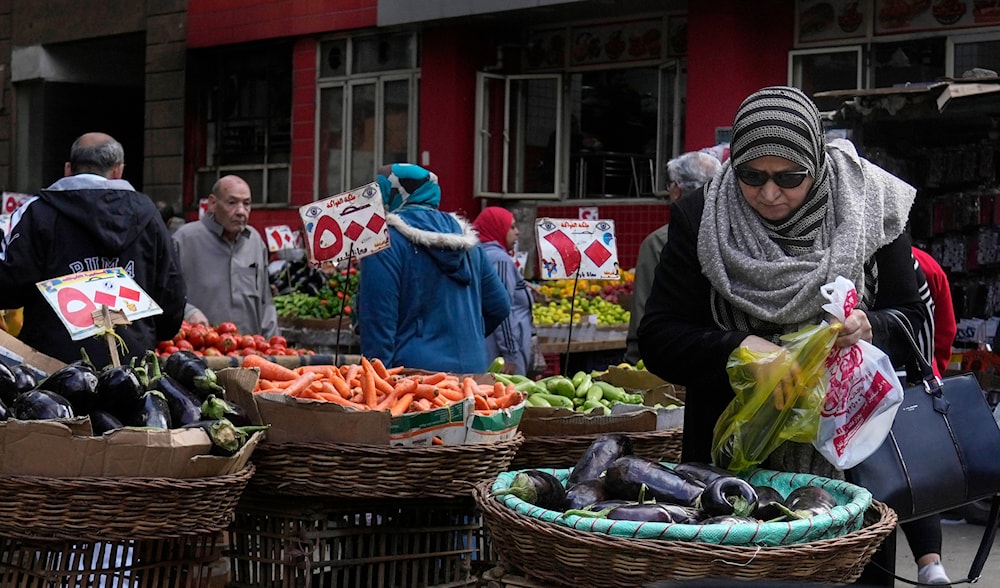
Egyptians buy vegetables at a popular market in Cairo, Egypt, Thursday, Jan. 12, 2023 (AP)
The International Monetary Fund completed two reviews of Egypt's economic reform programme on Wednesday, along with a review under its Resilience and Sustainability Facility (RSF), unlocking approximately $2.3 billion in fresh disbursements.
The decision by the IMF's Executive Board allows Egypt to draw roughly $2 billion under its 46-month Extended Fund Facility (EFF), alongside $273 million under the RSF, bringing total disbursements under both programmes to approximately $5.2 billion.
Egypt first agreed to a $3 billion loan with the Fund in December 2022, a deal that was nearly doubled to $8 billion in March 2024 as the country contended with inflation that had peaked at 38 percent in September 2023 and a severe shortage of foreign currency.
Since then, headline economic indicators have improved. Annualized urban consumer inflation fell to 11.9 percent in January, the foreign currency crunch has eased, and the external position has been shored up by a combination of IMF disbursements, record tourism revenues, remittances, and tens of billions of dollars in investment deals with Gulf states, most significantly, the $35 billion Ras El-Hekma deal with the UAE.
The IMF acknowledged Egypt's progress, noting that "tight monetary and fiscal policies, together with exchange rate flexibility, have helped restore macroeconomic stability." But the Fund's own assessment also sounded a familiar warning, ie, structural reforms have been "uneven".
Progress on divestment of state assets, a centerpiece of the loan deal, has been "slower than envisaged," and high public debt alongside elevated gross financing needs continue to weigh on medium-term growth prospects.
The programme is due to end in December 2026, and the same structural tensions that have defined every Egyptian engagement with the IMF for more than six decades remain largely unresolved.
Six decades of the same relationship
Egypt's borrowing relationship with the IMF dates back to 1962, making it one of the longest-running in the Global South. Over the following decades, the country entered into a succession of programmes, standby arrangements in the 1970s and 1980s, a landmark structural adjustment deal in 1991 tied to debt relief following Egypt's participation in the Gulf War coalition, a $12 billion EFF in 2016 under President Abdel Fattah el-Sisi, and now the current $8 billion programme.
Cumulatively, Egypt has drawn billions from the Fund across more than a dozen arrangements, and each new programme has arrived at a moment of acute crisis, balance of payments pressure, currency collapse, inflationary spiral, and each has been presented as a turning point toward sustainable growth.
The through-line across all of these programmes is not hard to identify. The IMF's toolkit has remained almost identical across six decades and wildly different political contexts: devalue the currency, cut subsidies on energy and food, privatise state-owned enterprises, tighten fiscal policy, and reduce the public wage bill.
The 2016 programme demanded a flotation of the Egyptian pound that sent it into freefall, and the current programme demanded the same. The 1991 deal required subsidy reductions, and so has every programme since. This consistency reflects a structural worldview, baked into IMF conditionality, that fiscal discipline and market liberalization are the path to macroeconomic health.
What the reforms actually demand
The standard conditionalities impose the harshest immediate costs on ordinary people, while the most structurally significant reform, privatization of state assets, has chronically failed to materialise.
This is not a coincidence. Egypt's military-commercial complex controls vast swathes of the national economy, from food production to construction to consumer goods. Transferring these assets to private hands would require a political decision with profound implications for the institutions that underpin the current order; a decision that has not been made.
The result is a consistent pattern. Egypt implements the painful portions of every programme, currency devaluation, subsidy cuts, and interest rate hikes, while the transformative portions stall. In August 2024, Egypt ratified legislative amendments aimed at accelerating the sale of state-owned assets, which the IMF welcomed. But by the time of the fifth and sixth review completions this week, the Fund was still flagging that divestment progress had been slower than envisaged.
Who benefits?
Understanding who gains from IMF programmes in Egypt requires looking past the headline figures. IMF disbursements do not flow into the government budget for schools, hospitals, or infrastructure, but to the Central Bank of Egypt.
At the Central Bank of Egypt, their primary function is to replenish foreign exchange reserves, refinance maturing treasury bills held by foreign portfolio investors, and signal creditworthiness to external lenders, unlocking further financing from Gulf states and multilateral creditors.
The IMF's own framing of the 2022 EFF was that it would "catalyse additional financing" of around $14 billion from other sources. The loans function, in effect, as creditor insurance, keeping Egypt solvent enough to continue servicing its existing debt obligations.
And those obligations are enormous. According to analysis by the Egyptian Initiative for Personal Rights (EIPR), 64.8 percent of Egypt's FY2025/26 government expenditure is allocated to debt servicing, enriching domestic and foreign creditors and banks. Education and healthcare together receive roughly 12 percent of the budget, a ten-year low.
The actual beneficiaries of the austerity architecture that the IMF demands and the financing it provides are, in practice, creditors, Gulf investors, military-linked commercial entities, and real estate elites. The poor and middle class absorb the costs.
Who bears the cost?
Since 2016, the Egyptian pound has lost the vast majority of its value against the dollar through successive waves of devaluation demanded under IMF conditionality. This led to the devastation of the purchasing power of ordinary Egyptians and inflation that peaked at 38 percent in 2023.
Food price shocks have measurably degraded dietary quality among lower-income households. Subsidy cuts on bread, fuel, and electricity have hit those with the least capacity to absorb them hardest, while the social protection mechanisms meant to offset these losses have not expanded commensurately.
Decades of IMF programmes in dozens of countries show us that these are not side effects, but the actual mechanism of the programme. Austerity compresses domestic demand, which reduces import volumes, which improves the trade balance and stabilises the balance of payments. That is the model.
The stabilization the IMF celebrates is achieved precisely by squeezing the living standards of the population. Whether that trade-off is justified, and who gets to decide that it is, is a question that IMF programme documents do not tend to dwell on.
Egypt in global context
Egypt is far from alone. Pakistan, Jordan, Tunisia, Ghana, and Argentina have all received near-identical reform prescriptions from the IMF at moments of crisis, with near-identical results: short-term stabilization, persistent debt dependence, and underlying structural conditions largely unchanged.
Research on IMF structural adjustment programmes across 81 countries has found a consistent pattern of increasing poverty and widening inequality. The IMF's standard toolkit tends to produce managed dependency, not structural transformation.
What distinguishes Egypt from many of its counterparts is geopolitics. Egypt's strategic importance, manifested in its control of the Suez Canal, its role in regional security architecture, and its proximity to multiple active conflicts, has repeatedly secured it exceptional treatment that pure economic logic would not have warranted.
The $35 billion UAE investment deal, the Gulf backing that has provided foreign currency lifelines at critical moments, and the augmentation of the IMF programme from $3 billion to $8 billion in 2024 are proof that none of these would have materialised for a country of equivalent economic vulnerability without Egypt's geopolitical weight. Egypt's "success" in the IMF's terms is partly a function of who it is, not what it has done.
If not IMF reforms, then what?
Critics of the IMF framework argue that its programmes systematically misdiagnose Egypt's economic problems. The issue is not fiscal profligacy or an overvalued exchange rate in isolation, but a productive base too narrow and too distorted to generate sustainable foreign currency earnings.
Egypt remains heavily dependent on a handful of sources: the Suez Canal, tourism, remittances, and aid. Manufacturing, export diversification, and value-added production have remained underdeveloped for decades, in part because the military-commercial complex that dominates large sectors of the economy is not subject to competitive pressure and has little incentive to invest in productive transformation.
The alternative framework structural critics propose centers on industrial policy that builds genuine export capacity and reduces import dependence; progressive taxation as a revenue base rather than regressive subsidy cuts; privatization that breaks up monopolies rather than transferring them from one politically-connected entity to another; and redirecting debt servicing resources, or at least a greater share of them, toward education, healthcare, and productive investment.
With the current IMF programme set to expire in December 2026 and public debt still elevated, Egypt faces a question its policymakers have deferred for decades. Whether the stabilization achieved at such cost to ordinary Egyptians has created any of the structural conditions that might prevent the next crisis, or whether it has simply reset the clock.


