
Iran-Russia oil cooperation nears final stage, gas deal close
 5 Min Read
Iran and Russia are finalizing a joint oil field development agreement and nearing completion of a gas import deal following the 19th session of their bilateral economic commission, as broader military and diplomatic coordination continues.
-
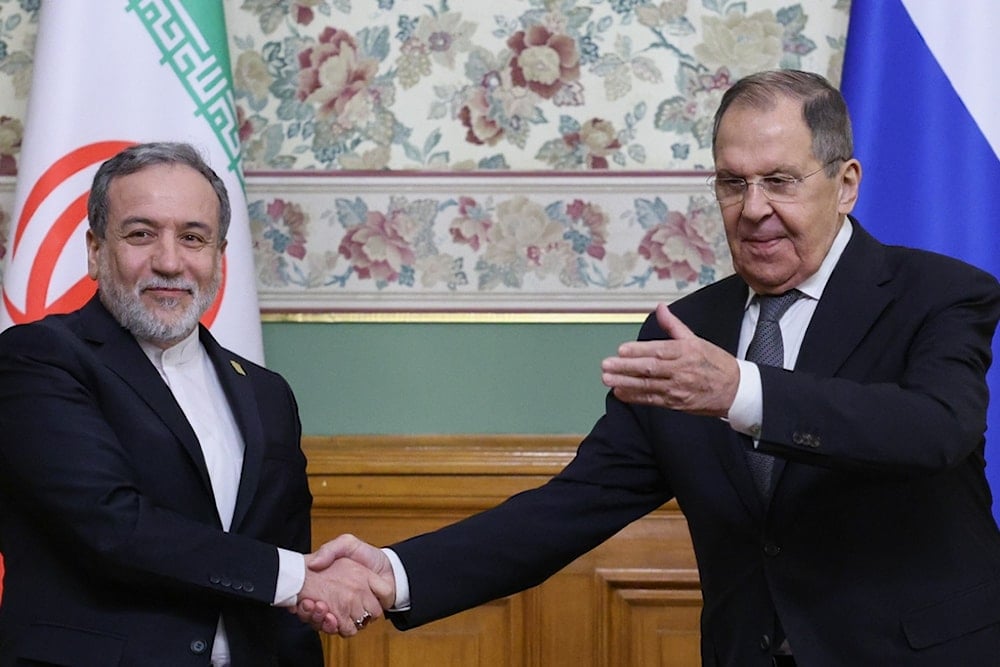
Russian Foreign Minister Sergey Lavrov, right, and Iranian Foreign Minister Abbas Araghchi shake hands after a joint news conference at Zinaida Morozova's Mansion in Moscow, Wednesday, Dec. 17, 2025. (AP)
Iran-Russia oil cooperation has entered a decisive phase, with negotiations on the development of a major joint oil field nearing completion and a gas import agreement approaching finalization, Iran’s oil minister announced on Wednesday.
The remarks came following the 19th Session of the Permanent Iranian–Russian Commission on Trade and Economic Cooperation, held in Tehran.
Joint oil field development talks in final phase
Speaking after the commission meeting, Iran’s Oil Minister Mohsen Paknejad said discussions on transferring the development of a large shared oil field to Russia are in their final stages.
The move marks a significant step in Iran-Russia joint oil field development and reflects deepening strategic coordination between Tehran and Moscow in the energy sector.
Paknejad stressed that progress had moved beyond preliminary discussions toward concrete implementation.
“What was ultimately agreed upon at this meeting is the achievement of ‘moving from understanding to the stage of implementation,’” the Iranian oil minister said.
He described the outcomes of the latest talks as highly significant, given the current sensitive international conditions.
Gas import agreement between Iran and Russia near completion
In addition to oil field development, negotiations on Iran's gas imports from Russia have also advanced.
“In the gas trade sector, the understandings related to the import of gas from Russia have also reached the final stages, and only the review of a few limited clauses remains, which is expected to soon lead to the signing of a final contract,” Paknejad stated.
The anticipated agreement would further strengthen Iran-Russia energy agreement 2026 efforts and broaden bilateral cooperation in natural gas trade.
Paknejad credited the progress to sustained coordination between both sides.
“I sincerely thank him and his colleagues for providing the grounds for remarkable progress in finalizing the understandings and removing obstacles in some of the areas of interest,” he said, referring to Russian Energy Minister Sergey Tsivilyov and his delegation.
He added that the advances would not have been possible “without the constructive cooperation and diligent follow-ups of the Russian energy minister and his colleagues in various sectors and fields of Russia.”
Statements by Russian energy minister
For his part, Russian Energy Minister Sergey Tsivilyov expressed sympathy with the Iranian people over last month’s deadly riots across the country.
“We are fully aware that these incidents occurred due to the interference of enemies,” he said.
Tsivilyov emphasized the level of coordination achieved between the two countries through various working groups of the joint commission.
“This year we were able to move the work forward very successfully and see the results of our performance,” he said, noting that over the past 11 months, projects had been “13 times more successful compared to last year.”
He also expressed confidence that the 20th meeting of the joint commission would yield further results and greater successes.
Outcomes of the 19th permanent Iranian–Russian commission
The 19th session of the Permanent Iranian–Russian Commission was held at Iran’s Ministry of Oil after two days of expert-level meetings between Iranian and Russian delegations.
During the session, one cooperation document and four memoranda of understanding were signed between the Islamic Republic of Iran and the Russian Federation.
Among the signed documents was a memorandum of understanding between the Federal Accreditation Service of the Russian Federation and the National Accreditation Center of the Islamic Republic of Iran.
Another MoU was concluded between the Federal Service for Labor and Employment of the Russian Federation and Iran’s Ministry of Cooperatives, Labor and Social Welfare in the field of employment development and labor inspection.
A further memorandum of understanding focused on expanding cooperation in the energy and petrochemical sectors, reinforcing bilateral collaboration across strategic industries.
Broader strategic coordination amid regional tensions
The expanding energy coordination comes as Tehran and Moscow deepen military cooperation. The two countries are set to conduct joint naval drills in the Sea of Oman and the northern Indian Ocean aimed at enhancing maritime security and protecting commercial shipping routes.
The exercise follows recent naval maneuvers by Iran in the Strait of Hormuz under the codename “Smart Control over the Strait of Hormuz,” and comes amid an extensive US naval presence in the region.
The developments also coincide with indirect nuclear negotiations between Iran and the US in Geneva, focused on Tehran’s nuclear file and the lifting of sanctions.


