
Israeli banking cutoff threatens West Bank economic collapse
 6 Min Read
The Israeli move could isolate the occupied West Bank financially, disrupt essential imports, and push its already weakened economy toward collapse.
-
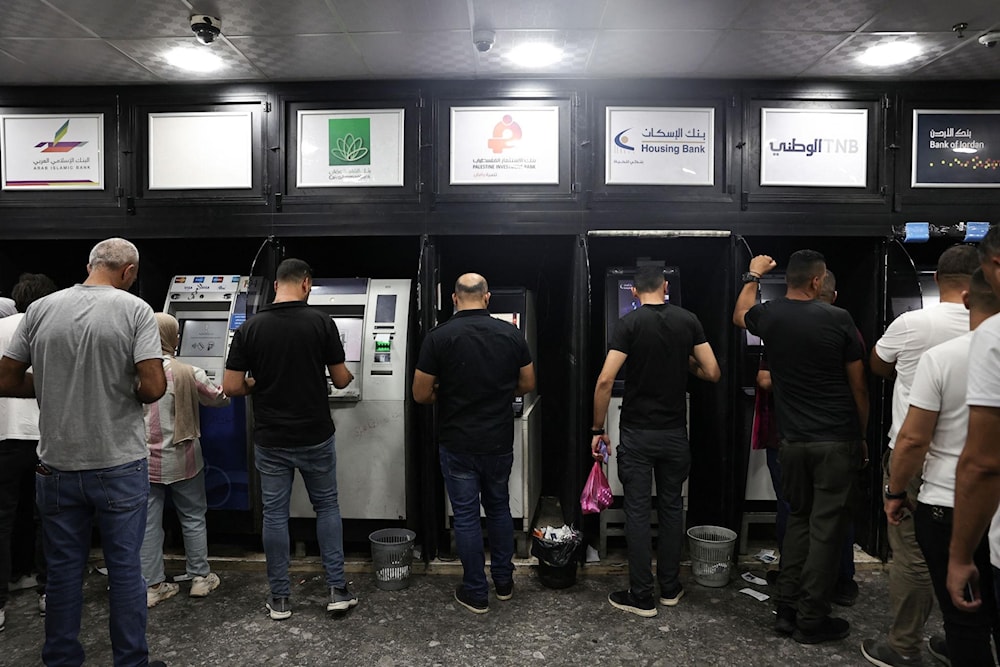
Palestinians use ATMs at a bank in Nablus in the occupied West Bank on June 9, 2024 (AFP)
The threatened severing of banking ties between “Israel” and Palestinian financial institutions could impose a sweeping financial blockade on the occupied West Bank, exposing the economic dependency created under the Oslo framework, The New York Times reported.
Israel Discount Bank has informed Palestinian banks that it intends to terminate its correspondent banking services on September 1, while Bank Hapoalim is considering taking the same step.
The two institutions connect the 13 Palestinian banks to the Israeli and international financial systems, allowing them to process payments for imports, exports, currency transfers, and essential services.
Ending both relationships could isolate the Palestinian financial sector and disrupt access to food, fuel, electricity, water, clothing, and other basic goods.
“There is a huge fear,” said Feras Milhem, who served as governor of the Palestine Monetary Authority from 2021 to 2025. “There is also a belief that this will not happen, that Israel cannot really cut the relations unless they want to push the Palestinians to anarchy.”
Oslo leaves Palestinian banks dependent on occupation
The correspondent banking arrangement dates back to the 1990s and the financial system established under the Oslo Accords.
Rather than giving Palestinians economic sovereignty, the framework left their banks dependent on Israeli institutions for shekel exchanges, international transfers, and commercial payments.
Trade with “Israel” accounts for 55% of Palestinian imports and 85% of exports, according to Milhem.
The looming cutoff therefore demonstrates how the Palestinian economy remains subject to Israeli control over currency, trade, borders, and financial access more than three decades after Oslo.
Israeli banks argue that continuing the relationships could expose them to lawsuits or allegations involving money laundering and the financing of armed groups.
The Israeli government has addressed those concerns by issuing temporary guarantees protecting the banks from certain lawsuits and prosecution.
In a statement on Wednesday, the Israeli Finance Ministry said the banks had “announced their desire to cease providing correspondent services.”
It said talks were underway to find a “safe and responsible manner” for the services to continue, while acknowledging that their termination could have “negative implications for economic stability in the region.”
Observers argue that such allegations are being used to justify collective punishment, with workers, hospitals, businesses, municipalities, and families across the occupied West Bank bearing the consequences.
Smotrich uses banking access as leverage
Israeli Finance Minister Bezalel Smotrich has repeatedly threatened to delay or withhold the legal protections required by the banks.
He has used their renewal as political leverage, including to advance settlement expansion and obtain approval for illegal outposts in the occupied West Bank.
Although the guarantees have ultimately been renewed under international pressure, Smotrich has sometimes extended them for only two weeks and waited until shortly before their expiration to act.
An aide to Smotrich accused the Palestinian financial system of involvement in "terrorism" and "money laundering".
“The demand that Israel mitigate this risk instead of demanding that the Palestinian Authority cease engaging in terrorism and meet accepted international standards reflects the hypocrisy and racism of low expectations,” the aide said.
Financial specialists cited by the Times disputed the allegation, saying Palestinian regulators had worked to prevent Hamas and other Resistance factions from accessing the formal banking system.
“The Palestinian banking system is no friend of Hamas, quite the contrary,” said Daniel L. Glaser, a former US assistant treasury secretary. “And the Palestinian Monetary Authority is no friend of Hamas. It’s one of the few things that works there.”
The assessment suggests that the proposed cutoff would target the wider Palestinian economy despite the banking system’s cooperation with international financial regulations.
No viable alternative in place
The current Israeli guarantees remain valid until the end of 2026, but the two banks reportedly want to withdraw earlier because of the uncertainty surrounding repeated temporary extensions.
Israel Discount Bank said it recognized “the importance of economic stability,” but claimed that it must consider the risks to its depositors and shareholders.
“We remain willing to assist with the operational solution, provided that the relevant responsibility and risk are assumed by the state,” the bank said.
The Israeli government established a company in 2019 to serve as an intermediary between Palestinian and Israeli banks, but it has never become operational. New legislation would be required to activate it.
Palestinian officials have also failed to find a workable replacement.
Transactions conducted in dollars or euros could sustain the system for only a few weeks, while abandoning the Israeli shekel would create serious political and legal complications.
The Oslo framework barred Palestinians from issuing their own currency and established the shekel as the primary legal tender, leaving them without an independent monetary alternative.
Essential supplies could be disrupted
The threatened banking cutoff comes as the West Bank economy is already suffering under Israeli measures imposed since October 2023.
Israeli authorities have withheld billions of dollars in Palestinian tax revenues and revoked the work permits of tens of thousands of Palestinians previously employed in the territories occupied in 1948.
These measures have accompanied intensified military raids, mass arrests, land seizures, settlement expansion, and settler attacks.
The West Bank receives all of its fuel, 93% of its electricity and 35% of its water from “Israel", according to Milhem.
Without functioning banking channels, Palestinian importers could become unable to pay for those supplies, causing shortages within weeks and affecting hospitals, transportation, businesses, and households.
Experts also warn that formal commerce could be replaced by an unregulated cash market in which Israeli suppliers demand physical payments, allowing black markets and intermediaries to exploit shortages.
“It’s not only a humanitarian issue, it’s a security issue,” Milhem said.
The Palestine Monetary Authority is hosting a meeting in Ramallah with officials from the United Nations, the World Bank, and the International Monetary Fund to discuss the threat.
Titled “The Breaking Point: Sounding the Alarm Before Collapse,” the gathering reflects mounting concern that Israeli control over banking and trade could bring the occupied West Bank’s economy to a standstill.
Read more: 'The whole of Gaza is under Israeli occupation,' UN official says


