
Japan scavenges for rare earth in Pacific Ocean mud: FT
 4 Min Read
Japan begins deep-sea mining near Minamitorishima to extract rare earths, aiming to reduce reliance on China amid export curbs.
-
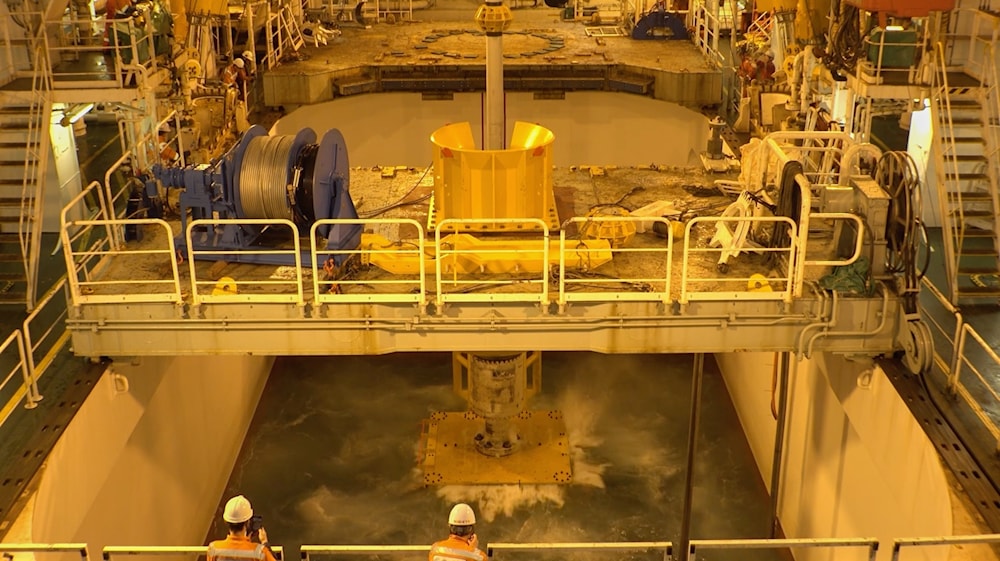
A mining device lowered to the seabed from the deep-sea drilling vessel Chikyu, off the atoll of Minamitorishima, Japanese exclusive economic zone, on February 18, 2026 (SIP/Japan Agency for Marine-Earth Science and Technology via AP)
Japan has launched a state-backed deep-sea mining initiative to extract rare earth elements from the Pacific Ocean, seeking to reduce its dependence on China, after Beijing reportedly cut off supplies following a diplomatic spat.
The Financial Times reported that a Japanese expedition this month successfully retrieved mud rich in rare earths from a seabed 6,000 meters below the surface, deeper than the height of Mount Fuji. The discovery site is near Minamitorishima, a remote atoll located 1,900 kilometers southeast of Tokyo within Japan’s exclusive economic zone, first identified as a potential resource in 2011.
China controls around 60% of global rare earth mining and over 90% of refining and high-power permanent magnet production. Japan, the world’s second-largest consumer of these minerals after China, has previously faced supply restrictions, notably in 2010 during a territorial dispute.
Japanese Prime Minister Sanae Takaichi, a right-wing hawk, described the deep-sea extraction as “the first step towards the industrialization of domestically produced rare earths.”
She indicated plans to involve the United States in the Minamitorishima project, aligning with Washington’s proposed cooperative trade zone for critical minerals with allies, including Japan and the European Union. China’s export restrictions came after Takaichi flaunted potential military action against Beijing in Taiwan. The Japanese prime minister's hawkish remarks triggered a strong diplomatic rebuke from Beijing, resulting in economic and cultural repercussions that affected rare earth supplies, fish markets, and tourism.
Read more: Takaichi says US alliance would break if Japan ignores Taiwan crisis
Why Japan is betting on Minamitorishima
Rare earths are critical for high-tech components used in defense systems, including missiles, radars, aircraft, and drones, as well as in civilian applications such as electric vehicle batteries.
Experts say the Minamitorishima deposits could compete with land-based mining due to high concentrations of heavy rare earths such as dysprosium, yttrium, and terbium. Unlike terrestrial deposits, the ocean mud is low in radioactive material, potentially easing processing challenges.
However, the project faces technical, economic, and environmental hurdles, according to FT. Large-scale extraction, planned for early next year with a target of 350 tonnes of mud per day, aims to test the feasibility of refining and transporting the mud to mainland Japan. Analysts warn that commercial production may not be sufficient to prevent short-term supply shortages, as Japan’s current reserves may last only until the end of the year.
Thomas Kruemmer, author of the Rare Earth Observer, described Minamitorishima as “seriously in play” and a “resource of last resort,” emphasizing the urgency of securing domestic sources. Yet others caution that the technical challenges of deep-sea mining, combined with the ¥40 billion ($255 million) already spent on exploration, could limit the project’s short-term impact.
Shoichi Ishii, the official overseeing the Minamitorishima programme, said the initiative could contribute to Japan’s supply chain after 2028, providing a domestic source of critical minerals for both industry and defense.
Tokyo, like other Global North nations pursuing a hawkish stance toward China, faces a strategic bottleneck created by Beijing’s dominance in rare earth refining. Efforts to shield markets from China’s rising influence are closely linked to aggressive militarization policies and the modernization of both deterrent and offensive capabilities.
However, these ambitions are constrained by the challenge of securing rare earths and permanent magnets, critical for producing next-generation systems. With China controlling the vast majority of these markets, Global North nations find themselves in a paradox, where they continue to rely on Chinese rare earths to develop and sustain their militaries.
Read more: US, Australia sign rare earths framework amid China's export controls


