
Lebanon finance minister defends tax hike amid union backlash
 5 Min Read
Lebanon tax hike approved to fund a sixfold public sector wage increase, drawing union backlash and protests amid the ongoing economic crisis.
-
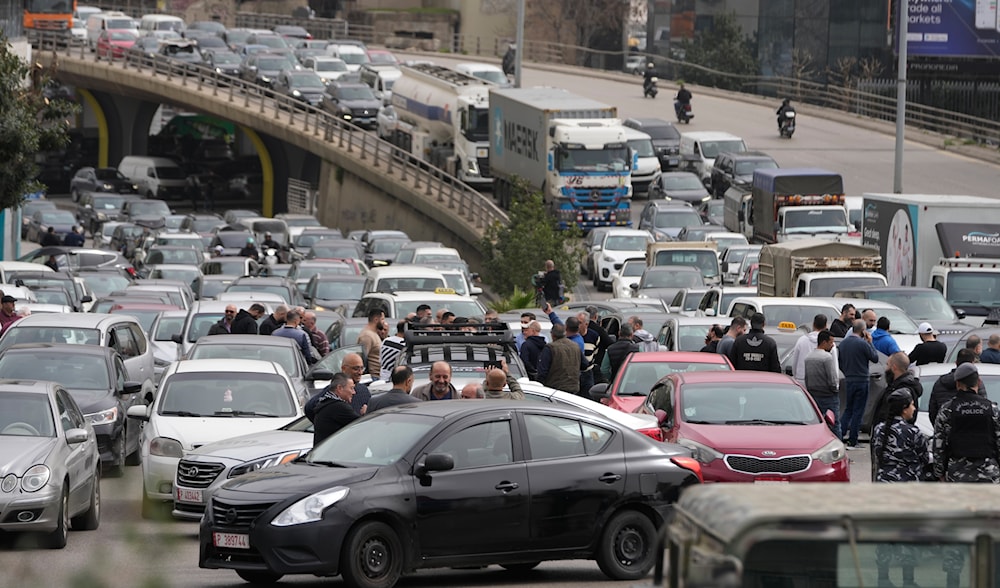
Taxi drivers, foreground, block a main highway with their cars during a protest against the increased taxes and gasoline prices issued by the Lebanese Cabinet on Monday, in Beirut, Lebanon, Tuesday, Feb. 17, 2026 (AP)
Lebanon’s finance minister on Tuesday defended the government’s decision to raise taxes in order to finance a long-awaited increase in public sector wages, a move that has triggered union backlash and street protests in the capital.
The cabinet approved the measures on Monday, aiming to increase by sixfold the rock-bottom wages and pension payments of hundreds of thousands of civil servants and retirees. The decision comes as the country continues to grapple with a devastating economic crisis that began in 2019 and sharply eroded purchasing power.
Lebanon is also facing the aftereffects of a recent war waged by "Israel", while international assistance remains tied to the implementation of public sector reforms.
Under the new measures, the value-added tax (VAT) will rise to 12 percent from 11 percent, and an additional 300,000 Lebanese pounds (around $3.30) will be added per 20-litre can of gasoline.
Finance minister claims tax hike necessary to preserve balance
Finance Minister Yassin Jaber said during a press conference that the wage hike would cost the state approximately $620 million. He said the tax increases were necessary to “preserve financial balance, because any imbalance would lead us to a crisis.”
The decision was not unanimous. Energy Minister Joe Saddi said he had “objected… to approving any tax increases at this stage.”
According to Jaber, Lebanon has around 320,000 public servants, including 120,000 members of the security forces. Their salaries have significantly declined in value over the past six years due to the severe depreciation of the Lebanese pound.
Government approach is doomed to fail
Walid Geagea, head of the Public Sector Employees Association, said the increases would raise public sector wages to about 28 percent of their pre-2019 crisis value. However, he rejected the government’s approach, arguing that “you give us a sixfold increase and it goes away (by paying for) fuel and taxes.”
Bassam Tlais, head of the Federations and Unions of the Land Transport Sector, said in a statement that while the group supports improving wages, it opposes “placing this additional burden on citizens and the transport sector.”
“Our demand is to find fair alternatives that don't burden people financially,” he said.
Taxi drivers briefly blocked a major road in central Beirut on Tuesday in protest against the measures.
Senior financial adviser Michel Kozah warned that the cabinet’s move “will create inflation,” adding that “the central bank will be forced to increase the money in circulation.”
Lebanon's public sector crisis' A-to-Z
Since the economic collapse that erupted in 2019, Lebanon has faced one of the worst financial crises in its modern history. A severe liquidity shortage, mounting public debt, and years of fiscal mismanagement led to a dramatic depreciation of the Lebanese pound, wiping out the real value of wages across both the public and private sectors.
Public sector employees were among the hardest hit. As inflation surged and the currency lost more than 90 percent of its value, civil servants’ salaries became nearly worthless in dollar terms. Many state institutions struggled to function as employees staged repeated strikes, demanding adjustments to offset the collapse in purchasing power.
Successive governments attempted temporary fixes, including limited bonuses and ad hoc allowances, but these measures failed to restore pre-2019 income levels. The widening gap between wages and living costs deepened social tensions and further strained public administration, particularly in critical sectors such as education, security, and public health.
The recent Lebanon tax hike emerged from this prolonged crisis. Officials argue that raising VAT and fuel levies is necessary to generate sustainable revenue to finance a structured increase in public sector wages, rather than relying on monetary expansion that could fuel further inflation.
History not on Lebanese government's side
Raising value-added tax and fuel levies in a fragile economy like Lebanon’s can easily backfire by reducing consumers’ already weak purchasing power. Higher VAT directly raises the cost of goods and services, meaning households may spend less on basic needs, worsening poverty and shrinking overall consumption.
Fuel tax hikes have a ripple effect: transport and delivery costs rise for businesses, pushing up prices across the economy. This can accelerate inflation, making everyday goods more expensive and feeding public frustration, especially when wages have not kept pace.
In high-inflation environments, the expected tax revenue gains can be dampened because rising prices reduce real tax collection and disincentivize economic activity. Households and firms cut back on spending when taxed more heavily, potentially slowing growth instead of boosting the state’s fiscal position.
Historical precedents reinforce this risk. During the eurozone debt crisis, Greece raised VAT and fuel taxes as part of austerity measures, yet the economy contracted sharply, shrinking the tax base. Argentina’s 2000–2001 tax increases amid recession similarly failed to restore stability and preceded economic collapse, while Italy’s VAT hikes during the same period coincided with a prolonged double-dip recession.
Politically, visible tax increases also risk provoking public backlash and protests when households are already under strain. Widespread unrest can destabilize governance, discourage investment, and complicate the very economic recovery the government is trying to achieve.


