
Oil prices rise after US attack on Iran, Israeli incursion in Lebanon
 4 Min Read
Oil prices rose over 2% after the US and Iran exchanged strikes and Israeli forces advanced further into Lebanon, heightening fears over supply disruption.
-
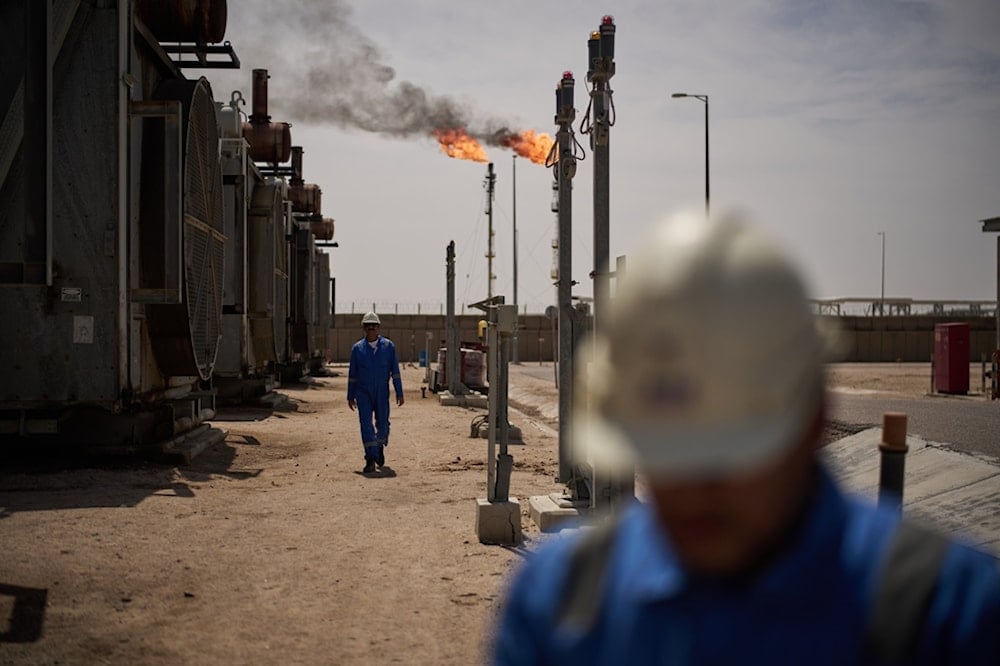
Workers walk in an area at a degassing station in Zubair oil field, whose operations have been reduced due to the US-Israeli war on Iran, near Basra, Iraq, March 28, 2026 (AP)
Global oil prices surged more than 2% on Monday after a renewed exchange of strikes between the United States and Iran, alongside reports of further Israeli military incursion into southern Lebanon, intensifying fears of broader regional escalation and potential disruption to key energy routes, Reuters reported.
The move added a fresh geopolitical risk premium to oil markets already sensitive to conflict dynamics across West Asia.
US crude futures climbed $2.29, or 2.62%, to $89.65 per barrel as of 0436 GMT. Brent crude rose $2.05, or 2.25%, reaching $93.17 per barrel.
The gains followed US aggression against Iran and the increasing Israeli attacks on Lebanon.
Market sentiment shifted sharply after a brief easing of prices late last week, when hopes of a possible extension of a ceasefire arrangement had helped push benchmarks lower.
US strikes in Iran, Iranian retaliation
The United States said it carried out what it described as “self-defense strikes,” targeting Iranian radar and drone control installations in Goruk and Qeshm Island, citing what it called “aggressive” actions by Tehran.
In response, Iran’s Islamic Revolution Guard Corps (IRGC) stated that its aerospace forces struck an airbase used in connection with a US operation targeting a telecoms tower on Sirik Island.
The exchange marks a further deterioration amid an already fragile ceasefire, undermining expectations that negotiations could soon lead to a sustained ceasefire extension.
US President Donald Trump had previously indicated that he would soon decide on a proposal to extend a ceasefire agreement announced in April, which was intended to allow further negotiations over Iran’s nuclear programme and regional tensions.
Read more: Suspicious $800 million US oil trades trigger regulatory probe
Israeli advances into Lebanon intensifies regional risk premium
Additional pressure on oil markets came from reports that Israeli forces had ordered further troop movements deeper into Lebanese territory amid Hezbollah's successful operations against the invading forces.
The escalation follows US-hosted discussions on the Israeli war on Lebanon in Washington last week under the pretext of bringing an end to the war.
"Israel's" military activity along the Lebanese front has added to concerns over the scope of Israeli aggressions as IOF and Knesset officials have called for the expansion of attacks.
Strait of Hormuz concerns and supply disruption fears
Analysts have warned that renewed tensions could increase risks to maritime security in the Strait of Hormuz, a critical shipping route for global oil and gas flows.
The waterway accounts for roughly one-fifth of global petroleum transit, making it one of the most strategically sensitive chokepoints in the global energy system.
Iran initially imposed a blockade on vessels linked to the US and Israeli aggressions against the Islamic Republic. Following the April 8 ceasefire, Washington then imposed its own blockade on the Strait, which only increased supply chain struggles.
Reuters reported that IG analyst Tony Sycamore stated that even if diplomatic progress is eventually achieved, supply normalization would likely remain gradual rather than immediate.
“Even if an agreement is reached, it won’t deliver a flood of supply,” he said.
Reports also circulated alleging increased mining activity in the Strait earlier in the week, further amplifying market concerns, though these claims have not been independently verified.
Read more: Oil prices plunge as US-Iran ceasefire eases Hormuz tensions
Market forecasts remain volatile amid geopolitical uncertainty
Meanwhile, Goldman Sachs warned that weaker demand in China and Europe poses a downside risk to its forecast of $90 per barrel for Brent crude in the fourth quarter and $83 for West Texas Intermediate.
However, the bank also noted that sustained supply disruptions due to the US-Israeli war on Iran could still push prices higher than current projections.
The outlook reflects a market caught between deteriorating demand fundamentals and escalating geopolitical instability, with traders increasingly pricing in rapid shifts in either direction.


