
Sanctions, EVs, tech controls: Gaps in the Trump-Xi summit
 3 Min Read
Trump's Beijing visit produced modest deals but left the thorniest US-China disputes, like sanctions, tech controls, and EVs, largely unresolved.
-
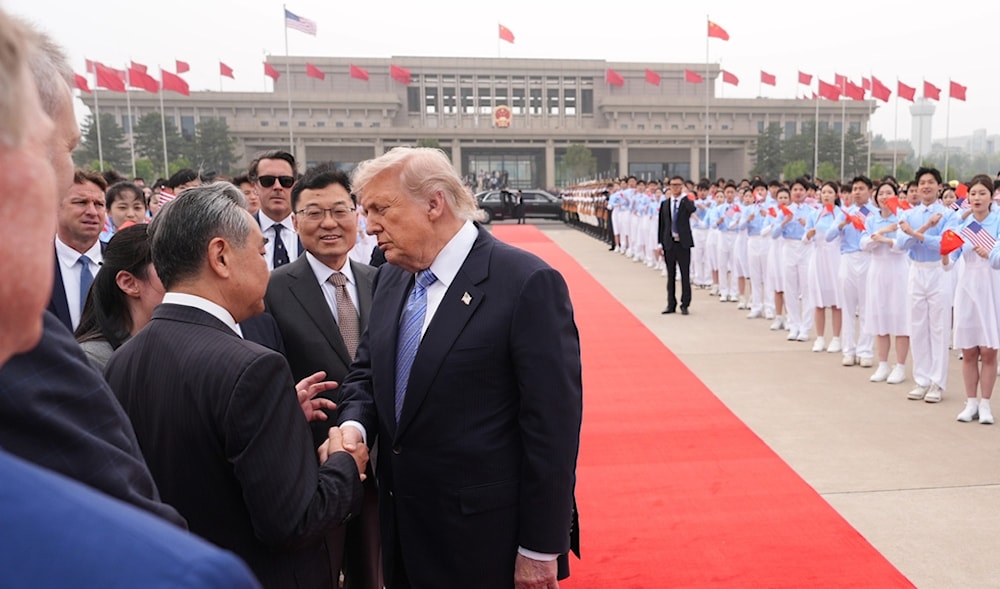
President Donald Trump shakes hands with China's Foreign Minister Wang Yi before boarding Air Force One, Friday, May 15, 2026, at Beijing Capital International Airport in Beijing (AP)
US President Donald Trump's state visit to Beijing this week produced a modest set of business commitments and enough diplomatic goodwill for both sides to claim progress.
But beneath the surface, the structural tensions that have come to define the US-China relationship remained largely intact, with the most sensitive issues either sidelined or unaddressed, CNN reported.
The frictions that have accumulated over a decade of strategic rivalry showed no sign of easing. For one, Washington offered nothing on its restrictions targeting critical minerals and semiconductor components, measures that have constrained technology development on both sides and continue to be a source of deep frustration for Beijing.
Chinese electric vehicles remained equally stuck. Despite Trump suggesting at the start of the year that he was open to allowing Chinese cars into the US market, US lawmakers pushed back hard, arguing the move would devastate domestic manufacturing and raise national security concerns.
No progress was reported on either front.
Sanctions in the spotlight, but only partly
One partial opening emerged after Trump left Beijing, when he told reporters aboard Air Force One that he was weighing whether to lift sanctions on Chinese companies purchasing Iranian oil, adding that a decision would come within days. The remarks confirmed that the issue had been discussed, even if it did not feature prominently in official readouts.
The oil trade sanctions, however, represent just one layer of a much broader sanctions architecture.
In the days before Trump's arrival, Washington designated nine Chinese and Hong Kong entities for supplying weapons and raw materials allegedly used in Iran's drone and ballistic missile programmes. Three additional Chinese firms were sanctioned for providing satellite imagery that allegedly enabled Iranian strikes against US forces. Neither set of measures was publicly addressed during the summit.
China, for its part, has instructed its companies and banks to disregard US sanctions on five Chinese refineries, invoking a formal blocking mechanism, the first time Beijing had activated it, and dismissing the underlying measures as a violation of international law. That legal standoff, too, went unresolved.
Read more: China's position on Iran, Hormuz remains unchanged: Exclusive
A diminished summit by any measure
The gap between this summit and Trump's 2017 Beijing visit was difficult to ignore.
That trip saw nearly 30 American executives accompany the president, with announced deals exceeding $250 billion and Chinese commitments to purchase 300 Boeing aircraft.
This week, 17 executives attended, Boeing commitments came in at 200 planes, and the overall value of announced agreements fell well short of the 2017 benchmark.
The contrast reflects how profoundly the bilateral relationship has shifted. Two rounds of trade war, China's growing economic self-reliance, and the maturation of domestic Chinese competitors in technology and manufacturing have steadily eroded US leverage.
While the 2017 business delegation arrived to lock in export agreements, this year's cohort appeared primarily focused on preserving whatever foothold they still hold in the Chinese market.
The summit produced enough to allow both governments to claim a measure of success. On the harder questions, it resolved very little.
Read more: Explainer: What is the ‘Thucydides Trap’ China says US must avoid


