
US approves Nvidia H200 chip sales to major Chinese firms
 4 Min Read
The US approved Nvidia H200 AI chip sales to major Chinese companies, including Alibaba and Tencent, marking a significant shift despite stalled deliveries.
-
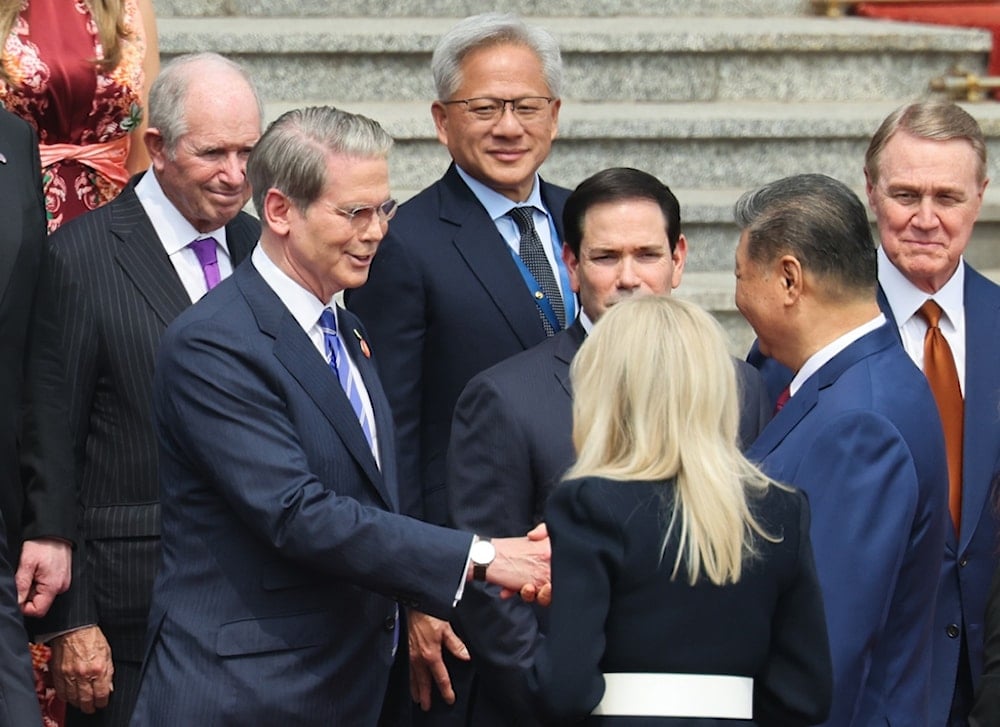
Chinese President Xi Jinping greets US Treasury Secretary Scott Bessent near US Secretary of State Marco Rubio, US Ambassador to China David Perdue, Nvidia CEO Jensen Huang, and Blackstone CEO Stephen Schwarzman at the welcome ceremony for US President Donald Trump, at the Great Hall of the People in Beijing, Thursday, May 14, 2026. (Maxim Shemetov/Pool Photo via AP)
The United States has approved export licenses allowing Nvidia to sell its H200 artificial intelligence chips to several major Chinese technology firms, three people familiar with the subject told Reuters, signaling a notable development in the escalating technological competition between Washington and Beijing.
According to Reuters, the approved buyers include major Chinese technology firms such as Alibaba, Tencent, ByteDance, and JD.com.
Distributors, including Lenovo and Foxconn, were also reportedly authorized to facilitate sales.
Under the licensing framework approved by Washington, each customer would be allowed to acquire up to 75,000 H200 chips.
However, despite approvals from the US Commerce Department, no shipments have yet been completed as political and regulatory concerns on both Beijing and Washington continue to delay implementation.
Jensen Huang seeks breakthrough during China visit
Nvidia CEO Jensen Huang reportedly joined US President Donald Trump during his trip to Beijing after receiving a direct invitation from the White House.
Reuters reported that Trump personally picked up Huang in Alaska en route to a summit with Chinese President Xi Jinping, fueling speculation that the visit could unlock the stalled semiconductor agreements.
Huang has repeatedly emphasized the importance of the Chinese market for Nvidia, which once controlled approximately 95 percent of China’s advanced AI chip sector before export restrictions intensified.
China previously accounted for roughly 13 percent of Nvidia’s revenue, while Huang estimated earlier this year that China’s AI market alone could reach $50 billion.
Speaking to Chinese state broadcaster CCTV, Huang expressed hope that discussions between Trump and Xi could improve bilateral relations and ease tensions affecting the technology sector.
Read more: Russia says yuan gaining ground in global oil payments
Beijing wary of dependence on US technology
Despite US authorization, Chinese firms have reportedly become increasingly cautious about moving forward with purchases.
One source told Reuters that Chinese companies scaled back plans after receiving unofficial guidance from Beijing, while another source indicated pressure is growing within Chinese institutions to either block or heavily scrutinize such imports.
The hesitation reflects Beijing’s broader effort to reduce dependence on foreign technology amid escalating geopolitical tensions and export restrictions.
Chinese firms have increasingly promoted domestic alternatives, particularly chips developed by Huawei.
Companies such as DeepSeek have publicly highlighted their reliance on Chinese-made semiconductor infrastructure, reinforcing the government’s push for technological self-sufficiency.
The report noted that Nvidia’s share of China’s AI accelerator market has effectively collapsed under the weight of US export controls.
Washington tightens conditions on AI chip exports
The proposed transactions remain constrained by a complex set of US regulatory conditions introduced earlier this year.
Washington requires Chinese buyers to prove they have implemented “sufficient security procedures” and guarantees that the chips will not be used for military purposes.
Nvidia must also certify that adequate inventory remains within the United States before exports can proceed.
The Trump administration reportedly negotiated an additional arrangement requiring the US government to receive 25 percent of the revenue generated from the chip sales.
Because US law prevents direct export fees, the arrangement reportedly requires the chips to transit through US territory before shipment to China.
That mechanism has reportedly generated concern inside China over potential tampering risks or embedded vulnerabilities within critical technology infrastructure.
Meanwhile, Beijing has intensified domestic scrutiny through new supply-chain security regulations aimed at reducing foreign dependencies in strategic sectors.
US-China tech rivalry deepens around semiconductors
The dispute surrounding Nvidia’s H200 chips underscores the increasingly confrontational nature of the technological rivalry between the United States and China.
Semiconductors have become central to broader geopolitical competition involving artificial intelligence, military modernization, industrial policy, and economic influence.
Critics inside Washington argue that even restricted semiconductor sales could narrow the US technological advantage.
Chris McGuire, senior fellow for China and emerging technologies at the Council on Foreign Relations, criticized the administration’s approach, stating, “Any deal that allows Nvidia to sell more chips to China means fewer Nvidia chips for U.S. firms, and a smaller U.S. lead in AI over China.”
“It is remarkable that President Trump keeps getting convinced to put Nvidia’s interest ahead of America’s,” he added.
Read more: US imposes new sanctions targeting Iran oil shipments to China


