
China grants first H200 approvals as AI needs clash with autonomy goal
 5 Min Read
China has approved Nvidia's H200 AI chips for import, marking a strategic shift as Beijing balances immediate tech needs against long-term semiconductor independence goals.
-
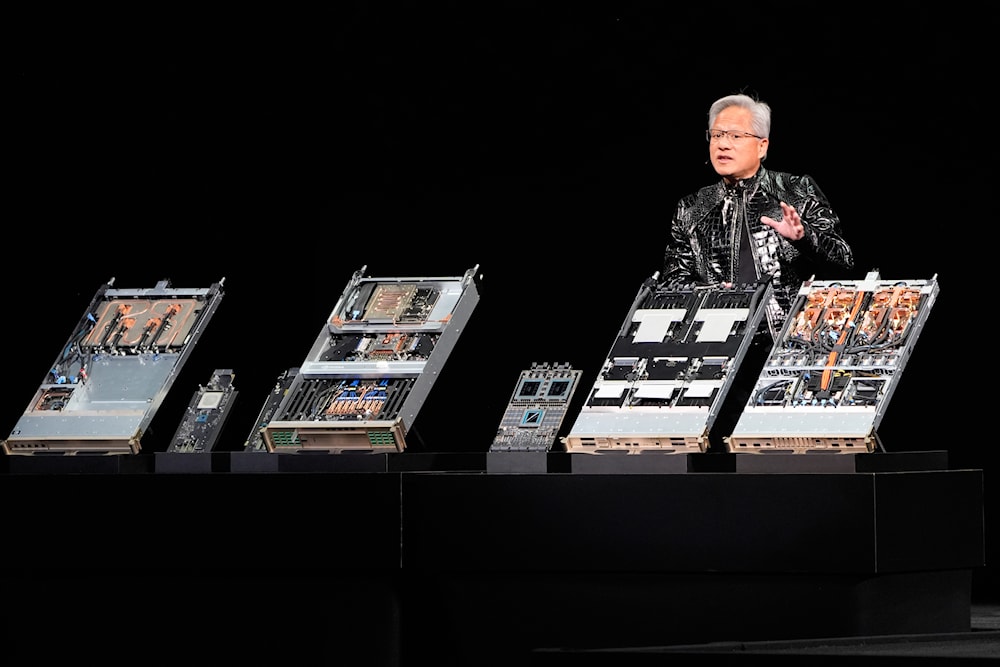
Nvidia founder and CEO Jensen Huang speaks about the NVIDIA Rubin AI super computing platform during a Nvidia news conference ahead of the CES tech show Monday, Jan. 5, 2026, in Las Vegas. (AP Photo/John Locher)
China has authorized the import of Nvidia's H200 artificial intelligence processors for the first time, according to sources cited by Reuters, signaling a calculated shift as Beijing navigates between immediate technological needs and long-term autonomy goals in its semiconductor sector.
The initial authorization encompasses several hundred thousand chips and coincided with Nvidia CEO Jensen Huang's visit to China this week, Reuters reported, citing individuals familiar with the matter who requested anonymity given the issue's sensitivity.
Three major Chinese internet companies received priority allocation in this first approval wave, with additional enterprises now queuing for subsequent clearances, one source told Reuters. The companies benefiting from initial authorization were not identified.
A flashpoint in US-China tech competition
The H200 represents Nvidia's second-most powerful AI chip and has become a contentious issue in US-China technological competition. While Washington formally authorized H200 exports to China earlier this month and Chinese firms demonstrated strong purchasing interest, Beijing maintained the ultimate authority over actual imports.
Chinese customs officials had previously instructed agents earlier this month that H200 chips were barred from entry. The directive was so restrictive that government representatives simultaneously convened meetings with domestic technology companies, explicitly instructing them not to purchase H200 chips unless absolutely necessary.
Demand for the chips is intense. Chinese technology companies had placed orders exceeding two million H200 units at approximately $27,000 each, a potential market worth over $54 billion, far surpassing Nvidia's available inventory of roughly 700,000 chips.
Security concerns shadow approval decision
The approval comes despite persistent security concerns voiced by China's Cyberspace Administration (CAC). In July 2025, CAC summoned Nvidia to address "serious security issues" centered on three principal concerns: potential backdoor vulnerabilities that could compromise user data or system integrity, location tracking capabilities that might map Chinese AI infrastructure, and remote shutdown functions that could serve as "kill switches" disabling chips during geopolitical crises.
CAC explicitly linked these technical concerns to proposals by US lawmakers, including the Chip Security Act, advocating mandatory tracking features in exported AI chips. Chinese regulators argued that if such capabilities are technically feasible and politically desired in Washington, Beijing must assume they could be covertly implemented in China-bound products.
In September 2025, CAC issued guidance effectively banning major Chinese technology firms, including ByteDance and Alibaba, from purchasing Nvidia's H20 chips. By October, customs agents at major Chinese ports began intensified inspections of Nvidia shipments.
Performance gap drives demand
The technical capabilities driving this demand are substantial. The H200 delivers approximately six times the computational performance of Nvidia's H20 chip, which had been the most advanced processor the company could previously sell to China under export restrictions. This performance gap persists despite progress by domestic manufacturers like Huawei, whose products now rival the H20 but remain significantly behind the H200's capabilities.
Balancing immediate needs with long-term goals
Beijing's approval reflects competing priorities. Chinese internet giants are investing billions in data center infrastructure necessary for AI services development and competition with American rivals, including OpenAI. These immediate infrastructure needs appear to have influenced authorization decisions, with major internet companies receiving preferential treatment in the initial batch.
In November 2025, Chinese authorities issued a sweeping directive requiring all state-funded or state-subsidized data center projects to use exclusively domestically produced AI chips. Projects less than 30% complete were ordered to remove all installed foreign chips or cancel purchase plans entirely, while future projects receiving state funding were prohibited from procuring foreign AI accelerators.
However, the approval framework may include conditions designed to protect domestic semiconductor development. Reuters previously reported that Beijing discussed requirements for companies to purchase specified quantities of domestically-produced chips as a prerequisite for foreign semiconductor import authorization, though details of such quotas in the H200 context remain unclear.
The approval timing, during Huang's China tour, which began in Shanghai last Friday for annual celebrations with Nvidia's Chinese employees before extending to Beijing and other cities, suggests diplomatic considerations accompanied the technical and commercial factors.
Uncertainty ahead
Uncertainty persists regarding subsequent approval batches, including how many additional companies will receive authorization and what eligibility criteria the Chinese government will apply.
The decision to authorize H200 imports marks a pragmatic adjustment rather than a strategic reversal. Beijing appears willing to address the urgent computational needs of major technology companies while maintaining its broader commitment to semiconductor independence. This approach allows Chinese firms to remain competitive in the global AI race today without abandoning the goal of reducing reliance on American-controlled chip technology tomorrow.


