
New DeepSeek AI model raises Blackwell export control concerns
 3 Min Read
DeepSeek is set to launch a new AI model reportedly trained on Nvidia’s Blackwell chip, raising concerns over US export controls and China access.
-
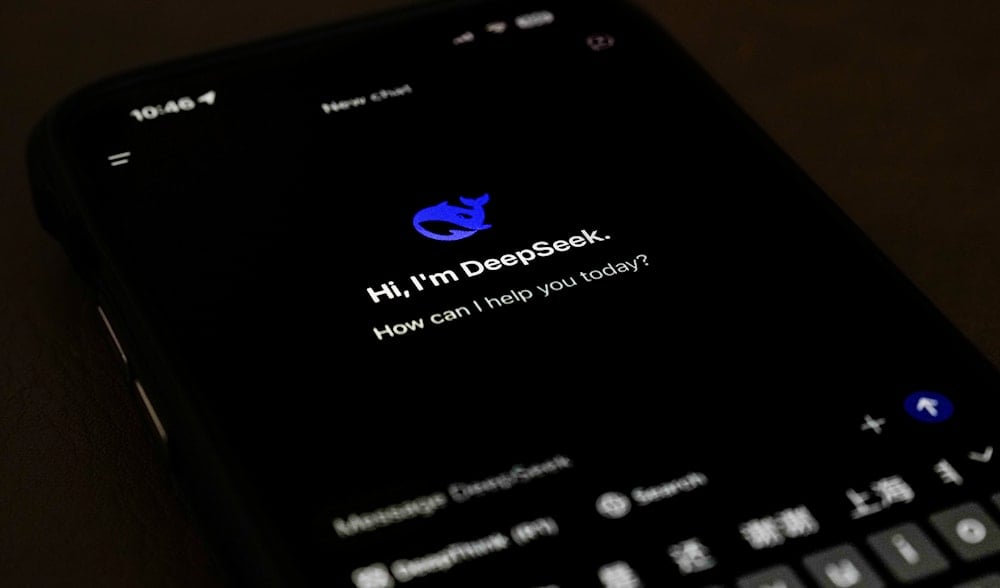
The page for the smartphone apps DeepSeek is seen on a smartphone screen in Beijing, Tuesday, Jan. 28, 2025 (AP)
Chinese AI startup DeepSeek is preparing to release a new AI model as early as next week, reportedly trained on Nvidia’s most advanced AI chip, the Blackwell, a senior Trump administration official told Reuters on Monday.
The official suggested this could represent a violation of US export controls, as US policy prohibits shipping Blackwell chips to China.
The official added that DeepSeek may have removed technical indicators that could reveal the use of American AI chips. The Blackwells are believed to be concentrated at the company’s data center in Inner Mongolia, an autonomous region of China. Details on how DeepSeek obtained the chips or how the US government learned of it were not disclosed.
Nvidia declined to comment, and neither the Commerce Department nor DeepSeek responded to requests for comment. The Chinese embassy in Washington criticized what it described as the politicization of trade and technology, stating Beijing opposes “drawing ideological lines, overstretching the concept of national security, expansive use of export controls and politicizing economic, trade, and technological issues."
Confirmation that DeepSeek has obtained Blackwell chips, first reported by Reuters, could deepen divisions among Washington policymakers over Chinese access to critical US AI technology. White House AI Czar David Sacks and Nvidia CEO Jensen Huang argue that exporting advanced AI chips helps discourage Chinese firms like Huawei from quickly catching up with US competitors.
However, China hawks warn that such chips could be diverted for military purposes, potentially threatening US dominance in AI. Chris McGuire, a former White House National Security Council official under President Joe Biden, said, “This shows why exporting any AI chips to China is so dangerous… we cannot expect them to comply with US conditions prohibiting use for military purposes.”
The history of the Blackwell and China
US export controls overseen by the US Department of Commerce currently prohibit shipments of Nvidia’s most advanced Blackwell chips to China. In August, Donald Trump signaled openness to allowing Nvidia to sell a scaled-down version of the chip to Chinese buyers, but later reversed course, stating that the firm’s most advanced technology should be reserved for US companies.
Trump’s decision in December to permit Chinese firms to purchase Nvidia’s second-most advanced chips, known as the H200, drew sharp criticism from China hawks. However, shipments remain stalled due to guardrails attached to the approvals, reflecting ongoing internal debate within Washington over the risks of technology transfers.
Saif Khan, who previously served as director of technology and national security at the White House National Security Council under former President Joe Biden, said Chinese firms’ alleged reliance on smuggled Blackwell chips highlights weaknesses in China’s domestic AI semiconductor production. Khan argued that approving H200 exports would effectively provide a critical lifeline to Chinese AI companies.
The administration official declined to comment on whether the latest developments involving DeepSeek would affect any decision on potential H200 sales. The official also said the model trained by DeepSeek likely relied on “distillation” techniques using leading US AI systems developed by Anthropic, Google, OpenAI, and xAI.
Distillation is a technique in which a newer AI model is trained by evaluating its outputs against responses generated by an older, more advanced model, effectively transferring knowledge and improving performance.


