
Trump fails to dictate terms on the Federal Reserve: FT
 4 Min Read
Kevin Warsh defied Trump and raised rates as inflation from tariffs and the US war on Iran forced the Fed's hand despite pressure.
-
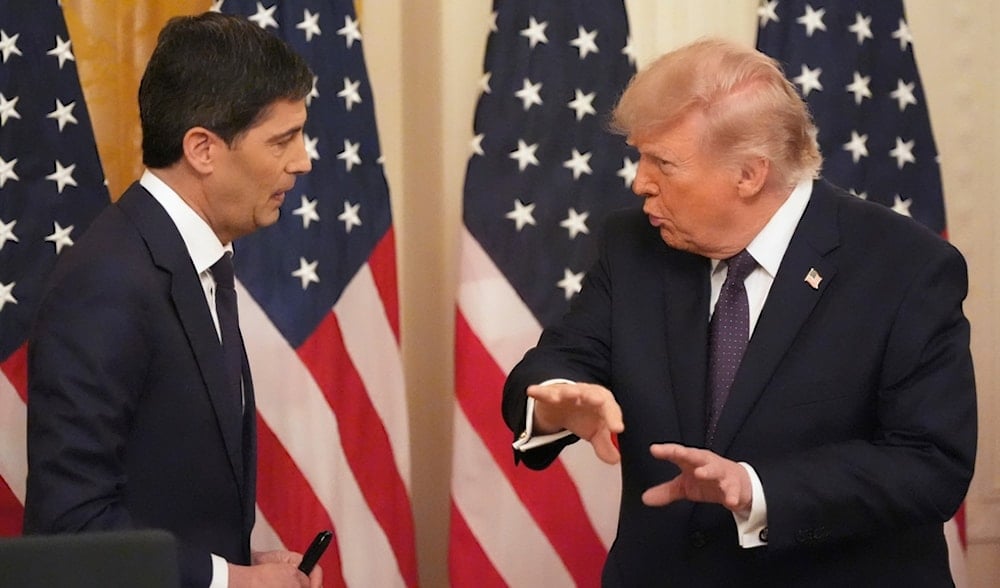
US President Donald Trump speaks with Federal Reserve Chairman Kevin Warsh during Warsh's swearing-in in the East Room of the White House, Friday, May 22, 2026, in Washington. (AP Photo/Alex Brandon)
Kevin Warsh, the man Donald Trump handpicked to run the Federal Reserve, has shown he will not simply follow the president's orders. Less than four months into the job, Warsh led all 12 members of the Federal Open Market Committee to back a quarter-point interest rate increase, the first such rise since 2023.
Trump had chosen Warsh believing he "certainly wants to cut rates." Instead, Warsh told reporters on Wednesday that inflation "is too high and has been for too long," and said he would be "hard pressed" to call current rates restrictive.
The signal came just weeks ahead of the midterm elections, at a moment when Wall Street had been losing patience with the Fed's tolerance for high prices.
Fed projections point to more tightening ahead, with a dozen officials expecting another quarter-point hike this year, and four expect two more. Only two anticipate rates staying unchanged through 2026. Economists cited by the Financial Times described Warsh as the most hawkish voice on the committee.
Trump lashes out, then backs down
Trump reacted on his Truth Social platform, insisting rates "should be 1%, or less" given what he called America's "Best Credit in the World."
But he then appeared to concede he had no real leverage over the bank, telling reporters he had advised Warsh to "vote with the board because it's just not going to matter," and blaming the "very hostile" board itself, which includes former chair Jay Powell and governor Lisa Cook, both of whom Trump has targeted in the past.
Analysts said Trump attacking the Fed publicly would only expose his own lack of control over it. Brown University professor Jeff Colgan noted that further complaints would "show that people can stand up to him."
Inflation tied to Trump's own policies
Economists interviewed by the Financial Times placed much of the blame for rising prices on the administration's own agenda.
The Fed's preferred inflation gauge, the PCE price index, is running at 3.7 percent, nearly double the central bank's 2 percent target. Claudia Sahm, a former Fed official now at New Century Advisors, pointed to tariffs and the US war on Iran as key drivers pushing prices upward. Meanwhile, Colgan insists that inflation "the Fed is fighting is a problem of President Trump's own making."
Since Warsh's nomination in January, rising fuel prices have been a major factor, costing American households an extra $108 billion since the war on Iran began, according to a Brown University tracker cited by the newspaper.
Ghalibaf mocks the Fed
Shortly before the Fed announced the rate hike on Wednesday, Mohammad Bagher Ghalibaf, speaker of Iran's parliament, posted a modified version of the Taylor rule, the formula central banks use to set interest rates.
Straits Taylor Rule:
— محمدباقر قالیباف | MB Ghalibaf (@mb_ghalibaf) September 16, 2026
i = r* + π* + 1.5(π−π*) + 0.5(y−y*) + α(SOH−SOH*) + β(BEM−BEM*), α,β > 0
Let’s see if a hike could open SOH or produce a single barrel :)
You can’t 25bp a chokepoint and r* isn’t neutral. It’s SOH risk premium, and We set it.
Stay unanchored !
The standard rule holds that a policy rate should equal the neutral real rate plus target inflation, adjusted for how far inflation and output stray from target.
Ghalibaf added two extra terms tied to the Strait of Hormuz and Bab al-Mandab, both assigned a positive coefficient, meaning the more those chokepoints are constrained, the higher the rate the Fed is forced to set to contain the resulting inflation.
"You can't 25bp a chokepoint and r* isn't neutral," Ghalibaf wrote, arguing that what the Fed treats as a neutral rate is in fact a risk premium tied to the straits. "It's SOH risk premium, and we set it." He closed with "Stay unanchored," a jab at the Fed's own language around "anchoring" inflation expectations.
The post suggests that Iran holds real leverage over the terms US monetary policy is set on, through its control over Hormuz.
Markets respond
The dollar gained about 0.7 percent against a basket of currencies following the decision. Two-year Treasury yields climbed to 4.74 percent before easing slightly to 4.71 percent on Thursday. Thirty-year yields, which had spiked to their highest level since 2007 after Warsh appeared indecisive at the Fed's July meeting, eased slightly after Wednesday's vote restored some investor confidence in his independence.
The Fed's next vote is set for late October, just days before the midterms. While another hike at that meeting is seen as less likely, markets are already pricing in at least one more increase before year's end.


