
US military faces readiness challenges war on Iran: The Intercept
 4 Min Read
US officials warn that the Iran war is placing severe pressure on the US military, with challenges including air defense strains, logistics issues, and readiness concerns.
-
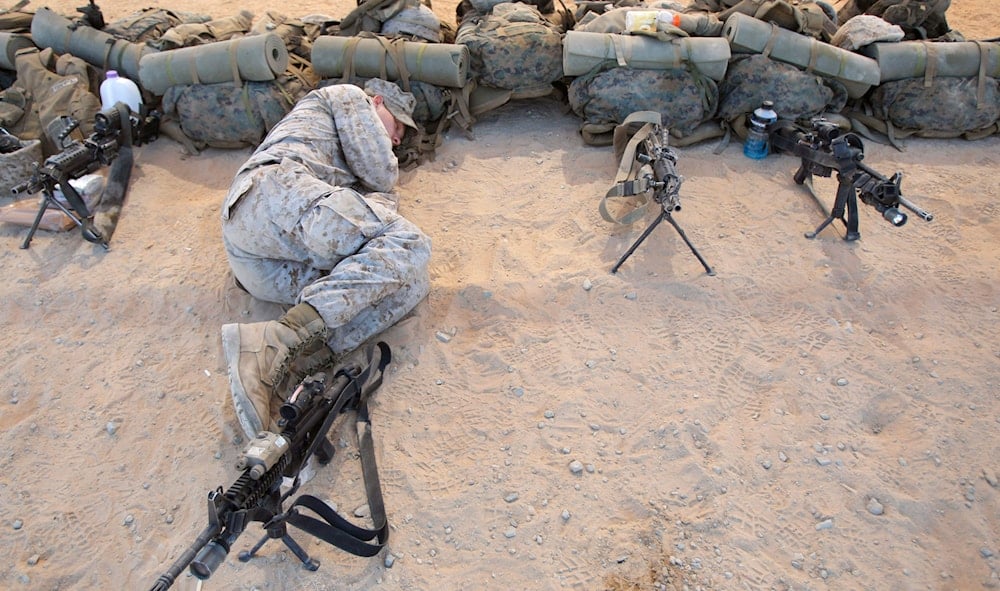
US Marine Lcpl. Scott Rucker, of Tampa, Fla., takes a nap at the Marine Corps Air Ground Combat Center in Twentynine Palms, Calif., on Sept. 29, 2009 (AP)
The US military is facing severe pressure as a result of the war on Iran, according to US officials familiar with developments in the Middle East who spoke to The Intercept.
One official warned that the strain could lead to "a collapse in the military's ability to continue the war effectively."
The outlet assessed that Iran's ability to penetrate US air defenses in the region using drones and advanced ballistic missiles has placed the US military in "a critical position."
Trump admin misjudged Iranian military capabilities
A US official said the administration of President Donald Trump "did not properly assess Iranian military capabilities," pointing to "a complete absence of war planning."
The military faces a growing list of challenges, according to the outlet, beginning with Iranian retaliatory strikes on US bases and warships in the Middle East, the depletion of defensive ammunition stockpiles, rising casualties, maintenance problems on ships, extended troop deployments, complex logistics, declining "morale," and other issues that have harmed military readiness.
The outlet said the Pentagon's budget is "strained," saying this contrasts with months of "rosy statements" issued by the Trump administration. Officials said the military's ability to operate at full capacity had been "paralyzed" in the first hours of the war.
Officials dispute white house claims on Iran
Trump had previously promoted the "destruction of the Iranian navy" as "one of his most prominent achievements in the war," but officials pointed to the severe pressure endured by US naval forces in the region, according to The Intercept.
A second official, speaking to the outlet, rejected White House assumptions that Iran "will collapse," saying: "The matter is difficult and ultimately unsustainable."
Despite months of claims by Trump and Secretary of War Pete Hegseth that the Iranian military had been "annihilated," Iran was able to "attack" more than 15 bases across the Middle East, according to information from US officials and Iranian reports.
Israeli outlet cites 'scale of American strategic defeat'
Israeli outlet Mekor Rishon discussed "the scale of the American strategic defeat in its unnecessary war on Iran and its far-reaching repercussions,"
In an article by editor-in-chief Rami Yitzhar, it said that "everything Trump tried to hide at any cost, everything Hegseth rudely denied, and everything White House officials deliberately concealed is now exposed to everyone."
According to the outlet, Iran's stockpiles of advanced air defense missiles, such as Patriot missiles and THAAD interceptor missiles, remain intact.
Iranian strikes devastated US assets across West Asia
A Pentagon watchdog's first formal assessment found that Iranian retaliatory strikes damaged or destroyed hundreds of buildings at US bases across Kuwait, Bahrain, Qatar, the UAE, Saudi Arabia, Iraq, Oman, and Jordan between February 28 and June 30, while depleting critical missile interceptor stockpiles, with CNN reporting nearly 80% of THAAD and about half of Patriot interceptors used and commanders warning reserves were dangerously low.
The strikes forced US Central Command to relocate personnel, equipment, and storage, including withdrawing Army medical evacuation helicopters from Iraq and Kuwait, and heavily damaged the Navy's Bahrain hub, which Acting Navy Secretary Hung Cao said Iran "blew the hell out of", pushing resupply through Diego Garcia and extending cycles to 14–18 days.
The damage has fueled debate in Washington over reducing the US military footprint in West Asia, where about 50,000 troops remain without a clear exit strategy, and where 18 service members have been killed and some 800 wounded, while US officials quietly discuss possible cuts to personnel and facilities.
The watchdog also reported more than 50 US aircraft damaged or destroyed, including 4 F-15Es, seven KC-135s, four AH-6 helicopters, and at least 30 MQ-9 drones.
Figures attributed to the Congressional Research Service and the Operation Epic Fury report to Congress also listing one F-35 damaged by enemy fire and one each of A-10, E-3 AWACS, HH-60W, AH-64, MH-60, and MQ-4C destroyed.


