
US-Iran deal weakens dollar as oil prices tumble
 5 Min Read
The US dollar hit a 10-day low as a US-Iran deal framework eased geopolitical tensions, pushed oil prices lower, and boosted risk-sensitive currencies.
-
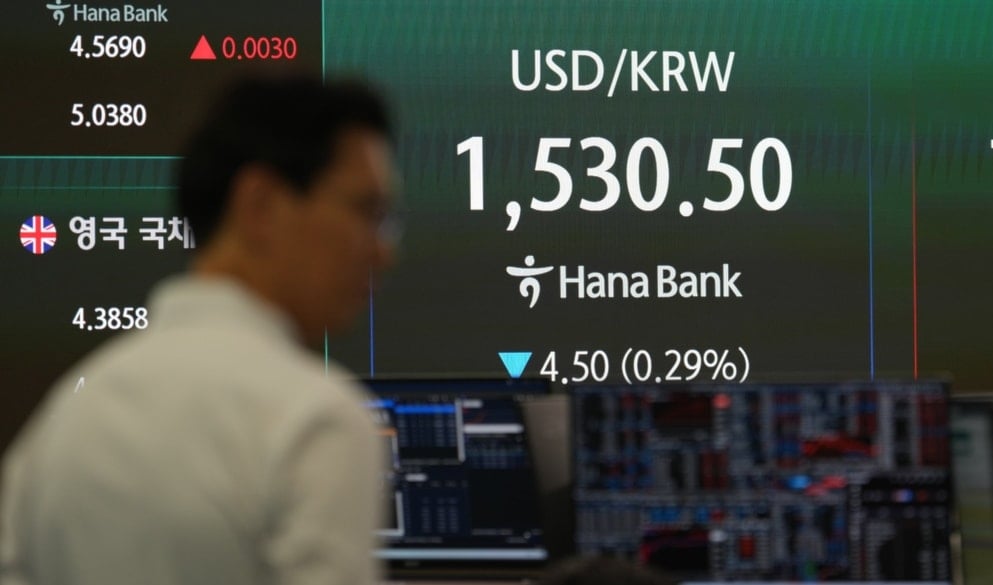
A dealer stands near the screens showing the foreign exchange rate between US dollar and South Korean won at a dealing room of Hana Bank in Seoul, South Korea, Tuesday, June 9, 2026. (AP)
The US dollar fell to a 10-day low against major currencies on Monday after a preliminary US-Iran deal eased geopolitical tensions, driving oil prices lower and boosting demand for risk-sensitive assets.
US and Iranian officials said on Sunday they had agreed on a framework for a deal aimed at ending the war, lifting the US blockade on Iran, and reopening the Strait of Hormuz. The memorandum of understanding is expected to be formally signed on Friday, although markets remain cautious as details continue to emerge and nuclear negotiations remain unresolved.
Agreement pressures safe-haven dollar
The prospect of reduced regional tensions weighed on the safe-haven dollar, while investors moved toward higher-risk currencies. Lower oil prices also helped ease inflation concerns, reducing demand for defensive assets.
Brent crude futures fell more than 4% to $83.82 per barrel, reflecting expectations that energy supplies could normalize following the reopening of the Strait of Hormuz.
The euro rose 0.3% to $1.1601 during Asian trading, while the British pound gained 0.2% to reach $1.3434.
Among risk-sensitive currencies, the Australian dollar climbed 0.6% to $0.7079, and the New Zealand dollar advanced 0.4% to $0.5854.
The dollar index, which tracks the US currency against a basket of major peers including the euro and Japanese yen, stood at 99.55 after earlier touching its weakest level since June 5.
"I think we'll see the dollar fall over the course of the next few sessions. We'll probably see some of the risk currencies like Aussie and yen appreciate a little bit. But I don't think we're going to see any huge moves," said Nick Twidale, chief market strategist at ATFX Global in Sydney.
"There's going to be a lot of wait and see, on how quickly the strait really reopens and how long it's going to take for oil flows to really get back to normal. It's certainly going to be months rather than weeks."
Oil prices remain sensitive to changes
Market participants are closely monitoring how quickly shipping activity can return to normal through the strategic waterway, which handles a significant share of global energy exports.
While the framework agreement has improved sentiment, traders remain cautious about the implementation timeline and the broader negotiations that will follow. Any delays or setbacks could affect oil prices and investor confidence across global currency markets.
The Japanese yen weakened to 160.225 per dollar, remaining near a level that investors view as a potential trigger for official intervention by Japanese authorities.
Central banks weigh inflation outlook
Attention is now turning to major central banks, with the Federal Reserve, the Bank of Japan, and the Reserve Bank of Australia all scheduled to announce interest-rate decisions this week.
Investors are assessing whether the US-Iran agreement and lower energy prices will reduce inflationary pressures and influence future monetary policy decisions.
The Federal Reserve is widely expected to keep interest rates unchanged within the current 3.5%-3.75% range on Wednesday. However, markets will closely scrutinize the policy statement and comments from Chair Kevin Warsh for signals on the future path of Federal Reserve interest rates.
According to the CME FedWatch Tool, traders now assign roughly a 50% probability to a rate increase in December, down from more than 70% just one week ago.
"Negotiations on aspects of the deal are ongoing, but no doubt central bankers will be breathing a sigh of relief, for now at least, that the upside risks to inflation appear to be receding and not becoming the central scenario," said Prashant Newnaha, senior rates strategist at TD Securities in Singapore.
Federal Reserve, BOJ, and RBA decisions in focus
The Reserve Bank of Australia is also expected to leave interest rates unchanged at 4.35% when policymakers meet on Tuesday, following three rate increases earlier this year.
Meanwhile, the Bank of Japan is expected to raise interest rates to 1%, marking its highest level in more than three decades. Policymakers are also anticipated to signal a willingness to continue tightening monetary policy despite easing geopolitical risks.
The direction of global currency markets this week is likely to depend not only on developments surrounding the US-Iran deal but also on how central banks interpret its implications for inflation, growth, and future interest-rate policy.
Read more: E4 nations ready to lift Iran sanctions following Iran-US deal


