
US national debt approaches $40 trillion amid war on Iran
 3 Min Read
US national debt surpasses $39 trillion amid rising government spending, war costs, and fiscal challenges, raising concerns over long-term economic stability and future borrowing.
-
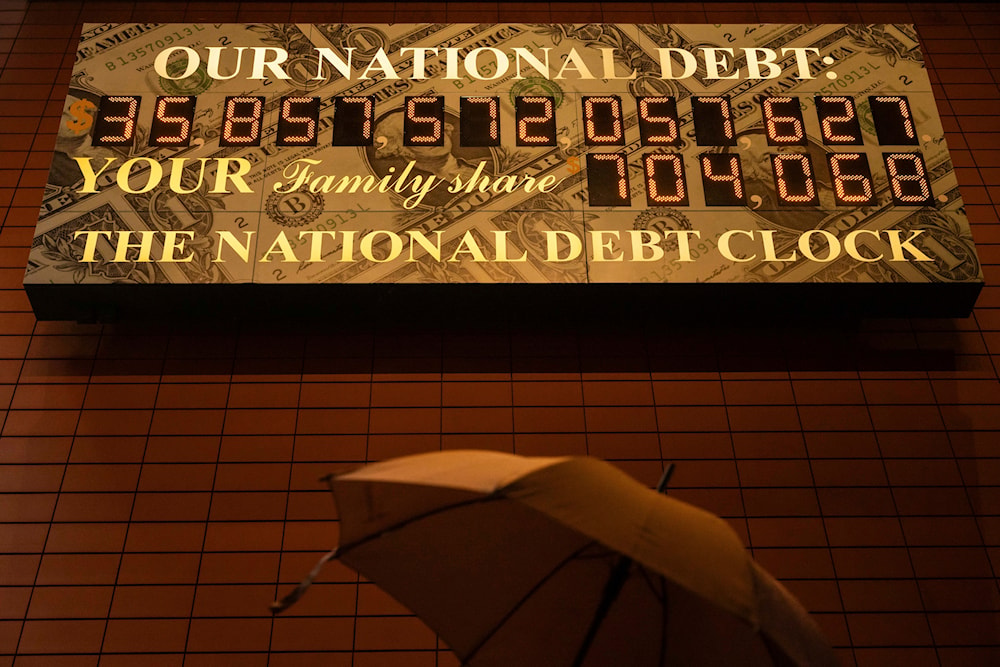
A person carrying an umbrella walks past the National Debt Clock, Monday, April 7, 2025, in New York (AP)
The US national debt exceeded a record $39 trillion on Wednesday, marking an unprecedented milestone just weeks into the ongoing US-Israeli war on Iran.
The surge underscores the tension between competing federal priorities, from enacting a massive tax law and increasing defense and immigration spending to efforts to reduce the debt, a promise US President Donald Trump made both on the campaign trail and during his presidency.
The Government Accountability Office (GAO) has highlighted the effects of rising government debt on Americans, including higher borrowing costs for mortgages and vehicles, reduced investment capacity for businesses that can lead to lower wages, and increased prices for goods and services. Advocates of a balanced budget warn that continued borrowing and rising interest payments will force Americans to make difficult fiscal tradeoffs in the future.
Definition of unsustainable
Michael Peterson, chair and CEO of the Peter G. Peterson Foundation, a nonprofit focused on raising awareness of long-term US fiscal challenges, said in a statement, “We must recognize this alarming rate of growth and the significant financial burden we are putting on the next generation.”
The federal debt has grown under both Republican and Democratic administrations, driven most recently by wars, pandemic-related spending, and tax cuts. The national debt reached $38 trillion five months ago and $37 trillion two months prior.
“At the current growth rate, we will hit a staggering $40 trillion in national debt before this fall’s elections,” Peterson added. “Borrowing trillion after trillion at this rapid pace with no plan in place is the definition of unsustainable.”
War on Iran cost US $12 bln in two weeks
White House economic advisor Kevin Hassett estimated Sunday that the war on Iran has already cost the US more than $12 billion, though the timeline for the war remains uncertain.
Despite the rising debt, White House spokesman Kush Desai highlighted a recent decline in the federal deficit. According to Treasury Department fiscal data, total government spending in fiscal year 2025 was $7.01 trillion, while total revenue reached $5.23 trillion, leaving a deficit of $1.78 trillion, $41 billion lower than the previous year.
Desai attributed the decrease to higher individual tax revenue, a “government right-sizing” initiative that reduced federal employment to its lowest level since 1966, and stricter enforcement against federal welfare fraud. “As these and other initiatives continue taking effect, America’s deficit and debt-to-GDP ratios will continue trending in the right direction,” he said.


