
Wall Street eyes Venezuela's 'opportunities' following US aggression
 5 Min Read
Wall Street eyes $500-750 billion in "opportunities" in Venezuela as Trump vows to "run the country" and extract its oil wealth.
-
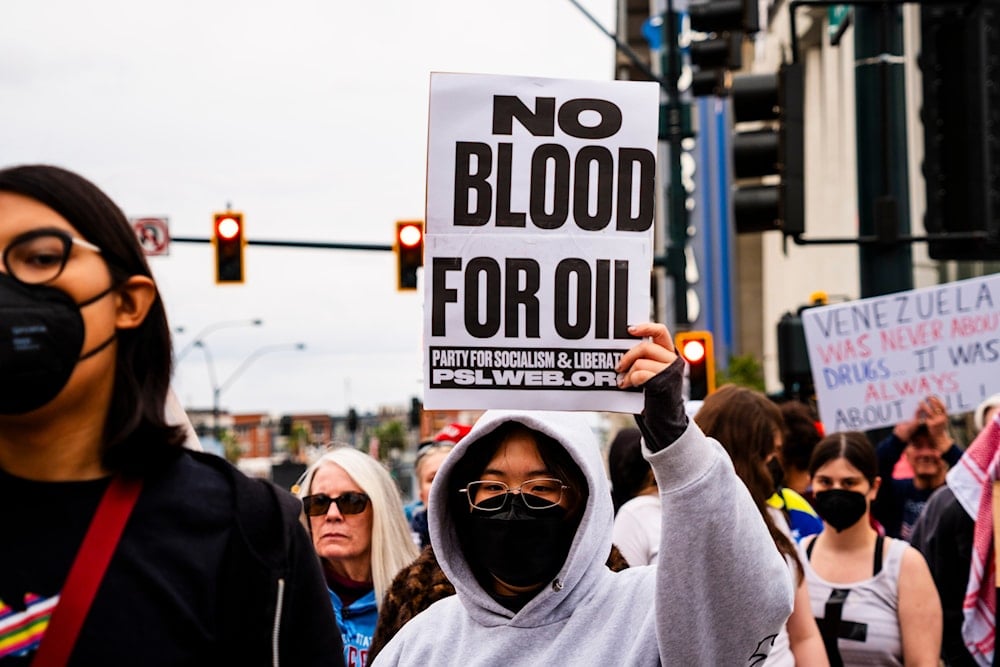
Protesters gather to denounce the US attack on Venezuela on Saturday, Jan. 3, 2026, in Las Vegas. (AP Photo/Ty ONeil)
A group of approximately 20 US investors is already planning to travel to Venezuela in March to assess investment prospects, following the January 3 US military aggression that resulted in the abduction of President Nicolás Maduro by US forces.
The investor delegation, organized by political risk advisory firm Signum Global Advisors, reveals how quickly financial interests are mobilizing to capitalize on what could become one of the most controversial regime change operations in recent Latin American history.
Charles Myers, chairman of Signum Global Advisors and former vice-chairman of Evercore, told Business Insider that investor sentiment is one of "cautious optimism" following Maduro's kidnapping. The planned March reconnaissance mission is set to include meetings with Venezuelan government officials that the US will appoint to shape economic policy in the oil-rich nation.
Myers additionally said his firm does not take a "moral position" on whether US intervention was justified, but rather focuses on helping clients "anticipate investment opportunities or mitigate risk due to geopolitical events." His firm, he noted, "very much expected" the situation would unfold as it has and has been preparing investor groups accordingly.
"People have seen this coming, especially very smart investors, and many of them have actually bought bonds in anticipation of this," Myers said, revealing that financial speculators positioned themselves to profit from military intervention before it occurred. The "cautious optimism" is stronger than with Syria, he added, "just because this is a United States-directed action."
"I think the centerpiece of Venezuela's success, looking out 12 months or even 24 months, is foreign investment," Myers said, estimating between $500-750 billion in investment opportunities across oil, mining, tourism, construction, and infrastructure over the next five years.
Unlawful military intervention, civilian casualties
The investment frenzy follows an unprecedented US military operation involving more than 150 aircraft launched from 20 bases across the Western Hemisphere. The strikes, which Venezuelan officials say killed at least 40 people, including civilians, targeted military installations around Caracas before Delta Force operators abducted Maduro and his wife.
US President Donald Trump authorized the operation in violation of international law, breaching state sovereignty and the prohibition on the use of force through the unlawful removal of a sitting head of state. The lack of international authorization or legal basis renders the action illegal, while the absence of prior congressional notification raises additional, though secondary, constitutional concerns over executive overreach.
Trump has also been remarkably explicit about the intervention's economic motivations. "We're going to have very large United States oil companies, the biggest in the world, go in and spend billions of dollars, fix the badly damaged oil infrastructure," Trump announced at Mar-a-Lago on Saturday, adding that oil companies would be "reimbursed for what we're doing" and describing plans for "taking a tremendous amount of wealth out of the ground."
Trump stated the US would "run the country" during an undefined transition period, a frank acknowledgment of direct control over Venezuelan governance.
Resource extraction disguised as liberation
This transactional framing exposes neocolonial resource extraction disguised as liberation. Venezuela possesses the world's largest proven oil reserves, approximately 300 billion barrels, alongside substantial deposits of gold, lithium, copper, and other critical minerals.
The country's petroleum infrastructure, however, has deteriorated severely under decades of US sanctions and economic isolation, with production collapsing from 3.5 million barrels per day in 2013 to approximately 1 million today.
Industry analysts acknowledge that restoring Venezuelan oil production to pre-sanctions levels will likely require tens of billions of dollars and could probably take at least a decade of sustained commitment.
Meanwhile, Reuters reporting indicates that US firms won't return until sanctions are removed, security concerns are addressed, and Venezuelan laws are reformed to allow larger foreign investment, essentially demanding the country restructure its legal framework to accommodate US corporate interests.
Who profits from Venezuela's transformation?
The companies best positioned to benefit include Chevron, currently Venezuela's only major US operator, alongside ExxonMobil and ConocoPhillips, which hold outstanding arbitration awards exceeding $10 billion from Venezuela's 2007 nationalization of their assets.
Defense contractors have already profited substantially from the Caribbean military buildup, with leaked procurement records showing continued weapons contracts through 2028. Engineering and construction firms anticipate massive contracts for infrastructure rehabilitation, while distressed debt investors who accumulated Venezuelan bonds at pennies on the dollar stand to realize extraordinary returns from any restructuring.
Venezuelan opposition sidelined for "pliant" leadership
Ironically absent from Trump's transition plans is Maria Corina Machado, the 2025 Nobel Peace Prize laureate and opposition leader who claimed victory in Venezuela's 2024 election and had already developed a comprehensive governance blueprint for a post-Maduro Venezuela.
Trump dismissed Machado as lacking "the support" to govern, instead expressing preference for current acting President Delcy Rodríguez, Maduro's then vice president who served the very government the US violently overthrew. US officials characterized Rodríguez as a "more pliant option" who would cooperate with American directives, according to the New York Times.
However, Rodríguez publicly contradicted Trump's characterization, denouncing the operation as "barbaric" and an "illegal and illegitimate kidnapping," while insisting Maduro remains "the only president of Venezuela." This immediate contradiction exposes the fundamental instability of imposing client leadership on a sovereign nation.


