
Trump's bombing spree: Disguising aggression and failure as peace
 11 Min Read
Trump launched 600+ airstrikes in 2025, yet most of these attacks failed to meet their goals, exposing the flaws in his aggressive foreign policy.
-
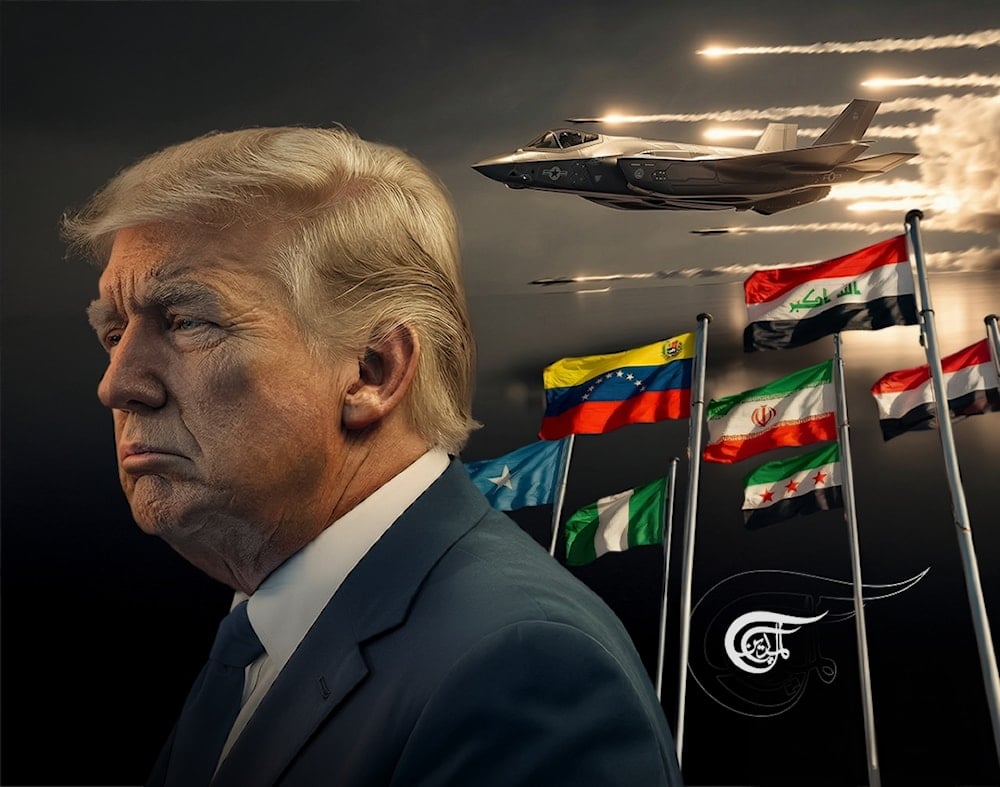
An illustration showing US President Donald Trump, with an F-35 Multi-role Fighter Jet overhead and the flags of Somalia, Nigeria, Venezuela, Iran, Syria, Iraq, and Yemen (Illustrated by Ali al-Hadi Shmeiss for Al Mayadeen English)
US President Donald Trump has long portrayed himself as a harbinger of peace on earth, claiming that his term will bring several wars to an end, incessantly demanding that he should be handed a Nobel Peace Prize; however, the number of countries Washington has bombed since Trump's inauguration tells a different story.
Since his return to the Oval Office, Trump upped his country's military footprint around the globe, carrying out over 600 airstrikes overseas in 2025, spanning Africa, Asia, and South America. While the US president, like a broken record, insisted on portraying many of his airstrikes as total successes, the facts on the ground lead to one conclusion: 600 airstrikes didn't further Uncle Sam's goals by much.
Data from the Armed Conflict Location & Event Data Project (ACLED) shows that US forces conducted or partnered in 622 air and drone strikes across seven countries in 2025. These operations targeted both terrorist groups and, controversially, state-linked activities.
The affected countries and key periods of operations include:
-
Yemen: January 12 to May 6, 2025
-
Somalia: February to December 2025
-
Iraq: March 13, 2025
-
Iran: June 22, 2025
-
Syria: December 19, 2025
-
Nigeria: December 25, 2025
-
Venezuela: Early December 2025
Venezuela: From pretext to invasion
On January 3, 2026, the US launched a major operation in Caracas involving airstrikes and special forces, leading to the abduction of Venezuelan President Nicolas Maduro and his wife in a flagrant violation of all international laws.
US airstrikes targeted multiple sites in and around Caracas, including Fuerte Tiuna, La Carlota Air Base, communications facilities, and key ports and airports, causing explosions and smoke plumes that were visible across the city. Venezuelan authorities reported casualties among soldiers and civilians.
The New York Times editorial board sharply criticized the Trump administration’s attack on Venezuela, arguing it lacked both domestic and international legal justification and risked severe regional consequences. The opinion writers said the strike on Caracas was carried out without congressional authorization or credible legal grounding, potentially violating the US Constitution and international law, while repeating the unsuccessful logic of past regime-change interventions.
Previously, the United States repeatedly bragged about its violations of international law, carrying out strikes on a Venezuelan docking facility as part of what it described as a campaign against vessels allegedly smuggling drugs, a move that Washington repeatedly claimed targets narcotics trafficking networks, without providing any proof.
Yemen: Failure to cull resistance
Under "Operation Rough Rider," Trump decided to “teach the Houthis a lesson” in Yemen, starting in January 2025, allegedly in response to Ansar Allah's blockade of Israeli-linked vessels in response to the genocide in Gaza.
Trump's campaign, which began boldly, only revealed the brutality of the Washington regime:
US and allied airstrikes in Yemen exacted a heavy price on civilians and infrastructure, with an April 17, 2025, strike on the Ras Isa oil terminal, killing at least 80 people and injuring around 150 while damaging a key fuel facility essential to local livelihoods and transport routes. On April 28, 2025, a US air attack on a migrant detention centre in Saada killed at least 68 detainees and wounded dozens more, prompting calls from human rights groups for an independent investigation into the loss of life.
Human rights monitors report that US strikes since March 2025 have hit homes, markets, health facilities, and civilian infrastructure in Sanaa, Hodeidah, and other regions, contributing to hundreds of civilian deaths, injuries, and widespread destruction of essential services, even as officials dispute the figures and characterize targets as military-linked.
"Operation Rough Rider" barely achieved any of its goals: Ansar Allah continued their naval blockade of "Israel" unabated by aggression; furthermore, two US F/A-18 Super Hornets are currently sleeping with fish after they fell off their aircraft carriers while evading Ansar Allah missiles.
Iran: Trump claims victory, Pentagon disagrees
During the 12-day Israeli war on Iran in June, the US carried out airstrikes on three Iranian nuclear facilities: Natanz, Isfahan, and Fordow on June 22. Trump described the attacks as a necessary measure to slow down Iran’s nuclear program.
Trump insisted that the strikes on Iran's nuclear facilities were a "spectacular military success" and constantly pushed a claim that the sites were "completely and totally obliterated," but Washington's governmental institutions disagreed with their president. Internal reports from the Defense Intelligence Agency indicated the strikes did not destroy the underground enrichment centrifuges and likely only delayed Iran’s nuclear programme by months, not decades, as Trump claimed.
Meanwhile, Iran reported only limited damage to Fordow, with the spokesperson for Iran's Atomic Energy Organization, Behrouz Kamalvandi, noting that much of the sensitive materials and equipment kept in the facility were relocated to a safe location.
The joint US-Israeli aggressions on Iran instead led to a collapse in the ongoing talks at the time, with Tehran taking a firm stance against negotiating with the United States, which Iranian officials have described as impositions, rather than genuine negotiations.
Syria: A one-off bombing campaign that misses the point
On December 19, 2025, US forces launched strikes under "Operation Hawkeye Strike" on 70 ISIS positions in Syria in response to attacks that killed two American personnel and a civilian interpreter. The operation targeted weapons storage sites and was described as a demonstration of continued US resolve against ISIS remnants, even as the wider Syrian conflict remains protracted and unstable.
Framed by Trump as a "very serious retaliation," a one-off striking campaign lasting one day may not have a notable effect on ISIS and its operation, because, according to Forbes, the terrorist group currently operates in scattered cells following the collapse of its "caliphate". This marks a one-off large-scale airstrike campaign, only temporarily effective, disrupting operations temporarily before the group adapts and recollects.
Critics have also pointed out that the strikes were largely performative, with Sam Heller, a Beirut-based security analyst with Century International, telling The Wall Street Journal that “it seems mostly geared toward retribution than anything that might really impact ISIS as it presently is."
“I highly doubt that ISIS is in a position to step operations up,” Heller said, according to WSJ, noting that ISIS has been operating under several years of sustained pressure.
Somalia: Peace through civilian casualties
Somalia experienced a significant increase in airstrikes in 2025, mainly targeting al-Shabaab and ISIS-Somalia, with reports indicating at least 111 separate strikes throughout the year. These airstrikes, much like many US strikes, killed civilians, which Washington habitually brushes off as "collateral" or denies.
Local sources reported that on November 16, 2025, an airstrike near Jamame in the Lower Juba region killed at least 12 civilians, including children, with witnesses describing explosive blasts and families among the dead, linked to operations supported by US Africa Command.
Nevertheless, despite years of campiagn against the group, al‑Shabaab remains a major and persistent threat in Somalia and the wider region, continuing to exploit weak state capacity and humanitarian crises to launch frequent and complex attacks against Somali government forces, peacekeepers, and civilians, with UN experts warning it is still the “greatest immediate threat to peace and stability” in the Horn of Africa.
Iraq: No regard for consequences
In March 2025, US aircraft carried out strikes in Iraq’s al-Anbar province, killing ISIS deputy leader Abdallah “Abu Khadijah” Muslih al-Rifai. Coordinated with Iraqi intelligence, the operation was hailed by President Trump as an example of “peace through strength.”
This strike is reminiscent of the assassination of Iranian Commander Hajj Qassem Soleimani, who was martyred during Trump's first term, when Washington launched an airstrike targeting the General just outside Baghdad International Airport.
United Nations expert Agnes Callamard, the UN Special Rapporteur on extrajudicial killings, concluded on July 7, 2020, that the drone strike that killed Soleimani was “unlawful” and violated the UN Charter because the US provided no evidence of an imminent threat, effectively making it an arbitrary killing under international law. US officials warned of the potential consequences of such action: then-House Speaker Nancy Pelosi described the strike as “provocative and disproportionate,” urging checks on executive war powers, while Senator Richard Blumenthal warned it could spark “the most consequential military confrontation in decades."
Nigeria: A propaganda mission
On December 25, 2025, US forces conducted airstrikes in northwest Nigeria’s Sokoto State against ISIS‑linked groups. The operation, carried out over the Christmas period, was described by President Trump and his allies as a measure to protect Nigerian Christians exclusively, sidelining other communities equally affected by terror groups in the country.
On April 29, 2025, suspected ISIS‑affiliated fighters from the Islamic State West Africa Province (ISWAP) carried out a deadly attack along the road between Rann and Gamboru in Borno State, Nigeria, detonating improvised explosive devices that killed at least 26 civilians, most of them Muslim farmers and traders traveling in vehicles.
In the weeks leading up to the December 25 airstrikes in Sokoto State, Trump repeatedly framed Nigeria’s insecurity through a religious lens, insisting that his actions were meant to protect Christians, portraying himself as the protector of Christians in the world. Trump claimed militants had been “targeting and viciously killing, primarily, innocent Christians, at levels not seen for many years, and even centuries!” and warned that if they did not stop such violence “there would be hell to pay.”
However, Nigerian officials pushed back on the US religious framing of the operation, stressing that the violence in Nigeria affects all communities, not just Christians. On December 26, 2025, the Nigerian Ministry of Foreign Affairs stated that “terrorist violence in any form, whether directed at Christians, Muslims or other communities, remains an affront to Nigeria’s values and to international peace and security."
Nigerian Foreign Minister Yusuf Tuggar also told the BBC that the December 25 operation “has nothing to do with a particular religion” and was aimed at targeting militants “who have been killing Nigerians,” rejecting the notion that the campaign was solely about defending Christians.
Using military might to hide crimes and failure
Trump constantly portrayed himself, and more broadly, US actions, as a grand pathway to "peace on earth"; however, closer inspection reveals a dark underbelly of international law violations, as well as an attempt to disguise failure with military might.
In the cases of Yemen and Iran, the US president's ambitious plans were cut short, either through steadfast resistance in the face of Washington's brutality or through Trump's own arrogance, which fell flat against the reality on the ground.
Somalia and Syria reveal a failure to address the root issues of the conflicts, a pattern that also crystallizes in the so-called ceasefire in Gaza, which "Israel" continues to violate on a near-daily basis, culminating in a death toll of 418 Palestinians since the ceasefire was reached on October 10.
Meanwhile, the Nigeria episode reflects how President Trump’s foreign policy messaging has increasingly aligned with a far-right, civilizational narrative, in which complex security crises are reframed as battles to defend Christians, often at the expense of factual nuance.
As for Venezuela and Iraq, they highlight what has long been a facet of the US hegemony: its ability to violate and disregard international laws and norms in the name of its goals, with no one to hold it accountable for its actions.


