
Climate crisis fuels extreme drought across Europe, study finds
 7 Min Read
Europe’s record heatwaves are accelerating drought conditions, with scientists warning climate change is driving extreme water loss, crop damage, and deadly impacts.
-
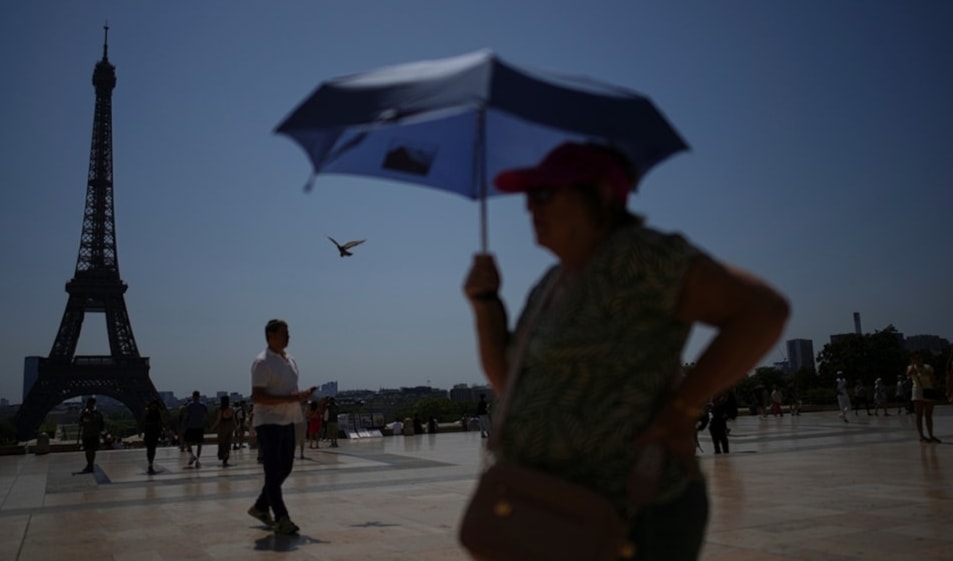
People walk near the Eiffel Tower during a heat wave on July 2, 2005, in Paris (AP)
Extreme heat amplified by the climate crisis is drying out Europe during the summer months and worsening drought conditions across the continent, The Guardian reported, citing a new scientific assessment.
The study found that record-breaking heatwaves significantly increased evaporation from rivers, lakes, soils, and vegetation. Researchers determined that these conditions were made 80 times more likely by global heating in western Europe and 40 times more likely in eastern Europe. Soil dryness in western Europe was five times more likely because of fossil fuel pollution, while in eastern Europe the likelihood increased elevenfold.
Traditionally, droughts have been associated with a lack of rainfall, but scientists noted that western Europe experienced a wet winter before the current dry spell. They said the climate crisis is reshaping the nature of drought across Europe, with elevated temperatures emerging as the primary driver this summer. According to the analysis, drought conditions currently classified as “extreme” in western Europe would have been considered only “moderate” in a world unaffected by the climate crisis.
Water restrictions and agricultural losses mount
Although the assessment covers conditions only through the end of June, impacts have already become significant across the region. Numerous countries have introduced emergency measures to limit water consumption, while most of southern England is now subject to a hosepipe ban.
Severe wildfires have swept through parts of Spain and France, while farmers have faced some of the driest soil conditions ever recorded. Across Europe, grain losses are projected to reach about 9 million tonnes. France is expected to experience its poorest maize harvest in half a century, and Romanian farmers have lost more than one million hectares of crops.
Low river levels disrupt energy and transport
Water levels in rivers across Europe have dropped sharply, reducing hydropower generation and limiting the movement of cargo vessels. At Lobith in the Netherlands, the Rhine has fallen below the minimum level recorded during the hot summer of 1976.
Researchers warned that these disruptions could contribute to higher food and energy prices, with lower-income households likely to bear the greatest burden.
The researchers said evidence linking the drying of European summers to human-caused climate change was strong.
“We now see an enhanced tendency for unusual soil drying already in spring, before summer has even begun,” said Dr. Dominik Schumacher of ETH Zurich. “That is our own doing: as temperatures climb, the atmosphere’s thirst increases quickly, sucking moisture out of rivers, lakes, reservoirs and the soil. If you have increasingly hot air, it will suck the soils dry.”
Schumacher said the 2026 drought arrived two months earlier than a comparable event in 2022. He added that western Europe had also experienced particularly hazardous wildfire conditions this year.
“Conditions starting off fairly wet and then transitioning to very, very dry are the prime ingredients for an extreme fire season, because more vegetation can grow and then burn later on,” Schumacher said.
Rising temperatures could double future risks
Dr. Mariam Zachariah, of Imperial College London and a member of the research team, warned that the findings were especially concerning given current levels of warming.
“What’s most alarming is that these conditions are occurring at 1.4C of warming. If global emissions push temperatures up to 2.8C as predicted, these intense evaporative conditions could double in likelihood. Without rapid, aggressive emissions cuts, Europe is heading for a future where these scorching, dry summers happen time and time again,” Zachariah stressed.
UN climate chief issues warning
UN climate chief Simon Stiell said worsening drought conditions demonstrated the consequences of a warming planet.
“Worsening droughts are an unignorable red alert that our planet is overheating. Until humanity stops burning huge amounts of coal, oil and gas, these brutal climate-driven droughts will only get more severe and more costly for households and whole economies alike. But the solutions are just as clear: move much faster to renewable energy,” Stiell said.
Attribution study examines drought across Europe
The analysis was conducted by the World Weather Attribution (WWA) consortium using peer-reviewed methods. Researchers examined drought conditions in western Europe, including England, France, Spain, Portugal and Italy, between April and June.
Because eastern Europe has experienced reduced rainfall for the past year, the study assessed conditions over the previous 12 months across 15 countries stretching from Belgium to Estonia.
Scientists combined weather observations with climate modeling to compare drought conditions in today’s world, which has warmed by 1.4C, with a hypothetical world without that level of warming.
“In both study regions, human-induced climate change was found to have made the 2026 drought more severe,” the researchers concluded.
Heatwave death toll and economic costs
A previous WWA study found that the heatwave at the end of June was Europe’s most severe on record and would not have occurred without the climate crisis.
Researchers estimate that approximately 20,000 people across Europe died as a result of the extreme temperatures, including around 2,200 in England and Wales. Another study published on Thursday estimated that productivity losses caused by high temperatures cost the UK economy more than £1 billion.
Tom Lancaster, of the UK’s Energy and Climate Intelligence Unit, said the summer’s heatwaves underscored the immediate consequences of climate change.
“The heatwaves this summer have been a shocking reminder that climate change is a problem for now, not for the future. And it is hitting the very foundations of our way of life, none more fundamental than access to secure, safe supplies of water for drinking and growing food,” Lancaster added.
Helen Wakeham, chair of England’s National Drought Group, said hot and dry conditions were placing increasing pressure on water resources.
“Dry weather depletes our water, while the hot conditions mean we use more of it. This is a difficult combination,” Wakeham said.
France reports thousands of excess deaths during heatwave
French authorities said more than 5,700 excess deaths occurred during the country’s June heatwave as large parts of southern Europe continued to endure another period of record-breaking temperatures.
France’s national health agency reported 5,764 excess deaths between 17 June and 2 July, representing an excess mortality rate of 36%.
The agency said more than half of those deaths occurred between 25 and 27 June. People aged 75 and older accounted for roughly two-thirds of the excess mortality recorded during the period.
Officials said those who died between June 17 and July 2 succumbed to “all causes,” with no deaths yet directly attributed to the heatwave. France recorded a slightly lower figure of 5,722 excess deaths during the entirety of last summer.


