
Europe scorches record heat as UK and Switzerland break June highs
 8 Min Read
A sweeping heatwave pushes temperatures across Europe to historic levels, straining health systems, triggering alerts, and intensifying concerns over climate-driven extremes.
-
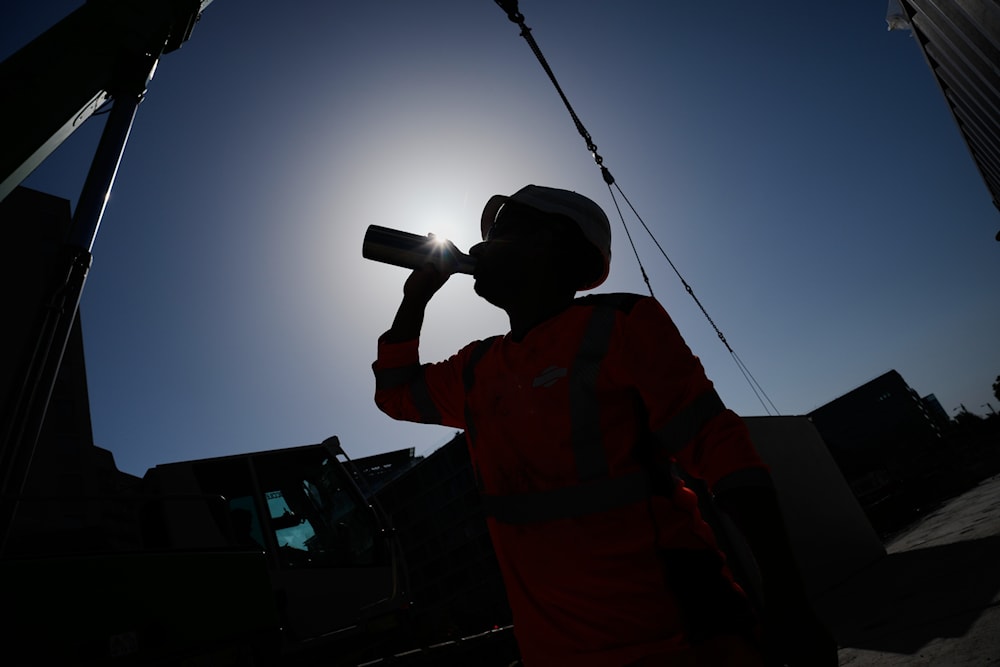
A worker drinks water on a construction site during high temperatures in Boulogne Billancourt, outside Paris, June 24, 2026. (AP)
The UK and Switzerland both registered their highest-ever June temperatures on Thursday, as extreme heat intensified by the climate crisis was linked to the death of a third young child in France and a sharp increase in medical emergencies across Europe.
In the UK, a provisional high of 36.4 °C (97.5 °F) was recorded in Yeovilton, Somerset, exceeding the previous June record set just a day earlier. Wednesday’s high of 36.1 °C in Gosport, Hampshire, had already surpassed the earlier benchmark of 35.6 °C recorded in Southampton in 1976.
Switzerland also reported unprecedented June heat, with the national weather agency stating that temperatures had climbed above 37 °C for the first time in the month, breaking a record dating back to 1947. “A temperature of 38 °C was even recorded at the Basel weather station” – the same location where the 1947 record was set, MétéoSuisse said on social media.
Overnight heat records and widespread Western Europe swelter
Earlier on Thursday, the UK’s Met Office said unusually warm overnight conditions in Cardiff had set another national record. Temperatures in the Welsh capital did not fall below 23.5C overnight, marking the highest minimum June temperature ever recorded in the UK.
The extreme heat extended across much of western Europe, with Agence France-Presse reporting that at least 101 million people were expected to experience temperatures above 35C on Thursday.
France records historic heat and rising death toll
In France, where three-quarters of the country remained under extreme heat alerts, the national weather agency recorded the hottest night since records began in 1947. Overnight temperatures from Wednesday into Thursday broke a record set earlier in the week.
Public prosecutors linked the heat to the death of a three-year-old boy who became trapped inside a family car in the suburbs of Paris. Officials said the child had been believed to be sleeping but had instead entered the vehicle and was unable to exit after the child locks were engaged.
Earlier in the week, extreme temperatures in France were also associated with the deaths of two young children. Prime Minister Sébastien Lecornu said at least 40 people, many of them young, had drowned while swimming in unsupervised areas.
Emergency pressure mounts across France
Authorities across France have been working to manage the severe conditions for days. Three nuclear reactors were shut down after surrounding cooling waters became too warm, while public gardens and parks in Paris were opened to residents struggling in overheated housing. Officials also attempted to adjust school conditions for hundreds of thousands of students taking national exams.
The mayor of Paris, Emmanuel Grégoire, said there had been an “increase in mortality” in the city but did not provide figures. “Pretty much all our indicators are in a critical state,” he told TF1, citing emergency calls, hospital admissions and deaths.
France’s Health Ministry said 25 cardiac arrests were recorded in Paris over a 24-hour period on Wednesday, compared with a typical average of fewer than 10. Nationwide, emergency room visits for heat-related conditions increased fourfold.
Heat-related deaths and impacts across Southern Europe
In Spain, most weather alerts were lifted on Thursday, but public health estimates based on excess mortality data suggested the heatwave may have caused 212 deaths between Sunday and Wednesday.
Spain recorded its highest daily average temperatures for June since at least 1950, with 28.1 °C on Monday, followed by 28.2 °C on Tuesday.
While much of the north is typically cooler, it experienced some of the most intense conditions, with temperatures exceeding 40 °C in parts of the Basque Country. The Cantabrian village of Tama reached a record 43.7 °C on Tuesday.
In Italy, courts in Palermo, Sicily, suspended all non-urgent hearings until 29 June due to “malfunctioning air conditioning”. The newspaper Corriere della Sera reported five heatwave-related deaths, including two farmworkers and a construction worker.
Warnings spread across Northern Europe
The Netherlands issued a rare red alert for extreme temperatures expected on Friday. Germany also prepared for rising heat, with forecasts predicting temperatures between 35 °C and 41 °C in parts of the country on Friday and Saturday.
Authorities cancelled open-air sporting events, and the national rail operator Deutsche Bahn warned passengers against travel due to risks of disruption from wildfires, heavy summer rain, and thunderstorms.
Scientists say heatwaves are becoming more intense and more frequent due to carbon pollution from fossil fuels, estimating that current extreme temperatures across Europe are 2 °C to 4 °C higher as a result.
While precise death tolls require detailed statistical analysis, experts believe thousands may have died prematurely. The UK Health Security Agency found that more than 10,000 people died in Britain during summer heatwaves between 2020 and 2024.
The agency has extended its red heat-health alert by 24 hours until 11 pm on Friday. It is only the second such red alert ever issued. The Met Office also extended its red warning for south-east England until 9 pm on Friday.
Health experts have estimated that rising global heat is currently responsible for one death per minute worldwide.
Global climate response and political debate
“Europe’s savage heatwave is the latest price to pay for fossil fuel pollution baking our planet,” said Simon Stiell, the UN’s climate chief. “Schools closing, the vulnerable dying, economies sweating: this is what the climate crisis looks like in practice, and it’s just getting started.”
He added that global warming will continue unless carbon emissions reach net zero, noting that emissions increased again in 2025. Stiell also warned that extreme heat and other climate impacts, including droughts, floods, wildfires, and storms, would intensify without faster emissions cuts, while calling for a rapid shift to renewable energy and greater forest protection.
UK policy response and local impacts
The UK parliament voted on Wednesday to establish a legally binding target of an 87% emissions reduction by 2040. The target follows recommendations from the Climate Change Committee, which said in May that UK infrastructure was “built for a climate that no longer exists” and required urgent upgrades to protect the population.
Across the UK, schools have closed and train services have been disrupted during the heatwave, which has been worsened by high humidity. The National Education Union has called for a plan to equip schools with air conditioning, noting uneven distribution across the country.
South East Water imposed a hosepipe ban in Kent, affecting about 850,000 customers, with additional restrictions in Sussex, Hampshire, and Berkshire. Customers have been urged to reduce water use as demand rises.
Emergency services have reported significant strain, including a record 642 Category 1 calls handled by the London Ambulance Service on Wednesday. Hampshire police are also searching for a 15-year-old boy who went missing while swimming in a lake.
London Mayor Sadiq Khan launched the city’s first heat plan on Thursday, warning that “Extreme temperatures are no longer a future threat, they are a present danger,” The plan includes retrofitting vulnerable homes, increasing tree cover, and improving access to water for cooling. A 2025 study found that overheating in UK homes had quadrupled over the past decade, affecting 80% of households.
Greenpeace measurements showed surface temperatures in London reaching 50 °C to 60 °C in some locations, including 53C on a playground surface in Islington.
“This record-smashing heatwave has turned London into a sticky, sizzling cauldron,” said Mel Evans, Greenpeace UK’s head of climate. “This isn’t just weather, it’s a public health emergency driven by fossil fuel giants. These abnormal temperatures are stretching homes, schools, transport and our own health to breaking point.”


