
Greenland meltwater may be intensifying Europe heatwaves
 5 Min Read
A new study suggests that accelerating Greenland ice melt may be cooling parts of the North Atlantic, shifting the jet stream and intensifying heatwaves across western Europe and the Mediterranean.
-
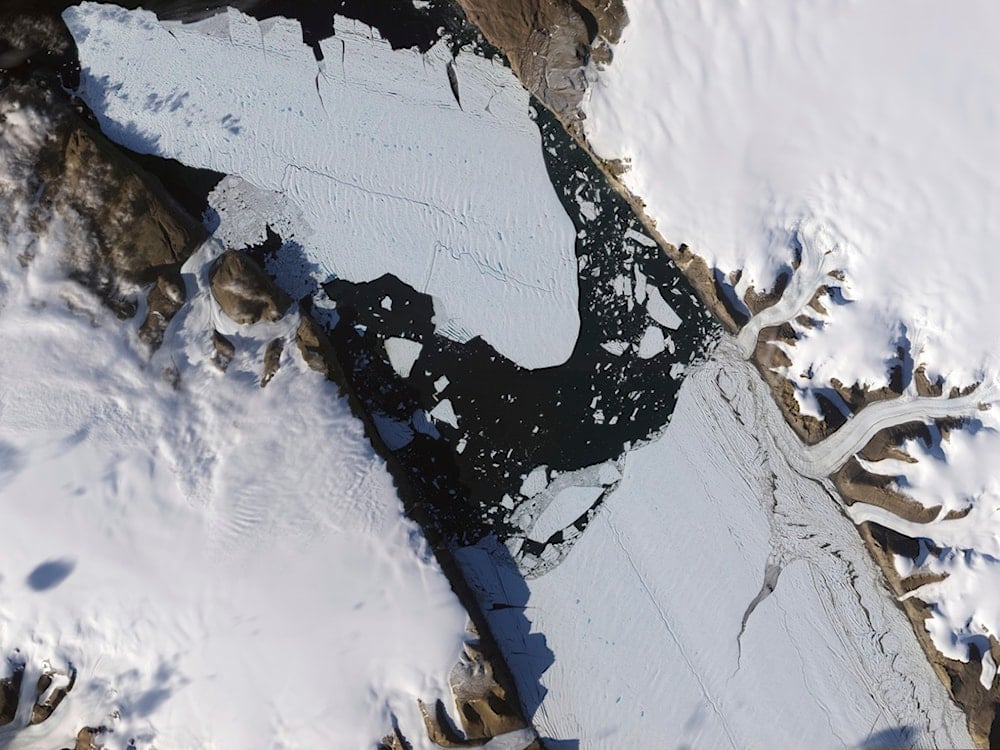
This Aug. 16, 2010, image provided by NASA Earth Observatory shows a piece of the Petermann Glacier that cracked in Greenland (AP)
Accelerating ice loss in Greenland could be playing a previously underestimated role in worsening heatwaves across Europe by disrupting North Atlantic ocean temperatures and altering the path of the jet stream, according to new research reported by New Scientist.
The study, which is currently undergoing peer review, suggests that large pulses of cold, fresh water flowing from the Greenland ice sheet are helping create atmospheric conditions that favor prolonged periods of extreme heat over western Europe and the Mediterranean.
'Atmospheric bridge'
Researchers identified what they describe as an “atmospheric bridge” connecting Greenland’s melting ice to changes in European weather patterns, with the mechanism believed to have contributed substantially to this summer’s exceptional heat.
“Europe heats up faster. This is because of the jet stream shift,” said Marilena Oltmanns of the UK’s National Oceanography Centre, one of the study’s authors.
“In future years… it will be even more extreme. In the future we will think this [year’s heatwave] was not a heatwave; this was nice.”
While rising global temperatures are already increasing the frequency and severity of heatwaves, scientists have continued to debate how much shifting atmospheric circulation patterns are adding to the trend.
The new research points to changes in high-pressure systems over Europe as one potential factor.
Over the past three decades, high-pressure ridges have appeared increasingly often across the continent, bringing clear skies and allowing intense heat to build. Such systems are associated with bends in the jet stream, the band of powerful winds circulating through the Northern Hemisphere.
When the jet stream arches northward around western Europe, warm air from the Atlantic and the Sahara can move into the region and remain trapped beneath persistent high pressure.
Similar atmospheric setups have been associated with some of Europe’s deadliest heat events, including the 2003 heatwave that killed an estimated 70,000 people.
Greenland runoff linked to Atlantic cooling
The researchers traced years of particularly strong European ridging back to unusually high levels of Greenland melt during the preceding summer.
They found that, ahead of such years, about 81 billion tonnes more meltwater than average flowed from the ice sheet into the North Atlantic.
That influx of cold, low-salinity water spreads across the ocean during autumn and winter, lowering surface temperatures. Because fresher water mixes less readily with warmer and saltier layers beneath it, the cooling effect can persist.
'Cold blob'
The process appears to reinforce the so-called North Atlantic “cold blob,” an area of unusually cool ocean temperatures that has developed over decades.
Some scientists have linked that cooling to a slowdown in the Atlantic Meridional Overturning Circulation, or AMOC, a major system of currents that redistributes heat across the Atlantic.
According to the study, the combination of Greenland meltwater and the existing cold anomaly creates a pronounced temperature boundary between cooler waters in the north and warmer areas farther south.
The resulting atmospheric instability can promote cyclone formation and increase the waviness of the jet stream.
As the jet stream dips southward around Atlantic storm systems before turning north again over Europe, conditions become more favorable for persistent high-pressure ridges and prolonged heat.
Models may underestimate future extremes
Oltmanns warned that existing climate models may not fully account for this chain of interactions, potentially leaving future heat risks underestimated.
“This is a big problem,” she said. “It’s going to be even more intense in terms of heatwaves and droughts, in particular in the Mediterranean region, so the weather extremes are likely underestimated.”
The findings come amid wider research into changes in the Atlantic jet stream.
A study published in July found that the jet stream has moved southward over the Atlantic in recent decades, broadly resembling the pattern identified in the new research. That study, however, attributed the shift primarily to natural climate variability and suggested it could eventually reverse.
John Methven of the University of Reading, who co-authored the July study, said Greenland meltwater could be one factor influencing the jet stream but cautioned that the connection remains uncertain.
“That’s the weak link as far as I’m concerned, the link between the cold blob and whatever’s melting in Greenland is not established, and there might be other things going on,” he said.
AMOC also possible factor
Methven noted that changes in the AMOC or broader atmospheric circulation across the North Atlantic could also be contributing.
The implications could extend beyond European heatwaves if cooling in the North Atlantic continues to influence the jet stream.
Researchers say the same process could increase the likelihood of sharp swings between drought, flooding and powerful storms.
Oltmanns said the study also linked the altered circulation pattern to an exceptional Mediterranean derecho in 2022, when a fast-moving system of severe thunderstorms produced winds exceeding 60 metres per second and fist-sized hail, killing 12 people.
“We [will] have more droughts at some locations, flooding events at others, and the variability on top of this increases,” she said.
Read more: Portugal now facing costs of its largest-ever wildfire


