
Europe is losing the space race: Bloomberg
 4 Min Read
Europe’s regulatory-heavy approach and reliance on systems like Starlink risk deepening its strategic and technological vulnerabilities as space becomes central to defense and global influence.
-
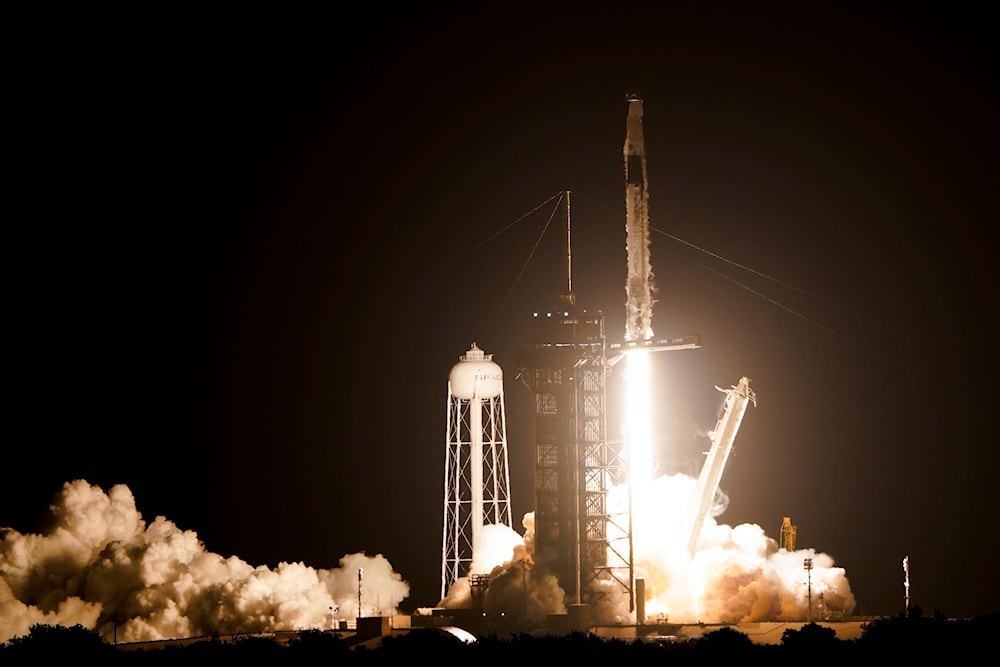
A SpaceX Falcon 9 rocket lifts off from pad 39A at the Kennedy Space Center in Cape Canaveral, Florida, on April 27, 2022. (AP)
In a piece published by Bloomberg's editorial board, the newsletter argued that as outer space increasingly becomes a critical domain of modern warfare and infrastructure, Europe risks falling further behind in the global space race. Its current approach, prioritizing regulation over competition, may hinder its strategic and technological ambitions.
The European Union's vulnerability was thrown into sharp relief during the war in Ukraine, where Kiev relied heavily on SpaceX’s Starlink satellite constellation for secure communications and battlefield coordination. With over 8,000 satellites, the US-based system has played a decisive role, one that Europe currently cannot match.
Despite recognizing the gap, the report suggests, the EU's response risks repeating past mistakes: excessive regulation, limited innovation, and high operational costs.
At the center of the debate is the proposed EU Space Act, which aims to unify fragmented member-state space policies and set global norms for safety, sustainability, and cybersecurity in orbit. While such goals are valid, the act risks extending the so-called "Brussels effect", imposing European standards globally, into a capital-intensive, innovation-driven sector where Europe is already lagging.
The proposed framework could deter investment, stifle competition, and deepen the EU's reliance on non-European systems.
Space investment gap and launch limitations
According to Bloomberg, the disparity in space investment is stark. Europe accounts for just 10% of global public investment in space and 22% of private investment, while the US dominates both spheres. Europe’s share of the global launch and manufacturing market has fallen to 6%, down from over 20% in 2008, largely due to the rise of SpaceX. The economics of launch systems highlight this problem. The Ariane 6, a subsidized European rocket, has managed only a few launches and costs over $100 million per flight.
In contrast, Bloomberg notes that SpaceX’s reusable Falcon 9 launched more than 160 times in the past year at an estimated $70 million per launch. Without improving cost-efficiency, Europe’s efforts to deploy a competitive satellite constellation will face major obstacles.
Read next: Trump taps more firms to challenge China in space
Industry leaders and policymakers have raised alarms about the draft legislation’s impact. The EU Space Act could increase costs for satellite operators by up to 10%, according to European Commission estimates, with other studies suggesting even higher impacts on profitability, R&D, and investment.
Smaller companies are especially vulnerable, facing obligations that in some cases are technologically unfeasible or undefined. The law’s registration and legal-representation rules could be seen as protectionist, particularly targeting non-EU operators and disproportionately affecting large US-based constellations.
Moreover, a conflict of interest emerges as the EU space agency is tasked with both operating Europe’s satellite network and enforcing compliance on foreign systems, a dual role that undermines its credibility and hampers collaboration with international partners, according to Bloomberg.
Strategic autonomy requires capabilities, not just compliance
The report suggests that if the EU aims to secure strategic autonomy in space, it must shift focus from overregulation to capacity-building. While Germany’s proposed $41 billion in space-based defense investment is a positive step, broader joint procurement, clearer rules for dual-use systems, and a larger role for the European Space Agency are needed.
Programs like IRIS2, the EU’s flagship satellite constellation scheduled for launch by 2030, will only succeed if they prioritize credible delivery over regulatory protectionism.
Read next: Trump signs order to deploy nuclear reactors on Moon by 2030
According to Bloomberg, there is still time to rethink the current course. First, the EU should amend the Space Act to prevent duplication with national laws and reduce burdens on SMEs. Second, the bloc should adopt regulatory equivalence, recognizing operators who already comply with international safety and sustainability standards.
Finally, Europe's space ambitions must be backed by the necessary funding and defense integration. Space is no longer just a scientific frontier; it is a pillar of national security and technological sovereignty. Europe has not regulated its way to global competitiveness on Earth, and it will not succeed that way in orbit.


