
Jamaica to petition King Charles over slavery reparations
 6 Min Read
Jamaica is set to petition King Charles III for a legal assessment of Britain's responsibility for slavery and whether it owes reparations for its enduring consequences.
-
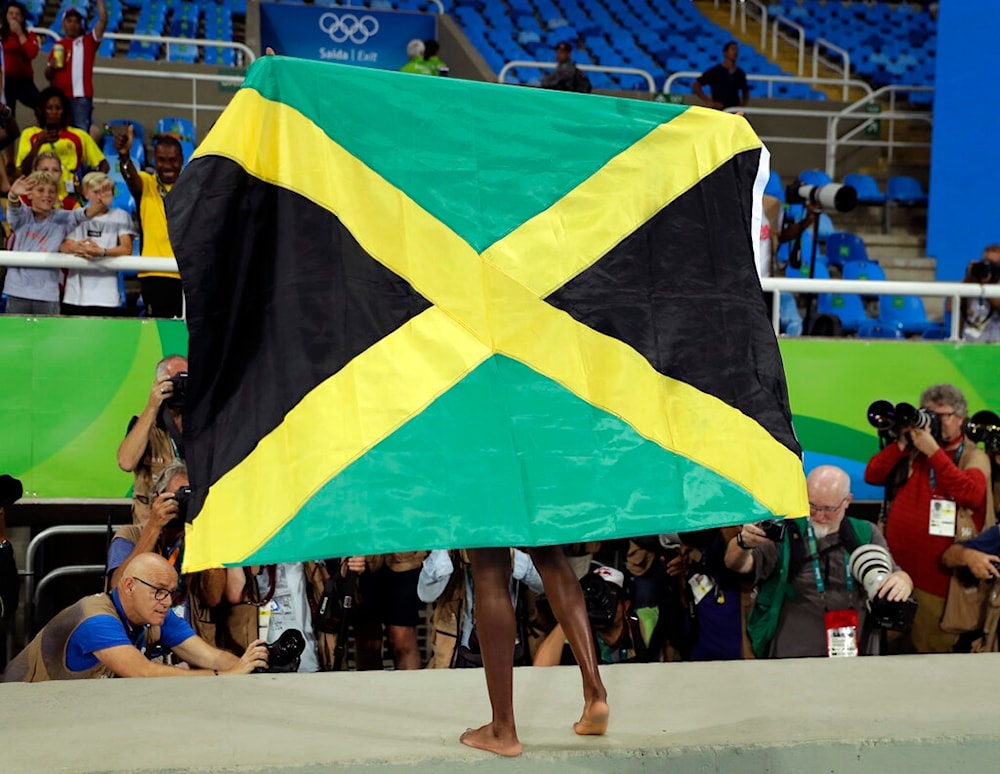
Elaine Thompson from Jamaica celebrates with the Jamaican flag after winning the gold medal in the women's 200-meter final during the athletics competitions of the 2016 Summer Olympics at the Olympic stadium in Rio de Janeiro, Brazil, Wednesday, Aug. 17, 2016 (AP)
Jamaica is set to formally take its campaign for slavery reparations to King Charles III, seeking a legal assessment of Britain's responsibility for the forced transportation and enslavement of Africans and the lasting consequences of colonial rule, The Guardian reported.
A Jamaican delegation is expected to submit the petition to Charles on Monday, asking the monarch, who remains Jamaica's head of state, to seek advice from the Judicial Committee of the Privy Council on a series of questions surrounding slavery and restitution.
The initiative represents a significant step in Jamaica's long-running push to establish whether Britain bears a legal obligation to compensate the Caribbean nation for centuries of enslavement and the structural inequalities that followed.
Jamaican Culture Minister Olivia Grange, who traveled to London with members of the country's National Council on Reparations, told The Guardian that the effects of slavery continue to shape Jamaica's economic and social conditions.
“We’re a resilient people. We were able to bounce back from [Hurricane] Melissa, for example,” Grange said.
“But we still have a lot of work to do, and you can imagine if we did not have those inherited problems, the legacy that came out of slavery, how much better we would have been able to do so.”
Petition seeks legal ruling on Britain's responsibility
The petition, first announced in June 2025, asks Charles to use his constitutional position to request legal advice from the Privy Council, which serves as the highest court of appeal for several Commonwealth countries and British overseas territories.
Jamaica wants the body to consider whether the forcible removal of Africans to the island was lawful, whether the system amounted to a crime against humanity, and whether Britain has an obligation to provide restitution for slavery and its continuing impact.
For the Jamaican government, obtaining a legal opinion is viewed as an important step toward strengthening the country's reparations claim and moving the issue beyond political appeals.
More than 12.5 million Africans were forcibly transported across the Atlantic between the 15th and 19th centuries, with millions sold into slavery across the Americas and the Caribbean.
Legacy of slavery remains embedded in Jamaican society
Jamaica, which was one of Britain's most profitable slave colonies, established its national reparations mechanism in 2009, becoming the first Caribbean country to create such a body.
Grange said the consequences of slavery remain visible across several sectors of Jamaican society, including health and education.
“We have inherited systems that continue to deprive our country and our people. The legacy in education, even in health, the way we eat, our diet because of what we were fed, our ancestors were fed,” she said.
Caribbean leaders link present inequalities to colonial rule
The Jamaican initiative forms part of a wider Caribbean effort to press former European colonial powers over slavery, Indigenous genocide, and centuries of economic extraction.
Ralph Gonsalves, former prime minister of St Vincent and the Grenadines and a key figure in the creation of the Caribbean Community Reparations Commission, said the region's present-day economic challenges cannot be separated from its colonial past.
“The present is very much the past, because what we are dealing with is the legacies of underdevelopment which you can source, and we do source, to native genocide and enslavement of African bodies,” Gonsalves said on Sunday.
“People must remember this: that European nations were enriched because of the enslavement of African bodies.”
Reparations push moves onto international stage
Gonsalves, who serves as an elder and advisor to the Repair Campaign, said Jamaica's visit to Britain comes amid a broader diplomatic effort to intensify demands for reparatory justice.
A Caribbean reparations conference is due to take place in Barbados later this month, while campaigners are also preparing to raise the issue during the UN General Assembly in September and the Commonwealth heads of government meeting in Antigua in November, which Charles is expected to attend.
International pressure over reparations grows
Calls for Britain and other former colonial powers to address the consequences of transatlantic slavery have gained momentum internationally.
In March, 123 countries backed a UN resolution describing chattel slavery as the gravest crime against humanity.
Caribbean governments followed in June with a manifesto setting out what they described as the moral, ethical, and legal foundations of their reparations demands.
A UN Committee on the Elimination of Racial Discrimination also said last month that states have legal obligations to consider reparations for the transatlantic slave trade and to address the continuing effects of racial discrimination.
Britain was among several European countries that abstained from the March UN vote and has repeatedly resisted efforts to place reparations formally on the Commonwealth agenda.
Jamaica takes reparations campaign to London
The Jamaican delegation's visit to Britain will also include meetings with members of Parliament and discussions at the British Museum regarding the repatriation of Jamaican artifacts.
A remembrance church service is also scheduled to take place in Brixton.
Grange said Jamaica's pursuit of reparatory justice should ultimately be understood within a broader demand for recognition and equality.
“We may have different history, different heritage, different skin colour, but it’s about humanity. It’s about, as a people, being able to live together, to work together, and to respect each other.
“And in our efforts to seek reparatory justice, we will use the opportunity to also promote and encourage what Jamaica is known for, One Love, because we have the song of the century through Bob Marley.”
Read more: British firm trafficked enslaved Africans to Guyana after abolition


