
'Almost an honor': Cuba first lady hits back at US sanctions
 3 Min Read
Cuba's first lady mocked new US sanctions after Washington expanded restrictions against senior officials and their family members.
-
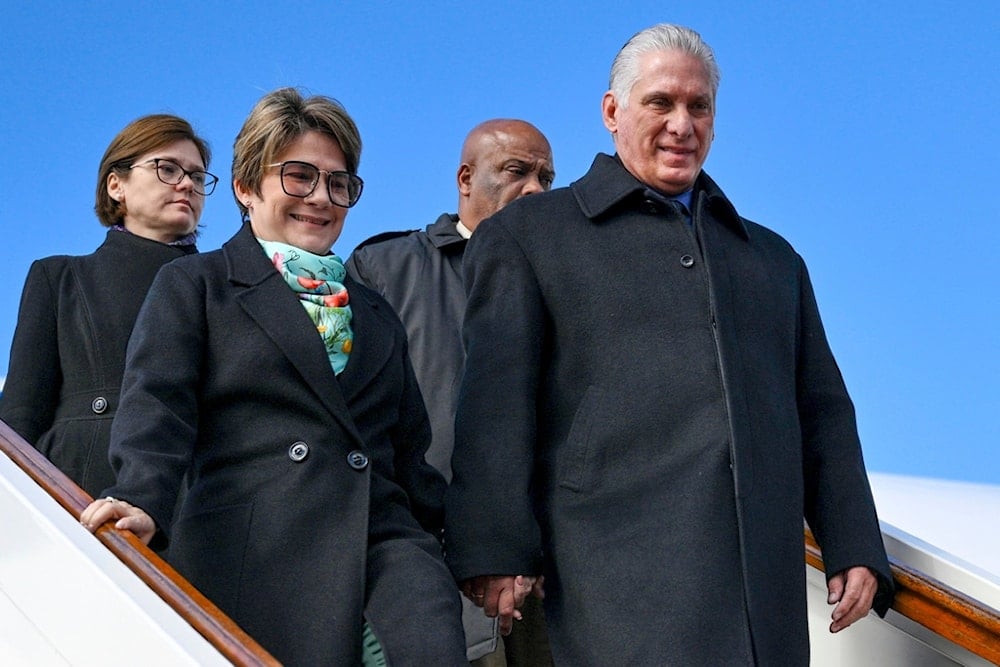
Cuba's President Miguel Diaz-Canel, right, and his wife Lis Cuesta Peraza, left, leave a plane upon arrival at the Vnukovo airport ahead of celebrations of the 80th anniversary of the Soviet Union's victory over Nazi Germany during the World War II, in Moscow, Russia, Tuesday, May 6, 2025. (Kirill Zykov/Photo host agency RIA Novosti via AP)
The wife of Cuban President Miguel Díaz-Canel, Lis Cuesta Peraza, dismissed newly imposed US sanctions against her and several members of Cuba's political leadership, saying inclusion on Washington's sanctions list was "almost an honor."
Her remarks came after the US Treasury Department announced sanctions on Díaz-Canel, Cuesta Peraza, her son Manuel Anido Cuesta, as well as Alejandro Castro Espín, the son of former Cuban President Raúl Castro, and Raúl Alejandro Castro Calis, Castro's grandson.
Reacting to the move on social media platform X, Cuesta Peraza wrote, "On the sanctions: it is almost an honor to be on that 'list'. They [US] are never tired of their ridiculousness and political stupidity."
Sobre las sanciones: es casi un honor estar en esa "lista". No se cansan del ridículo y la estupidez política. Ah, y una precisión al vuelo: nací en Sancti Spíritus.
— Lis Cuesta (@liscuestacuba) June 5, 2026
¡Viva Cuba Libre! 🇨🇺
Washington expands pressure on Cuba
The sanctions are part of a broader US campaign targeting Cuban officials and state-linked institutions.
US Secretary of State Marco Rubio said the measures were intended to target individuals involved in sustaining Cuba's "malicious campaign" aimed at undermining US national security.
Cuban Foreign Minister Bruno Rodríguez condemned this move, saying it represents "the latest manifestation of the US interventionist plan aimed at portraying Cuba as a threat to US national security." At the same time, he stressed that "every US action aimed at creating an atmosphere of conflict between the two countries will be doomed to fail."
Rubio also warned that individuals and entities conducting business with Cuba's GAESA conglomerate, the Ministry of the Interior, or the Ministry of the Revolutionary Armed Forces could face potential US sanctions.
The latest measures follow a series of actions taken by Washington this year. In January, the US authorized duties on imports from countries supplying oil to Cuba and declared a state of emergency over a threat posed by Havana to US national security.
Cuban authorities have repeatedly condemned the measures, arguing that Washington is using economic restrictions and energy sanctions to suffocate the island's economy and worsen living conditions for its population. Havana says the restrictions have deepened fuel shortages and disrupted electricity generation, transportation, food production, healthcare, and education.
Tensions between the two countries escalated further in May when the US Department of Justice indicted Raúl Castro and five Cuban military officers over the 1996 downing of two aircraft linked to the Miami-based exile group Brothers to the Rescue.
Havana rejected the accusations as a political provocation, maintaining that Cuban authorities acted in self-defense after repeated violations of the country's airspace by aircraft associated with the group.
Read more: UN: Over 100,000 surgeries postponed in Cuba over medical shortages


