
'Board of Peace' draft resolution gives Trump sweeping power over Gaza
 5 Min Read
Trump's "Board of Peace" drafts a plan giving him sweeping authority over Gaza's reconstruction, governance, and aid efforts.
-
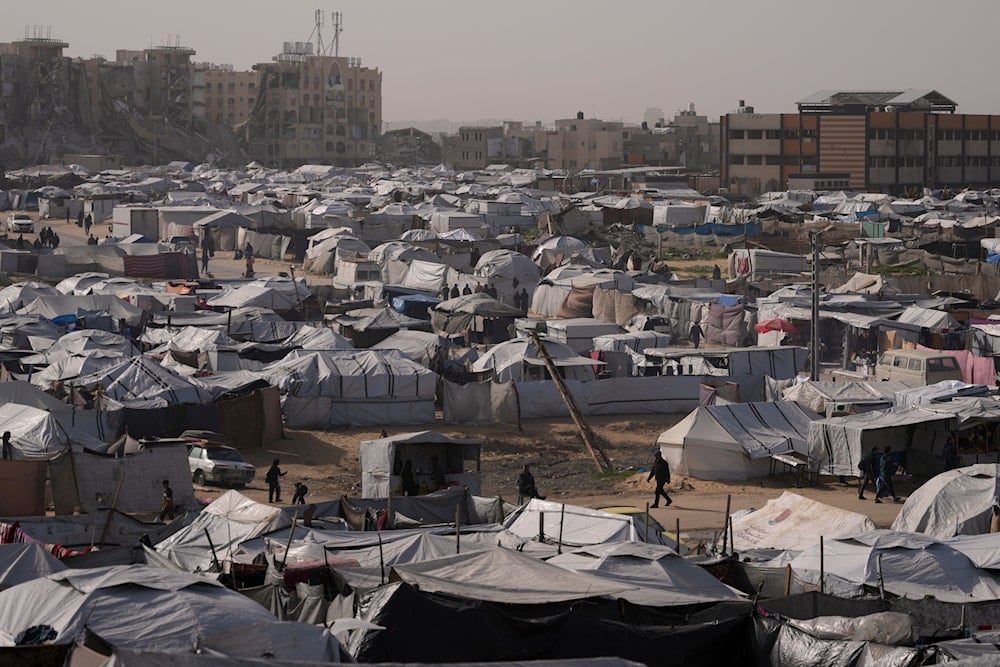
Palestinians walk along tents at a makeshift camp for displaced people in Khan Younis, southern Gaza Strip, Tuesday, Jan. 27, 2026. (AP)
US President Donald Trump would wield sweeping authority over the future governance and reconstruction of the war-ravaged Gaza Strip under a draft resolution prepared by the newly formed international body he leads, according to a document obtained by The New York Times.
The proposal outlines the powers of the “Board of Peace,” an international group chaired by Trump, which convened its first meeting last week in Davos, Switzerland. Member states, including Azerbaijan and Qatar, signed the group’s founding charter, which commits the board to securing “enduring peace in areas affected or threatened by conflict.”
While many details surrounding the "Board of Peace" remain unclear, the draft resolution would grant Trump, as chairman, the authority to nominate senior officials responsible for administering Gaza and overseeing security arrangements. These include a “high representative” for Gaza, who would supervise a Palestinian body managing the enclave, and a commander of an international stabilization force intended to help maintain security. The chairman would also have the power to approve board resolutions and suspend them in urgent cases.
Not yet in effect
The resolution is dated Jan. 22 and has not yet been signed by Trump, a step required for it to enter into force, according to three officials briefed on the document who confirmed its authenticity. The officials, speaking on condition of anonymity, said the resolution remains under discussion and may not represent the final text.
Modeled in part on a United Nations Security Council resolution, the document appears to formalize the board’s plans for post-war Gaza governance. The concept of the "Board of Peace" was first introduced in Trump’s 20-point plan, announced last September, aimed at ending the two-year war that "Israel" launched on Gaza.
In November, the UN Security Council granted the "Board of Peace" a mandate as part of US-led efforts to sustain the Gaza ceasefire. While the initiative was initially expected to focus solely on Gaza, the Trump administration said this month that the board would also address conflicts elsewhere, though its broader scope remains undefined.
US allies divided over participation in BoP
Participation in the board has divided US allies. While some countries joined after receiving invitations from Trump, others, including France and Britain, declined. Spanish Prime Minister Pedro Sánchez said Spain would not participate because the board excludes the Palestinian Authority and operates “outside the framework of the United Nations.”
Under the proposed structure, leaders of participating countries would comprise the "Board of Peace," chaired by Trump, who would also have the authority to appoint his successor. An executive board would operate beneath it. On Jan. 16, the White House announced seven executive board members, including Jared Kushner, Trump’s son-in-law, and former British Prime Minister Tony Blair, tasked with implementing the 20-point Gaza plan.
However, the draft resolution also lists White House Chief of Staff Susie Wiles and New York-based real estate lawyer Martin Edelman as executive board members, marking the first public mention of their involvement in the initiative.
US to take charge of Gaza
“The draft resolution makes clear the United States is in charge of Gaza, with all other countries and entities playing a support role,” said Michael Ratney, a former US consul general in al-Quds. Ratney described the resolution as having “uncertain legal standing,” but added that “Gazans are desperate and anything that stands to improve their lives, including the 20-point plan, is worth pursuing.”
According to the document, the "Board of Peace" would coordinate Gaza’s reconstruction, a project expected to cost tens of billions of dollars and take years to complete, while also facilitating humanitarian aid delivery. It calls for the establishment of “humanitarian zones” where civilians could safely access relief.
The resolution also addresses governance challenges, stipulating that individuals or organizations with a “demonstrated history of collaboration, infiltration or influence” with Hamas would be excluded from administrative and reconstruction roles. Tens of thousands of civil servants and security personnel previously served under Gaza's government, including medical staff, police officers, and rescue workers.
The draft further details the role of Nickolay Mladenov, a former UN envoy to the Middle East peace process, whom the White House named as the first high representative for Gaza. Under the proposal, Mladenov would closely supervise the National Committee for the Administration of Gaza, a body of Palestinian technocrats tasked with governing the territory, overseeing the police force, and managing all day-to-day activities.


