
Is Trump's 'Board of Peace' systematically undermining the UN?
 3 Min Read
Human Rights Watch’s Louis Charbonneau warns that Trump’s proposed "Board of Peace" poses a direct threat to the UN system, lacking any human rights mandate and seeking to centralize power under US leadership.
-
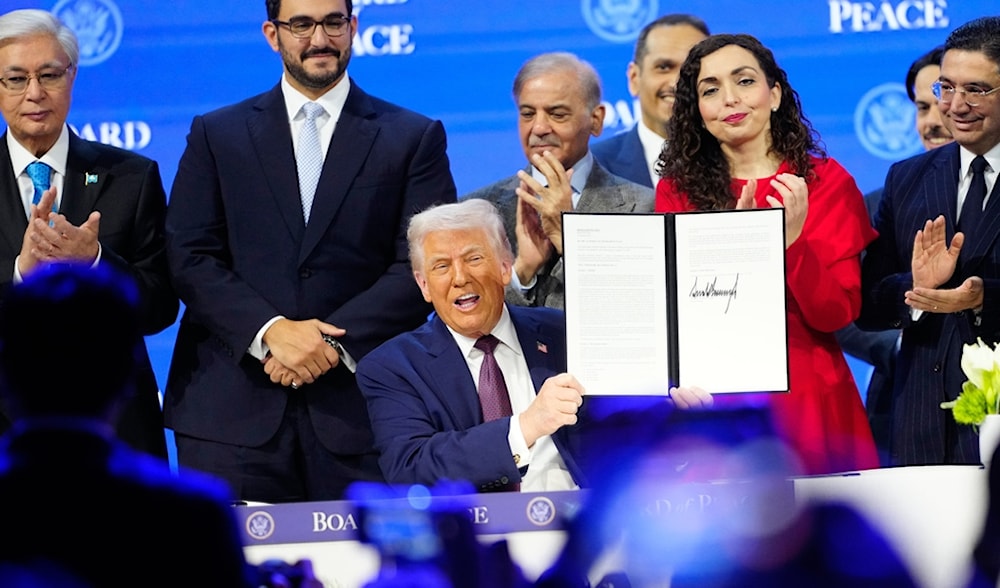
President Donald Trump holds the charter during a signing ceremony on his 'Board of Peace' initiative at the Annual Meeting of the World Economic Forum in Davos, Switzerland, Jan. 22, 2026. (AP)
As the United Nations marks the 80th anniversary of the General Assembly’s first meeting, the institution is facing one of the most serious challenges in its history. Established to prevent a recurrence of the crimes against humanity and genocide witnessed during World War II, the UN now finds itself under sustained political and financial pressure.
The US played a central role in founding the UN. Today, however, US President Donald Trump is actively undermining large parts of the organization, including through funding cuts.
According to Louis Charbonneau, the United Nations Advocacy Director at Human Rights Watch (HRW), the US government has spent the past year dismantling UN programs and agencies, driven by claims that the institution is “anti-American” and advancing a “hostile agenda.”
During negotiations, US officials have sought to remove terms such as “gender,” “climate,” and “diversity” from UN resolutions and statements. Diplomats told Human Rights Watch that US representatives have aggressively resisted human rights language they label as “woke” or politically correct.
A Trump-led alternative to the Security Council
In what appears to be an attempt to marginalize the UN Security Council, Trump has proposed the creation of the so-called "Board of Peace", which he would personally chair. Reports indicate that Trump has offered seats on the board to leaders of governments widely accused of serious human rights abuses, including "Israel".
The "Board of Peace" was initially presented as a mechanism to oversee Gaza following more than two years of genocide by Israeli forces, actions in which the US was complicit. Yet, Charbonneau highlights that the proposed charter does not mention Gaza at all, suggesting that the scope of the initiative has significantly expanded beyond its original justification.
Notably, the draft charter contains no reference to human rights. It instead grants Trump, as chairman, sweeping authority “to adopt resolutions or other directives” at his discretion.
Price tag for 'peace'
Membership in the proposed board would require a $1 billion fee. Some leaders have already rejected the offer. French President Emmanuel Macron, for example, declined to participate. Trump responded by threatening to sharply increase tariffs on French wine and champagne.
The United Kingdom, China, Russia, and more are also some of the powerhouses missing from the initiative. Moreover, there has been no indication that the Palestinian Authority was invited to participate, although former PA minister Ali Shaath will sit on Gaza's technocratic administration, formed at the bottom of the initiative's chain of hierarchy.
Canada, on the other hand, had its invitation revoked by Trump after it asserted its sovereignty following remarks made by the US President, alleging that Canada "lives because of the United States."
Reform the UN, don’t replace it
While the UN system is far from perfect, Charbonneau argues it remains preferable to a centralized, unaccountable global authority. Rather than investing billions in a Trump-led body with no human rights mandate, governments should focus on reinforcing the UN’s capacity to uphold international law and protect fundamental rights.
As the UN enters its ninth decade, the challenge is not whether it should exist, but whether states are willing to defend and strengthen it against efforts to weaken multilateralism in favor of unilateral power.


